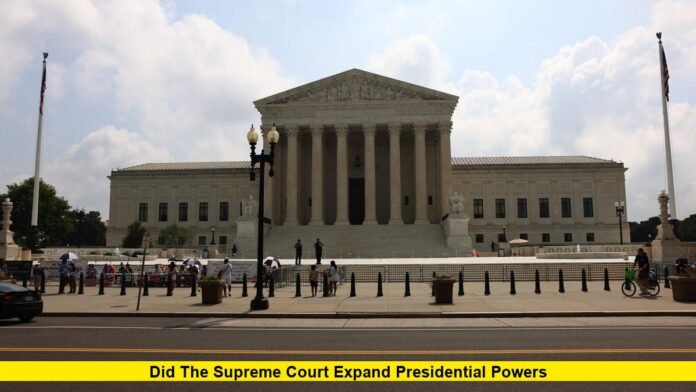

Many Americans are asking whether the Supreme Court expanded presidential powers after the justices closed out their term with a flurry of major decisions touching nearly every corner of executive authority. The answer depends on which ruling you look at. In one case, the court dramatically broadened the president’s control over federal agencies. In another, decided just a day later, the justices firmly rejected an attempt to reshape citizenship through executive action. Together, these decisions paint a more complicated picture than a single yes-or-no answer, and understanding both sides is essential to grasping where presidential power currently stands.
Background: A Term Defined by Executive Power Disputes
Throughout the 2025-2026 term, the Supreme Court took up an unusually high number of cases testing the limits of presidential authority. Many of these disputes trace back to actions taken early in the current administration, when a wave of executive orders and agency firings set off legal challenges that worked their way up through the federal court system. By the time the justices issued their final opinions before the summer recess, they had addressed everything from the president’s power to remove agency officials to whether an executive order can redefine who qualifies as a citizen at birth.
This pattern reflects a broader trend of presidents testing the boundaries of executive authority and courts being asked to referee those disputes. What makes this term notable is not just the volume of cases, but how differently the rulings landed. Some decisions sided firmly with expanded executive power, while others drew a hard line against it, particularly when constitutional text was directly at odds with an executive order.
The Ruling That Expanded Presidential Power Over Agencies
The clearest example of the Supreme Court expanding presidential powers came in a case involving the Federal Trade Commission. In a 6-3 decision, the justices struck down a law that had prevented presidents from firing FTC commissioners without cause, overturning a 1935 precedent that had stood for roughly ninety years. The case arose after a Democratic commissioner was removed from her post and challenged her dismissal in court.
Chief Justice John Roberts, writing for the majority, concluded that the FTC “unquestionably” exercises executive power today and must therefore remain accountable to the president. The ruling did not stop at the FTC. Because more than two dozen federal agencies were structured with similar for-cause removal protections, the decision effectively extends presidential firing authority across a wide swath of the federal government, including agencies overseeing energy regulation, nuclear safety, and labor relations. In a sharp dissent, Justice Sonia Sotomayor argued that the ruling reshapes the government by turning independent commissions into agencies under direct presidential control.
Notably, the court did not extend this same authority to the Federal Reserve. In a related 5-4 decision, the justices declined to allow the removal of a Federal Reserve Board governor while litigation continues, citing the central bank’s unique historical role in setting monetary policy independent of political pressure. This distinction shows the expansion of presidential power in this term was significant but not unlimited.
Yesterday’s Decision: A Major Check on Presidential Power
Just one day after the FTC ruling, the Supreme Court issued a decision that moved in the opposite direction. In a case challenging an executive order that sought to restrict birthright citizenship for children born in the United States to parents who are undocumented or only temporarily present, the court ruled 6-3 against the administration. The decision affirms that the Fourteenth Amendment’s citizenship clause guarantees citizenship to virtually all children born on U.S. soil, regardless of their parents’ immigration status.
Chief Justice Roberts again wrote for the majority, this time joined by the court’s three liberal justices along with one additional conservative colleague. Roberts described citizenship as fundamentally tied to the ability to participate in the nation’s political community, tracing the constitutional guarantee back to the post-Civil War era when the Fourteenth Amendment was adopted specifically to establish broad, inclusive citizenship rules. The ruling firmly rejected the argument that an executive order could redefine who is considered subject to U.S. jurisdiction at birth.
This outcome stands in direct contrast to the agency-removal case decided the previous day. Where the FTC ruling gave the president sweeping new authority over the federal bureaucracy, the citizenship ruling reaffirmed that certain constitutional guarantees cannot be altered through executive action alone, regardless of how the order is framed or what national interest it claims to serve. Legal advocates who challenged the order have said they do not expect further litigation on this specific question, viewing the ruling as a decisive and unambiguous rejection of the policy.
Other Rulings Shaping the Broader Picture
The same day the court decided the citizenship case, it also issued rulings on two other closely watched matters. The justices upheld state laws banning transgender athletes from competing on girls’ and women’s sports teams, a decision that primarily concerns state authority rather than presidential power. Separately, the court struck down long-standing campaign finance limits on how much political parties can spend in coordination with candidates, a ruling that is expected to increase the flow of money in future elections.
While neither of these rulings directly expands or limits presidential authority in the way the agency-removal and citizenship cases do, they underscore how active and consequential this term has been across multiple areas of law. Taken together with a separate case scrutinizing the president’s ability to impose tariffs under emergency economic powers legislation, it is clear that questions about the scope of executive authority are being tested simultaneously on several fronts, not just through a single line of cases.
Public Reaction and What Comes Next
Reaction to these rulings has broken along familiar lines. Supporters of a stronger executive have celebrated the agency-removal decision as a long-overdue restoration of presidential accountability over the federal bureaucracy. At the same time, immigrant rights groups and civil liberties organizations have described the citizenship ruling as a critical safeguard against attempts to unilaterally redefine constitutional protections through executive orders. The president has publicly praised the agency-removal outcome while criticizing the citizenship ruling as a setback, underscoring just how differently these two decisions were received within the administration itself.
Legal analysts expect the practical effects of the agency-removal ruling to unfold over the coming months as more commissioners across various federal bodies face potential removal. Meanwhile, the citizenship ruling is considered largely final, with advocates suggesting there is little room for the issue to be revisited absent a constitutional amendment, though some officials have suggested Congress could attempt to address the matter through new legislation, a path that legal experts say faces significant hurdles given the court’s constitutional reasoning.
Final Thoughts
So, did the Supreme Court expand presidential powers this term? The honest answer is that it did, but not uniformly. The agency-removal ruling represents one of the most significant expansions of presidential authority over the federal bureaucracy in decades, while the birthright citizenship ruling stands as a firm reminder that constitutional guarantees remain outside the reach of executive orders, no matter how they are justified. Rather than a single sweeping trend, this term reflects a Supreme Court willing to expand executive power in some contexts while firmly restraining it in others, particularly when core constitutional text is at stake. As litigation over these rulings continues to unfold in lower courts, the practical boundaries of presidential authority will keep taking shape in the months ahead.
Stay tuned for more updates on these developing legal battles, and share your thoughts on how these rulings could reshape presidential authority in the comments below.