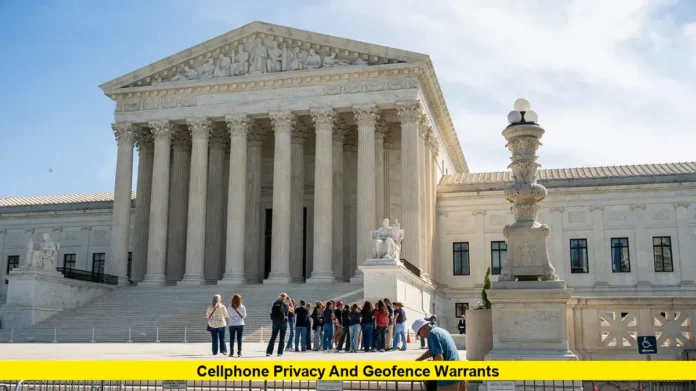

Cellphone privacy and geofence warrants have become one of the most closely watched legal topics in the country following a landmark Supreme Court decision handed down on June 29, 2026. In a 6-3 ruling, the nation’s highest court determined that when police request cellphone location data from a technology company to identify everyone who was near a crime scene, they are conducting a “search” under the Fourth Amendment. The decision reshapes how law enforcement agencies can use one of their most powerful digital investigative tools and gives millions of smartphone users new legal footing to challenge how their movements are tracked and shared.
What Is a Geofence Warrant
A geofence warrant works by having investigators draw a virtual boundary, or “fence,” around a specific location where a crime occurred. Once that boundary is set, police can ask a court to order a technology company, most commonly Google, to hand over information identifying every device that entered that zone during a defined window of time. Unlike a traditional warrant that targets a specific, named suspect, a geofence warrant casts a much wider net, sweeping in data from anyone who happened to be carrying a phone with location history enabled in that area, regardless of whether they had any connection to the crime.
This approach has made geofence warrants attractive to investigators working cold cases with few leads, but it has also drawn sustained criticism from privacy advocates who argue the technique amounts to a digital dragnet. Rather than starting an investigation with a suspect and building evidence, critics say geofence warrants let police search first and develop suspicion afterward, pulling ordinary bystanders into criminal investigations simply because their phone happened to ping a nearby cell tower or Wi-Fi signal.
The Case That Reached the Supreme Court
The ruling grew out of Chatrie v. United States, a case rooted in a 2019 armed robbery at a credit union outside Richmond, Virginia. A man entered the bank, handed the teller a note demanding cash, and left with nearly $200,000. With the case going cold, investigators turned to Google and obtained a geofence warrant covering the area around the bank for the half hour before and after the robbery.
Google’s response came in stages. The company first provided an anonymized list of devices within roughly 150 meters of the bank during that window, then narrowed the pool based on further requests from law enforcement, eventually identifying a small number of accounts, including one belonging to Okello Chatrie. That data led police to Chatrie’s home, where they recovered cash matching the amount stolen, a firearm resembling one seen on surveillance footage, and demand notes tied to the robbery. Chatrie was ultimately convicted and sentenced to nearly 12 years in prison, but he challenged the legality of the geofence warrant used to identify him, arguing it violated his Fourth Amendment rights because it swept in location data from people who had done nothing wrong.
Lower courts were divided on the question. A federal district judge found the warrant lacked the specificity the Constitution normally requires but still allowed the evidence, citing good faith by investigators. A divided panel of the Fourth Circuit Court of Appeals later upheld that outcome, and the full appeals court remained split when it reconsidered the case. That disagreement among lower courts set the stage for the Supreme Court to weigh in.
Inside the Supreme Court’s Decision
Writing for the majority, Justice Elena Kagan concluded that individuals maintain a reasonable expectation of privacy in their cellphone location records, even when that information is held by a third-party company like Google. She compared location history to other categories of private material, such as personal emails, photographs, and documents, reasoning that government access to this kind of data intrudes on a constitutionally protected interest regardless of how briefly the information is reviewed.
The ruling builds directly on the Court’s 2018 decision in Carpenter v. United States, which required law enforcement to obtain a warrant before accessing historical cell-site location records from wireless carriers. The new decision extends that same logic to geofence warrants, making clear that the government cannot bypass constitutional protections simply because the surveillance technique is newer or the data originates from a different type of company.
Importantly, the Supreme Court stopped short of declaring geofence warrants unconstitutional across the board. Instead, the justices sent Chatrie’s case back to the lower courts to determine whether the specific warrant used against him met the Fourth Amendment’s requirements for probable cause and particularity. In other words, geofence warrants remain a legal tool for investigators, but they must now be narrowly tailored and judicially authorized in a way that satisfies constitutional scrutiny, rather than functioning as broad, open-ended requests for data on anyone in a given area.
Justice Samuel Alito, writing in dissent, argued that no warrant should be required at all, characterizing the majority’s approach as an overreach that unnecessarily complicates law enforcement’s ability to solve serious crimes. He also suggested the ruling would ultimately have little practical effect on Chatrie’s own case, since the government could likely satisfy a narrower warrant standard on remand.
Why This Ruling Matters for Everyday Cellphone Users
For the average person, this decision offers meaningful reassurance about how their location data can and cannot be used by the government. Location history, generated automatically by most smartphones through GPS, Wi-Fi, and Bluetooth signals, can reveal an extraordinarily detailed picture of a person’s daily life, including where they work, worship, seek medical care, or attend political gatherings. Privacy groups have long warned that without limits, geofence warrants could be misused to identify protesters, monitor people visiting sensitive locations, or sweep up data from thousands of uninvolved individuals in the course of investigating a single crime.
Legal advocates responded to the ruling as a significant win for digital privacy. Groups such as the American Civil Liberties Union framed the decision as a critical safeguard against overly broad government data requests, emphasizing that new surveillance technology should not create loopholes around constitutional protections that have long applied to physical searches. At the same time, law enforcement organizations have expressed concern that added procedural requirements could slow down investigations that rely on this tool, particularly in cases where traditional leads have run dry.
It is worth noting that the decision does not ban geofence warrants or prevent police from ever requesting location data. What changes is the standard investigators must meet before a court will approve such a request, and how narrowly that request must be scoped. Warrants that once allowed police to gather data on hundreds of accounts covering a wide radius are likely to face closer judicial review going forward, with courts expected to demand tighter geographic boundaries, shorter time windows, and stronger justification tied to probable cause.
What Happens Next
With the case remanded, the Fourth Circuit will now have to determine whether the original warrant used to identify Chatrie satisfied the Fourth Amendment’s requirements for probable cause and specificity. That decision, along with how other federal and state courts apply the Supreme Court’s reasoning, will help clarify exactly how narrow a geofence warrant must be to survive constitutional review. Legal analysts expect a wave of follow-up litigation as defense attorneys in pending cases involving geofence evidence seek to apply the new standard to their own clients’ circumstances.
There are also practical ripple effects to watch. Some technology companies have already moved to limit how long they retain detailed location history or have shifted more of that data to on-device storage rather than centralized servers, making it harder for law enforcement to access even with a valid warrant. As access to this data narrows, some analysts anticipate that police may increasingly turn to other sources, including mobile data brokers, cellular carriers, and app developers that retain location information outside the scope of any single company’s privacy policy changes. The Supreme Court’s constitutional framework is expected to apply to those alternative sources as well, since the ruling centers on the nature of the data and the type of search being conducted rather than which specific company holds the records.
Final Thoughts
The Supreme Court’s ruling on cellphone privacy and geofence warrants marks one of the most consequential digital privacy decisions since the Carpenter case in 2018. By affirming that location data carries the same constitutional protections as other deeply personal records, the Court has drawn a clearer line around how far investigators can go when using modern technology to solve crimes. Geofence warrants are not gone, but they are no longer a blank check. Law enforcement agencies will need to justify these requests with the same rigor required for any other search, and courts across the country now have binding guidance to evaluate whether a given warrant respects the privacy rights of the people whose data it sweeps up. As lower courts begin applying this standard in the months ahead, the practical boundaries of digital privacy in the age of smartphones will continue to take shape.
Stay tuned for updates as lower courts apply this ruling, and share your thoughts on what this decision means for digital privacy in the comments below.