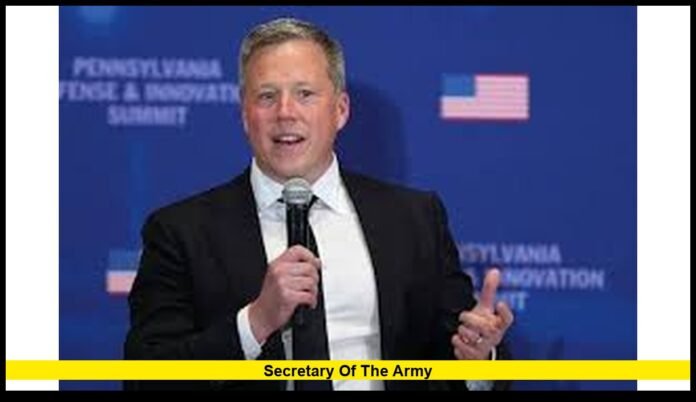

The secretary of the army Dan Driscoll is stepping down after about 18 months in one of the Pentagon’s most important civilian leadership positions. His resignation marks another major change in U.S. military leadership and comes after months of reported disagreements with Defense Secretary Pete Hegseth.
Driscoll submitted his resignation to President Donald Trump, and the White House confirmed that he would leave the position. The announcement came on August 31, 2026, making his departure the latest high-level change inside the Trump administration’s defense leadership.
His exit comes at a sensitive moment for the Army. The service is dealing with major modernization programs, changes in military leadership, evolving drone warfare, procurement challenges and ongoing U.S. military operations.
Dan Driscoll’s Resignation
Driscoll’s resignation ends a tenure that began in February 2025.
He was confirmed by the Senate and sworn in as the 26th person to lead the Department of the Army in the civilian role. His departure comes less than two years after taking office.
The White House did not provide a detailed public explanation for his decision to leave. However, tensions between Driscoll and Hegseth had become increasingly visible over recent months.
Those disagreements reportedly involved personnel decisions, Army leadership and the direction of the service.
Driscoll had previously rejected reports that he was planning to leave. Earlier in 2026, he said he had no plans to resign. His latest decision represents a significant change from those earlier comments.
The White House has praised Driscoll’s performance and highlighted his work on military readiness, Army lethality, major operations and international negotiations.
Why His Departure Is Significant
The position carries substantial responsibility.
The Army is the largest military service in the United States by active-duty personnel. Its civilian leadership oversees policy, resources, modernization, personnel matters, installations, acquisition and other major responsibilities.
The Army secretary also works closely with the Army chief of staff. Together, the civilian and military leadership help guide the service’s long-term direction.
Driscoll’s departure therefore creates more than a personnel change.
It comes during a period when the Army is attempting to transform its force for a battlefield increasingly shaped by drones, artificial intelligence, electronic warfare, precision weapons and rapidly changing technology.
A leadership transition could affect how those priorities move forward.
Driscoll Took Office in 2025
Driscoll became Army secretary on February 25, 2025.
His confirmation followed President Trump’s nomination during the transition into his second administration. The Senate confirmed him before he formally took over the position.
He entered the job with a background that differed from many traditional Pentagon leaders.
Driscoll was an Army veteran, lawyer, businessman and former investment professional. He served as an Army armor officer and deployed to Iraq with the 10th Mountain Division.
His military experience gave him firsthand knowledge of Army operations.
After leaving active duty, he attended Yale Law School and developed a career spanning law, finance and business.
He later became involved in Republican politics and worked closely with figures connected to the Trump administration.
That combination of military and private-sector experience influenced his approach to the Army.
A Push for Faster Army Modernization
One of Driscoll’s most visible priorities was Army modernization.
He argued that the service needed to move faster when developing and buying new military technology.
Traditional defense procurement can take years. Driscoll pushed for shorter development cycles and greater competition among companies.
His approach placed particular emphasis on technologies that could reach soldiers quickly.
Drones became one of the clearest examples.
The war in Ukraine demonstrated how inexpensive unmanned systems can affect battlefield operations. Both sides have used drones for surveillance, targeting and attacks.
For the U.S. Army, the lessons have increased pressure to develop affordable drones and effective counter-drone systems.
Driscoll supported efforts to adapt Army programs to this changing environment.
The Fight Over Military Technology
The modern battlefield has changed the economics of warfare.
An expensive missile interceptor may destroy a relatively inexpensive drone. That creates a difficult cost problem for military planners.
The Army has therefore looked for systems that can provide effective protection without creating unsustainable costs.
During Driscoll’s tenure, Army leaders placed greater attention on low-cost interceptors, counter-unmanned systems and other technologies designed for large-scale use.
The goal was not simply to create advanced weapons.
It was to create weapons that could be produced quickly, deployed widely and replaced when necessary.
That philosophy became an important part of Driscoll’s approach to Army acquisition.
Closer Ties With Defense Companies
Driscoll also pushed for stronger cooperation between the Army and private industry.
He regularly emphasized the need to understand manufacturing problems and identify ways to speed up production.
That included engagement with companies that build military vehicles, weapons and other equipment.
His approach was partly driven by concerns about the pace of defense production.
The United States has advanced military technology, but production capacity can become a challenge during prolonged conflicts.
Driscoll wanted the Army to consider manufacturing capacity as part of military readiness.
That meant paying attention not only to what a weapon could do, but also to how quickly and cheaply it could be produced.
A Different Approach to Defense Spending
Another major theme during Driscoll’s tenure was the cost of military equipment.
He questioned whether expensive systems always provided enough value for the Army.
That philosophy contributed to decisions involving Army programs that faced high costs or questions about battlefield usefulness.
The broader objective was to redirect resources toward systems that could deliver greater military value.
For the Army, the issue is particularly important because modernization requires large amounts of funding.
Every major procurement decision can influence what the service can afford elsewhere.
Driscoll’s emphasis on affordability was therefore connected to the larger question of how the Army should prepare for future conflicts.
Tensions With Pete Hegseth
Driscoll’s relationship with Defense Secretary Pete Hegseth became a major part of the story surrounding his departure.
Reports of disagreements increased during 2026.
The disputes reportedly involved senior personnel decisions and the direction of Army leadership.
Hegseth had already made significant changes across the Pentagon. The Army experienced several high-profile leadership departures during this period.
The relationship between the two officials became increasingly difficult as their approaches to Army leadership diverged.
Despite those reports, the administration continued to publicly recognize Driscoll’s work.
The White House has not officially described the disagreements as the formal reason for his resignation.
That distinction matters because the exact circumstances behind his departure remain different from the broader reporting about internal Pentagon tensions.
Army Leadership Has Already Seen Major Changes
Driscoll’s resignation is not an isolated leadership development.
The Army has already experienced substantial changes among its senior officials.
One of the most significant developments came in April 2026, when Gen. Randy George was removed as Army chief of staff.
George had served as the Army’s senior military officer. His departure was followed by the appointment of Gen. Christopher LaNeve as acting chief of staff.
The changes created an unusual period of turnover at the top of the service.
Driscoll’s resignation adds another major change to that environment.
The Army now faces the challenge of maintaining continuity while its senior leadership structure continues to evolve.
Driscoll and the Russia-Ukraine Conflict
Driscoll also gained international attention during his time in office because of his involvement in diplomatic efforts involving Russia and Ukraine.
An Army secretary normally focuses primarily on the service’s organization, resources and military priorities.
Driscoll became involved in discussions aimed at helping advance negotiations related to the conflict.
His involvement reflected the unusual responsibilities he held during the Trump administration.
The White House specifically praised his participation in negotiations when discussing his departure.
His role in those discussions became one of the more unusual aspects of his tenure.
What Happens to Army Modernization Now?
The biggest question following Driscoll’s departure is whether the Army’s modernization agenda will continue at the same pace.
Many of the changes underway are larger than one individual.
The service is already investing in drones, counter-drone systems, long-range fires, air defense, electronic warfare and artificial intelligence.
Those programs will continue to require senior-level decisions.
The next civilian leader will inherit those priorities along with ongoing budget and procurement challenges.
The transition could also influence the balance between traditional weapons programs and newer technologies.
That debate has become increasingly important as military planners study recent conflicts.
The Importance of Counter-Drone Technology
Drones have become one of the defining technologies of modern combat.
Small unmanned aircraft can provide surveillance and targeting information at relatively low cost.
Some can also carry weapons or operate as one-way attack systems.
That has changed how military units think about protection.
The Army needs systems that can detect drones, track them and stop them without exhausting expensive ammunition.
Driscoll supported efforts aimed at expanding affordable options.
His departure comes as those efforts remain a major modernization priority.
The Next Army Secretary
The administration now faces the task of selecting new civilian leadership for the Army.
A permanent nominee would need to go through the normal Senate confirmation process.
The identity of the next nominee will be closely watched because the individual will inherit a service undergoing major transformation.
The next leader will also need to work with the Defense Secretary and the Army’s military leadership.
That relationship could be particularly important after the tensions that surrounded Driscoll’s final months in office.
A new secretary could maintain Driscoll’s modernization priorities, modify them or place greater emphasis on other areas.
Until a permanent successor is confirmed, the Army will have to manage the transition through its existing leadership structure.
What Driscoll Leaves Behind
Driscoll’s tenure lasted about 18 months.
During that time, he became closely associated with efforts to make the Army faster, more technologically focused and more cost-conscious.
He promoted closer relationships with industry and greater attention to lessons emerging from modern warfare.
His leadership also coincided with major changes throughout the Pentagon.
His resignation now becomes part of that larger period of military leadership turnover.
Regardless of the disagreements surrounding his final months, his tenure placed Army modernization at the center of several important defense debates.
What Americans Should Watch Next
The next few weeks will be important for Army leadership.
The most immediate question is who will be selected to replace Driscoll.
The next appointment could influence several major areas, including:
- Army modernization
- Defense procurement
- Drone and counter-drone technology
- Military readiness
- Army personnel policy
- Defense manufacturing
- Long-term force planning
The choice will also provide a signal about the administration’s priorities for the Army.
For soldiers and military families, leadership changes can have practical consequences. Decisions made at the Pentagon can affect training, equipment, assignments, resources and future force structure.
For Congress, the transition will also provide an opportunity to examine the administration’s broader Army strategy.
A Major Moment for the U.S. Army
Dan Driscoll’s resignation closes a relatively short but consequential chapter in Army leadership.
He entered the Pentagon with military experience and a background in law, business and investment. He then became one of the administration’s leading voices on Army modernization and acquisition.
His time in office included efforts to speed up technology development, expand affordable military capabilities and improve cooperation with industry.
It also included increasing friction with the Pentagon’s top civilian defense official and major changes among senior Army leaders.
Now, the service enters another transition.
The next Army secretary will inherit a military organization preparing for a rapidly changing security environment. Technology, production capacity and readiness will remain central challenges.
The leadership decision ahead will help determine how those challenges are addressed.
For now, Driscoll’s departure stands as another major turning point for the Army and the Pentagon.
What do you think the next Army leader should prioritize most? Share your thoughts in the comments and stay informed as this leadership transition develops.