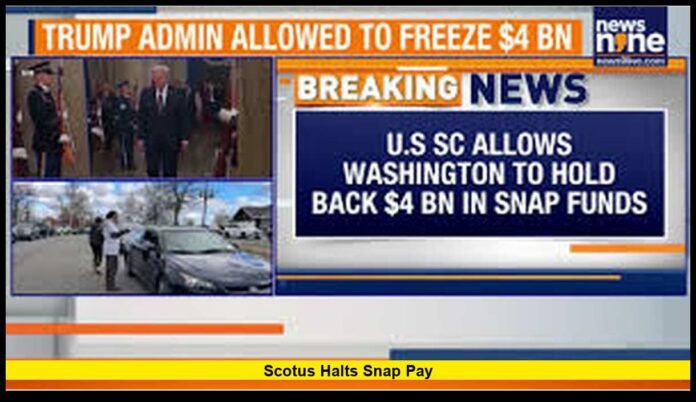

In a dramatic development this week, the phrase “SCOTUS halts SNAP pay” became reality as the Supreme Court of the United States (SCOTUS) extended its stay on a lower court order requiring full monthly payments under the Supplemental Nutrition Assistance Program (SNAP) for November 2025.
On November 11, 2025, the Court granted the Trump administration’s request to continue the pause on a district court ruling that required full SNAP benefits to be distributed this month. The decision affects roughly 42 million Americans who rely on the program for food assistance. Justice Ketanji Brown Jackson dissented, stating that she would have denied the stay and allowed full payments to proceed.
Several states had already begun processing full SNAP payments under previous court rulings, while others paused disbursements pending clarification. The result is a patchwork of benefit availability, leaving many low-income families uncertain about their food budgets. The United States Department of Agriculture (USDA) has directed states to reverse any full-payment distributions made under earlier orders, warning that failure to comply could lead to federal penalties. Meanwhile, Congress continues negotiations on a funding bill that could fully restore SNAP operations for the remainder of the fiscal year.
Understanding What “SCOTUS Halts SNAP Pay” Means
When headlines say “SCOTUS halts SNAP pay,” it means the Supreme Court has temporarily stopped the federal government from being required to issue full SNAP benefits while the case continues in lower courts. The lower court had ruled that the administration must continue paying full benefits despite the ongoing funding dispute, but SCOTUS intervened to suspend that directive.
This move does not end the case but delays enforcement of the previous order. The Court’s decision ensures that the administration can continue operating under limited funding rules until the legal questions are fully resolved.
Background: How the Situation Escalated
The current dispute stems from the recent federal government shutdown — one of the longest in U.S. history. During the shutdown, multiple federal programs, including SNAP, were affected by halted funding.
- October 24, 2025 – The USDA announced that November’s SNAP payments would be suspended due to insufficient appropriations.
- Late October – Several states and advocacy groups filed lawsuits, arguing that suspending SNAP violated federal law requiring food assistance continuity.
- November 7, 2025 – A federal district court ordered the USDA to release full November benefits to all recipients.
- November 8, 2025 – The USDA issued new guidance directing states to halt those full payments, citing the need to conserve funds.
- November 10, 2025 – The First Circuit Court of Appeals declined to block the lower court’s decision, pushing the administration to appeal to the Supreme Court.
- November 11, 2025 – SCOTUS granted the stay, officially halting the distribution of full payments for now.
The Court’s temporary ruling does not decide the case’s merits but preserves the administration’s position until further review.
Key Players and Legal Arguments
- The Trump Administration: Argued that SNAP payments depend on congressional appropriations and that issuing full payments without funding would violate federal spending laws.
- States and Advocacy Groups: Contended that cutting or suspending benefits during a shutdown causes irreparable harm to low-income families and breaches federal obligations under SNAP statutes.
- The USDA: Issued memos directing states to “undo” full payments and warned of losing federal reimbursements for noncompliance.
- The Supreme Court: Intervened to pause enforcement while deciding whether to hear the case in full.
- Legal Questions at Stake:
- Can the executive branch halt benefits when Congress has not provided sufficient funds?
- Do courts have authority to compel payment of benefits without appropriations?
- What liability do states face if they already issued full payments now deemed “unauthorized”?
Impact: Millions of Americans Caught in the Middle
The Supreme Court’s temporary action affects approximately 42 million people who rely on SNAP. For many, these benefits make the difference between food security and hunger.
- Recipients: Some already received full payments under prior orders, while others received reduced or delayed benefits. The inconsistency has caused confusion nationwide.
- State Agencies: States that moved forward with full disbursements may now face administrative complications or funding risks as the USDA reassesses compliance.
- Local Economies: SNAP benefits directly support grocery stores, farmers’ markets, and local food systems. Reduced benefits can have ripple effects across communities.
- Food Banks: With uncertainty surrounding federal aid, food banks are preparing for a potential surge in demand.
The halt also highlights the fragile nature of safety-net programs during political gridlock. Families living paycheck to paycheck are the most affected, facing the possibility of skipped meals and reduced nutrition support.
Timeline at a Glance
| Date | Event |
|---|---|
| October 24, 2025 | USDA announces suspension of November SNAP benefits. |
| October 31, 2025 | States and advocacy groups file lawsuits. |
| November 7, 2025 | Federal court orders full SNAP payments for November. |
| November 8, 2025 | USDA instructs states to halt full payments. |
| November 10, 2025 | Appeals court refuses to block lower court’s ruling. |
| November 11, 2025 | SCOTUS issues stay — halting full SNAP payments nationwide. |
What Happens Next
Congress is currently negotiating a broader government funding package that includes provisions for SNAP and other essential programs. If lawmakers pass the bill soon, it could restore normal benefit payments and make the Supreme Court case irrelevant.
However, if funding remains stalled, litigation will continue. SCOTUS may choose to hear the case to address the larger constitutional questions about executive authority and congressional power over appropriations.
In the meantime, states are left balancing compliance with federal directives and the urgent needs of millions of residents who depend on these benefits to feed their families.
The Broader Implications
This episode underscores the tension between law, policy, and human impact. SNAP is not merely a financial aid program — it’s a lifeline for millions of Americans. The decision by the Supreme Court to halt payments, even temporarily, reveals how deeply political disputes can affect real lives.
For many, this moment represents uncertainty, frustration, and renewed calls for policy reform. Whether Congress resolves the funding gap or the Court delivers a final judgment, one thing is clear: the country’s most vulnerable citizens are again caught in the middle of Washington’s power struggle.
As the situation develops, stay tuned for updates and share your thoughts below — how is this halt affecting you or your community?