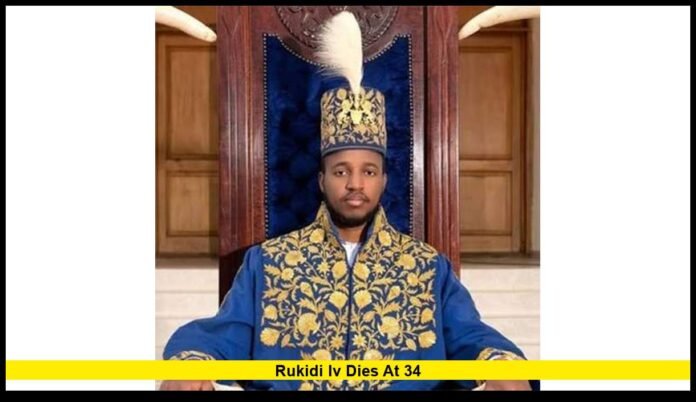

Rukidi IV dies at 34 after more than three decades as the traditional king of Uganda’s Tooro Kingdom, ending the extraordinary life of a monarch who became king at only 3 years old and remained a globally recognized royal figure until his death.
King Oyo Nyimba Kabamba Iguru Rukidi IV died at approximately 10 p.m. local time on Thursday, August 27, 2026, the Tooro Kingdom confirmed. He was 34. The announcement came from Tooro Kingdom Prime Minister Calvin Armstrong Rwomiire Akiiki, who described the death as an immeasurable loss for the royal family, the people of Tooro and Uganda.
The king’s death has prompted mourning across Uganda and renewed international attention on the remarkable story of a child who inherited a centuries-old traditional institution and grew into one of Africa’s best-known young monarchs.
The Tooro Kingdom has also confirmed that the crown will continue. King Oyo leaves behind a Prince who is recognized as his heir, although the kingdom said the heir’s identity will be formally revealed at the appropriate time under Tooro traditions and customs.
King Oyo dies at 34 after more than 30 years on the throne
Oyo Nyimba Kabamba Iguru Rukidi IV was born on April 16, 1992. His father, King Patrick David Matthew Kaboyo Olimi III, died in August 1995. Oyo then became the successor to the Tooro throne.
On September 12, 1995, the three-year-old prince ascended to the throne. His extraordinary age made him a global curiosity and ultimately earned him recognition as the world’s youngest reigning monarch. Guinness World Records listed King Oyo under that distinction.
His accession meant that Oyo spent almost his entire life associated with the Tooro monarchy. He inherited the crown before he was old enough to understand the responsibilities attached to it.
Because of his age, adults initially helped administer the kingdom’s affairs. His mother, Queen Mother Best Kemigisa, members of the royal family and other senior figures played important roles during his childhood years.
That unusual beginning shaped the public image of King Oyo. He was not simply a traditional ruler. For millions of people who followed his story, he represented a child growing into an institution.
Who was Rukidi IV?
King Oyo was the 13th monarch of the Tooro Kingdom. Tooro is a traditional kingdom in western Uganda, near the border with the Democratic Republic of Congo.
The kingdom has a long history stretching back more than two centuries. The Tooro monarchy was restored in Uganda in 1993 after traditional kingdoms had been abolished under an earlier political system.
Uganda remains a republic with an elected government. Traditional monarchs do not exercise sovereign political authority over the country. Instead, institutions such as Tooro play important cultural, social and community roles.
For the people of Tooro, however, the position of Omukama carries deep historical importance.
King Oyo became a symbol of that institution from an exceptionally young age. His public role evolved as he grew older, moving from that of a child monarch surrounded by regents to an adult royal who personally represented Tooro at cultural, educational, environmental and youth-focused events.
His transition from child king to adult monarch
King Oyo’s childhood reign attracted attention around the world.
His story was unusual even by the standards of traditional monarchies. He had inherited a royal title before reaching elementary-school age and eventually grew into the responsibilities associated with the position.
His 18th birthday in April 2010 marked a major turning point. At that stage, he began assuming the full duties associated with his position as Omukama.
His coronation ceremonies were held in April 2010 after he reached adulthood. The occasion attracted major attention in Uganda and internationally because it represented the transition from the famous “boy king” to an adult monarch.
King Oyo also maintained connections with the United States during his young adulthood. In 2010, at age 18, he visited the Fort Worth area of Texas as part of efforts to strengthen relations and educational connections involving Tooro and the United States.
His education included studies at Kabira International School and later Winchester University, where the Tooro Kingdom’s official biography says he studied business management.
Those experiences helped shape the public image of a young traditional ruler who combined royal responsibilities with education and modern development interests.
King Oyo’s work with young people
Youth empowerment became one of the most recognizable parts of King Oyo’s public work.
His position gave him a platform to speak directly to young people in Uganda, particularly on education, leadership, health and community development.
In July 2025, King Oyo addressed a youth conference in Tooro and encouraged young people to take leadership roles. He emphasized the importance of youth participation in shaping Uganda’s future.
His interest in young people was also closely connected to public health.
In 2016, King Oyo became a Cultural Champion for HIV and AIDS among young people in Eastern and Southern Africa through UNAIDS-related efforts. At the time, he promoted greater awareness of HIV prevention and encouraged young people to take responsibility for their health.
The role reflected a broader pattern in his public life. King Oyo frequently used his cultural position to reach audiences that government officials and organizations sometimes struggled to engage.
His youth-focused advocacy became part of the legacy he leaves behind at age 34.
Education remained a major priority
Education was another important theme during King Oyo’s reign.
The Tooro Kingdom’s official biography identifies education as a major focus of his leadership. His public work included support for educational opportunities, youth development and initiatives intended to expand skills within the kingdom.
King Oyo’s own unusual educational journey also gave him a personal connection to the subject.
He was educated in Uganda before pursuing university studies abroad. That combination of traditional royal responsibilities and formal education helped define his approach to leadership.
For a monarch who inherited the throne at 3, education also represented a crucial part of his transition into adulthood.
By the time he became fully responsible for his public duties, he was no longer simply the young king whose unusual childhood attracted global headlines. He had become an adult leader attempting to connect Tooro’s traditions with modern social and economic priorities.
Environmental conservation became part of his legacy
Environmental protection was another major area associated with King Oyo’s public activities.
The Tooro region contains forests, wetlands, rivers and mountain ecosystems, making environmental conservation important to communities and local economic activity.
King Oyo supported campaigns focused on tree planting, protection of water resources and environmental awareness. His official biography also highlights efforts connected with the River Mpanga and youth participation in environmental initiatives.
Environmental organizations working in the region have also highlighted his involvement in conservation campaigns.
His environmental advocacy showed how the traditional role of the monarch could extend into modern community concerns. Rather than treating culture and conservation as separate issues, his public work frequently linked protection of natural resources with the future of communities in Tooro.
That message became increasingly relevant as Uganda and other African countries faced concerns involving climate change, deforestation, water resources and sustainable development.
Vision 2045 was a major development initiative
One of King Oyo’s significant long-term initiatives was Tooro Kingdom Vision 2045.
He launched the vision in 2021 as the kingdom marked 26 years since his accession to the throne.
The program focused on long-term socio-economic development, transformation and prosperity. It also emphasized Tooro’s culture and heritage, tourism and skills development for young people.
The initiative demonstrated the evolution of King Oyo’s role.
His reign had started with a three-year-old inheriting a historic institution. Decades later, his agenda increasingly focused on long-term development and the future of communities across Tooro.
Vision 2045 also reflected an effort to preserve the kingdom’s cultural identity while addressing contemporary economic and social needs.
What is known about King Oyo’s final illness?
The circumstances surrounding King Oyo’s final illness remain limited.
The Tooro Kingdom’s official death announcement did not disclose the cause of death. It confirmed only that the king died at approximately 10 p.m. on Thursday, August 27, 2026.
Ugandan officials and media reports had indicated before the announcement that the king was receiving medical treatment in the United States.
Some international reports have described claims that he was being treated for cancer. However, the Tooro Kingdom has not officially confirmed a specific medical diagnosis or publicly identified the hospital where he received treatment.
For that reason, the precise cause of King Oyo’s death remains officially undisclosed.
The distinction is important because reports about his health circulated before the formal announcement. The confirmed information is that he was receiving treatment abroad and died on August 27 at age 34.
The final hours and official announcement
King Oyo’s death was announced by Tooro Kingdom Prime Minister Calvin Armstrong Rwomiire Akiiki.
In the official statement released August 28, Akiiki said the monarch died at approximately 10 p.m. on Thursday.
The prime minister called on the people of Tooro to remain united, calm and prayerful during the period of mourning.
The announcement also immediately addressed an important question surrounding the future of the monarchy.
The kingdom stated that continuity of the crown is assured because King Oyo left behind a Prince who is his heir.
However, Tooro officials said the identity of the heir would be formally revealed at the appropriate time in accordance with the kingdom’s traditions and customs.
The kingdom has not yet released full funeral and mourning arrangements.
Officials said a further announcement will provide details about those arrangements.
Why King Oyo’s death has attracted global attention
King Oyo’s story was unusual long before his death.
Few modern traditional monarchs became internationally known because they inherited a throne at age 3. Even fewer remained in that position for more than three decades.
His distinction as the world’s youngest reigning monarch gave him international visibility from childhood. Guinness World Records documented his position as the youngest reigning monarch, noting that he came to power at age 3.
But his significance to Tooro went beyond the record.
As he matured, King Oyo became involved in issues affecting young people, education, public health, environmental conservation, culture and economic development.
That evolution made his story different from a simple tale about a child king.
His reign became a long transition from childhood symbolism to adult cultural leadership.
King Oyo’s legacy in Tooro
King Oyo leaves behind a legacy that spans nearly 31 years.
His reign covered a period of major change in Uganda and across Africa. During those years, Tooro continued to preserve its cultural institution while adapting to a modern political and economic environment.
His public initiatives reflected that balance.
He supported traditional culture while promoting education. He represented the monarchy while engaging young people. He emphasized heritage while supporting tourism and development. He also used his platform to promote HIV/AIDS awareness and environmental conservation.
Those efforts helped establish an image of a young monarch who wanted traditional leadership to remain relevant to younger generations.
The Tooro Kingdom’s official biography lists several of his initiatives, including youth programs, HIV/AIDS advocacy, environmental efforts, agricultural education and support for higher education.
His death at 34 means that many of those initiatives now face the challenge of continuing without the monarch who helped champion them.
What happens next for the Tooro Kingdom?
The immediate priority for Tooro is mourning King Oyo and preparing for the traditional processes that follow the death of an Omukama.
The kingdom has already reassured the public that the institution will continue.
The identity of the heir remains officially undisclosed. Tooro authorities have said that information will be released according to traditional procedures.
Funeral arrangements and mourning plans are also expected to be announced separately.
The succession process will therefore become one of the most important developments following King Oyo’s death.
For now, however, the focus remains on the late monarch and his family.
A remarkable reign that began at age 3
King Oyo’s life was defined by a responsibility that began before he could fully understand it.
At 3, he inherited the Tooro throne.
At 18, he stepped into the full responsibilities of an adult monarch.
At 34, his reign ended unexpectedly.
Across those years, he went from being a global symbol of childhood monarchy to an advocate for youth, education, public health, conservation and development.
The Guinness World Records distinction that first brought him international attention became only one part of a much larger story.
For the people of Tooro, his importance was rooted in his position as Omukama and cultural custodian. For international audiences, his life offered a rare view of what it meant to grow up inside a traditional monarchy while carrying public responsibilities from childhood.
His death now closes one of the most unusual royal chapters of modern African history.
The Tooro Kingdom has entered a period of mourning, while the future succession process waits to unfold through its established traditions.
King Oyo’s extraordinary journey from a three-year-old heir to an adult monarch has come to an end, and readers can share their thoughts on his life, legacy and the future of the Tooro Kingdom.