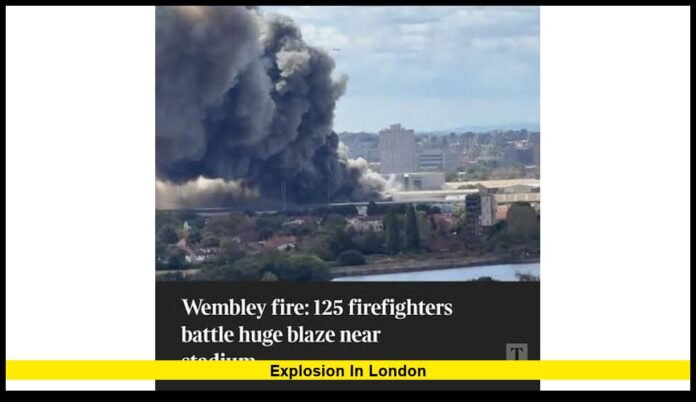

A major industrial fire near Wembley Stadium sent a huge column of smoke across London on Friday, August 28, 2026, prompting a large emergency response in northwest London. The incident happened at an industrial estate on Hannah Close in Neasden, where a mixed-waste facility and a large industrial unit caught fire.
London Fire Brigade initially sent 20 fire engines and around 125 firefighters to the scene. The response later increased, with reports indicating that 25 engines had attended as firefighters worked to bring the blaze under control. More than 90 emergency calls were received about the fire.
Reports of an explosion near the waste facility quickly circulated as dramatic images of the blaze spread online. However, authorities have not confirmed the cause of the fire, and the circumstances surrounding any reported explosion remain unclear.
The fire produced thick smoke that could be seen from large parts of London. Residents near the scene were advised to close windows and doors and remain indoors where possible.
Where the London Fire Started
The blaze broke out on Hannah Close in Neasden, an industrial area in northwest London.
The location is close to Wembley Stadium and several major commercial properties. The fire involved a waste transfer facility and an industrial unit measuring roughly 100 meters by 150 meters.
That size helps explain the scale of the emergency response.
Fire crews from Wembley, Park Royal, Willesden and surrounding stations were dispatched. The London Fire Brigade quickly recognized that the incident required a much larger response than an ordinary building fire.
The thick smoke also created a wider public-safety concern.
Instead of remaining focused only on the industrial estate, authorities had to consider the effect of smoke on nearby residential and commercial areas.
What Happened During the Fire
The first emergency calls came in shortly after 11:30 a.m. local time. The London Fire Brigade said its control room received the first report at approximately 11:34 a.m.
Within a short period, the number of calls increased sharply.
More than 70 calls were initially reported. Later updates put the total at more than 90 calls.
The large number of reports reflected how visible the fire had become.
A huge dark plume rose above the industrial estate and could be seen from distant parts of London. Videos posted online showed smoke dominating the skyline near Wembley.
Firefighters faced a substantial blaze involving waste materials and an industrial building.
The response included specialist equipment designed to help crews attack a large fire from multiple positions.
Emergency Response Grows as Firefighters Battle Blaze
The initial response involved 20 fire engines and about 125 firefighters.
As the operation continued, the number of engines responding increased.
Firefighters also deployed several 32-meter aerial ladders. These vehicles allow crews to work from an elevated position and direct water toward fires involving large buildings or industrial structures.
A drone team was also sent to the scene.
Drones can give emergency commanders an aerial view of a large incident. That can help crews understand how a fire is spreading and identify areas that require additional resources.
A hose-laying unit and high-volume pump were also deployed.
The equipment increased the amount of water available to firefighters as they worked to control the blaze.
The operation was expected to continue for several hours because industrial fires can remain difficult to extinguish even after the main flames appear to have reduced.
Huge Smoke Cloud Becomes a Major Concern
Smoke became one of the most visible effects of the fire.
Large amounts of dark smoke rose from the industrial estate and moved across the surrounding area.
Residents were told to close doors and windows and remain inside where possible.
That advice was particularly important for people close to the fire because the smoke was heavy and widespread.
People farther away could also see the plume from central and western parts of London.
The visibility of the smoke led to a rapid increase in public awareness. Social media users posted photographs and videos showing the plume from different parts of the city.
Those images helped demonstrate the scale of the incident but did not establish how the fire started.
What Is Known About the Reported Explosion
The reported explosion became an important part of the developing story.
Witness accounts and online reports referred to an explosion at or near the waste and recycling facility.
However, the official position remained that the cause of the fire was unknown.
That distinction is important.
A fire can produce loud explosions after it has already started. Industrial and waste facilities may also contain materials that can create sudden bursts, sounds or pressure during a fire.
Without an official investigation, it is not possible to say whether an explosion started the blaze, happened during the fire or was unrelated to its origin.
Therefore, the confirmed description remains a major industrial fire in Neasden.
Any stronger claim about the cause would go beyond the confirmed information available at the time of publication.
Nearby Amazon Facility Evacuated
A nearby Amazon facility was evacuated as a precaution during the emergency.
The warehouse itself was not identified as the source of the fire.
The evacuation demonstrated how the incident affected businesses operating near the industrial estate.
When a large fire produces heavy smoke, nearby businesses may need to move workers away from the area even when their own buildings are not directly involved.
The precaution helped keep employees away from the immediate danger zone while firefighters continued their work.
The evacuation also contributed to disruption around the industrial area.
London Underground Services Hit by Fire
The fire caused significant disruption to London’s transportation network.
The Metropolitan line was suspended during the emergency response.
The Jubilee line was also affected, with services disrupted between parts of the route around Wembley and Willesden Green.
Severe delays were reported on the remaining affected services.
The transportation disruption occurred because the fire was close to railway infrastructure.
Emergency services also needed space around the incident. Keeping trains away from the area reduced the potential risks associated with smoke, firefighting operations and access for emergency crews.
Passengers were directed toward alternative services where possible.
London’s transport network provided alternative options through buses, the DLR, Elizabeth line and other rail services.
The disruption added another layer to the impact of the fire because thousands of people use the Wembley and northwest London transport corridor each day.
Rail Services Around London Marylebone Disrupted
The effects also reached rail services around London Marylebone.
A fire near railway infrastructure between London Marylebone and Harrow-on-the-Hill caused disruption to services toward Aylesbury.
Some trains were canceled, delayed or revised.
At one stage, disruption was expected to continue into the evening.
Passengers were allowed to use alternative services under arrangements made during the disruption.
The transportation problems were therefore not limited to the immediate industrial estate.
The fire affected an important section of London’s wider transport network, creating delays for people traveling through northwest London.
Wembley Stadium Was Not the Location of the Fire
The proximity of the fire to Wembley Stadium generated considerable attention.
However, the blaze was at an industrial estate on Hannah Close in Neasden.
Wembley Stadium itself was not identified as the location of the fire.
The stadium’s proximity did make the smoke particularly noticeable. Photographs showed the plume rising near the well-known sporting venue.
The incident occurred ahead of a major weekend at Wembley, which increased public interest in developments around the area.
At the time of the latest verified updates, the fire had not been reported as a fire inside Wembley Stadium.
That distinction is important because some social media posts can make a nearby emergency appear to involve a landmark directly when it does not.
Firefighters Work to Bring the Blaze Under Control
As crews continued working, the appearance of the smoke changed.
Later reports indicated that the fire was being brought under control, with the smoke becoming lighter than the dense black plume seen earlier.
That did not mean the emergency response ended immediately.
Large industrial fires can require firefighters to remain at the site after the most intense flames have been contained.
Crews must identify and extinguish remaining hot spots. They also need to make sure that fire does not spread again through waste materials or damaged structures.
Fire officials described the incident as a prolonged operation.
Firefighters were expected to remain at the scene for much of the day while they worked toward fully extinguishing the fire.
No Confirmed Injuries at the Waste Facility
One of the significant updates from the facility involved the safety of its employees.
LondonEnergy, which operates the waste transfer facility, said its employees were safe and that there were no injuries among its staff.
That provided an important clarification as emergency crews continued working at the site.
No confirmed fatalities were reported in the latest verified updates available for this article.
Casualty information can change during an active emergency, so official updates remain important.
At the time of publication, the primary focus remained on firefighting, public safety and transportation disruption.
Why the Fire Produced Such a Large Smoke Plume
Waste facilities can contain many different materials.
When large quantities of waste burn, the resulting fire can produce substantial smoke. The exact characteristics depend on what materials are involved and how the fire develops.
In this case, the fire involved a mixed-waste facility and a large industrial unit.
The combination produced a smoke plume large enough to become visible across significant portions of London.
The size of the smoke cloud also made the incident appear particularly dramatic in photographs and videos.
For residents nearby, however, the smoke was more than a visual spectacle. It was the reason authorities advised people to stay inside and close openings to the outside.
What Authorities Are Investigating
The cause of the fire remains the key unanswered question.
Firefighters first need to make the site safe before investigators can examine the damaged area in detail.
That process can take time, particularly when a large industrial building has been severely affected.
Investigators will need to establish where the fire began and what circumstances allowed it to spread.
The reported explosion may form part of that investigation, but there is currently no confirmed explanation connecting it to the start of the fire.
Until investigators release further findings, claims about the cause should be treated carefully.
There is also no confirmed information indicating that the fire was deliberately started or connected to any terrorist activity.
Public Safety Advice During the Incident
The main safety message for people near the fire was straightforward.
Residents were advised to:
- Keep doors and windows closed.
- Stay indoors where possible.
- Avoid the immediate area.
- Follow instructions from emergency authorities.
- Check transportation updates before traveling through northwest London.
People who could see the smoke from a distance were not necessarily in the same situation as those immediately beside the industrial estate.
The strongest precaution applied to residents and workers closest to the fire.
The Latest Confirmed Picture
The latest information paints a clear picture of a major industrial fire that required a substantial emergency response.
The blaze began at a waste transfer facility on Hannah Close in Neasden.
Around 125 firefighters were deployed, with the number of responding fire engines reaching 25 in later updates.
Specialist equipment included aerial ladders, drones, a hose-laying unit and a high-volume pump.
More than 90 emergency calls were made to the fire brigade.
The smoke plume became visible across London.
Nearby residents were told to remain indoors with doors and windows closed.
A nearby Amazon facility was evacuated as a precaution.
The Metropolitan line was suspended, while the Jubilee line and rail services around London Marylebone experienced disruption.
Firefighters worked to bring the blaze under control.
Most importantly, the cause had not yet been established.
What Happens Next
The next stage will focus on completely extinguishing the fire and determining how it began.
Firefighters will continue checking the site for remaining hot spots and other hazards.
Transport services should gradually return as emergency officials determine that the surrounding infrastructure is safe.
Investigators will then have to establish the cause of the blaze.
That investigation should also clarify the circumstances surrounding reports of an explosion.
Until those findings are available, the most reliable description is a major industrial fire near Wembley rather than a confirmed explosion with an established cause.
For people in the United States following the story, the incident illustrates how quickly a large urban industrial fire can affect an entire area.
The impact reached beyond the facility itself, affecting residents, businesses, commuters and London’s transportation network.
The heavy smoke also turned a local industrial emergency into a highly visible event across the city.
Final Update on the Neasden Fire
The major blaze in Neasden has remained the central focus of emergency crews in northwest London. Firefighters deployed a large number of resources to control the fire, while officials worked to protect nearby residents from the heavy smoke.
The incident also caused significant disruption around Wembley and surrounding transport routes.
Although reports of an explosion have circulated widely, the fire’s cause remains officially unconfirmed. Further investigation will be needed before authorities can establish exactly what happened at the waste facility.
For now, the confirmed facts are clear: a large industrial fire broke out on Hannah Close, emergency crews mounted a major response, residents received safety warnings, nearby transportation was disrupted, and firefighters worked for hours to bring the situation under control.
Stay with the latest confirmed developments, and share your thoughts on the incident in the comments below.