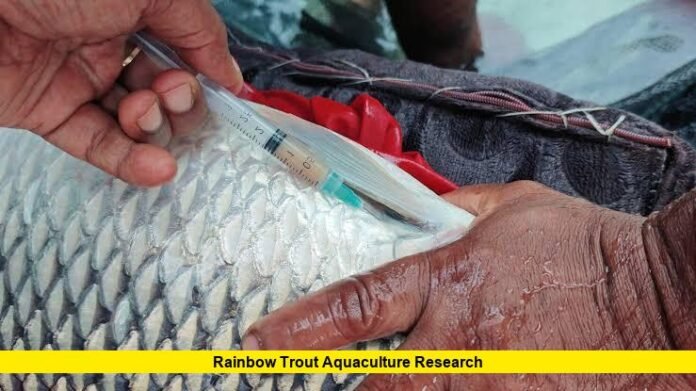

Washington State University is expanding its work in rainbow trout aquaculture research through a newly funded project focused on developing practical ways to produce healthy, sterile farmed rainbow trout. The research, led by WSU Associate Professor Michael Phelps, has received a combined $1,566,716 from the Foundation for Food & Agriculture Research (FFAR), Washington State University, and commercial trout producer Troutlodge. The project is designed to address both aquaculture productivity and environmental concerns associated with farmed fish.
New Rainbow Trout Aquaculture Research at WSU
The new research project focuses on a central challenge in modern finfish aquaculture: producing farmed fish that are healthy and productive while reducing the potential consequences if they escape into natural environments.
WSU researchers are investigating biological methods for producing sterile rainbow trout rather than relying entirely on conventional sterilization techniques. The project is supported through an FFAR Growing Impact Award, with matching contributions from WSU and Troutlodge.
The total project funding is $1.566 million, including an FFAR award of $747,360. The research is based in Pullman, Washington, and is being led by Michael Phelps in WSU’s Department of Animal Sciences.
Sterility can have two important implications for aquaculture. From a production perspective, a sterile fish may direct more of its biological resources toward growth instead of reproduction. From an environmental perspective, sterile farmed fish cannot reproduce normally if they escape and encounter wild populations.
The WSU project therefore brings together genetics, fish breeding and aquaculture production with the goal of developing an approach that could eventually be practical at commercial scale.
Why Sterile Rainbow Trout Matter to Aquaculture
Rainbow trout, scientifically known as Oncorhynchus mykiss, are an important species in aquaculture. They are raised for food production and are also widely used in research because of their biological and commercial importance.
One longstanding challenge is controlling reproduction in farmed fish. Conventional approaches to producing sterile trout commonly involve creating triploid fish, meaning the animals have three sets of chromosomes instead of the normal two.
Triploidy can produce sterile fish, but the current approach has limitations. According to the organizations supporting the new WSU project, the technique is not completely effective and can sometimes create fish health or production concerns.
That has encouraged researchers to investigate alternative approaches based on the natural biology of trout.
The goal is not simply to make fish sterile. The researchers are seeking a method that can produce fish that remain healthy, grow effectively and can potentially be produced in a practical manner for commercial aquaculture.
Two Biological Approaches Under Investigation
The WSU research team is examining two promising approaches to controlling fertility in rainbow trout.
The first approach involves specially produced male trout that pass a fertility-related trait to their female offspring. Under the strategy being studied, those female offspring would be sterile.
The second approach involves female trout whose eggs produce offspring that are unable to develop reproductive cells capable of producing eggs or sperm.
Researchers are breeding and studying fish generated through these strategies over multiple generations. Among the characteristics being examined are fertility, health and growth.
This multi-generation evaluation is important because a technique that works in a laboratory setting still needs to demonstrate that it can produce consistent and healthy fish before it can become a practical aquaculture technology.
There is currently no official confirmation that either approach has been established as a commercially available replacement for existing trout sterilization methods. The research is intended to determine which strategy, or strategies, can ultimately meet the necessary biological and production requirements.
Connection to Earlier WSU Trout Research
The current project builds on earlier work conducted by Phelps and his research group.
In 2021, Phelps received an FFAR New Innovator in Food & Agriculture Research Award for research that investigated how rainbow trout could be sterilized by preventing reproductive cells from developing.
That earlier work demonstrated a potential biological pathway but was considered too complicated for direct commercial use. The new project moves the research toward approaches that could be simpler and more scalable.
This progression is significant for rainbow trout aquaculture research because laboratory discoveries do not automatically translate into commercial farming systems. Researchers must also consider consistency, animal health, growth performance, breeding requirements and the practical demands of producing large numbers of fish.
The new funding provides an opportunity to test whether the biological concepts identified in earlier research can be developed into a more usable production method.
Potential Benefits for Fish Farmers
If the research ultimately produces a reliable method for creating healthy sterile trout, it could have implications for commercial aquaculture.
Sterile fish do not allocate resources toward normal reproductive development in the same way fertile fish do. The research team expects that controlling reproduction could allow more energy to be directed toward growth, potentially improving production efficiency.
For fish farmers, improvements in growth and production efficiency can influence how much feed, space and time are required to raise market-size fish.
However, the current project is still research rather than a confirmed commercial production system. The researchers are evaluating the health and growth characteristics of fish across generations, so the eventual production benefits remain to be demonstrated.
The distinction is important. The funding supports research into a potential technology; it does not mean that commercial farms are already using the new method.
Environmental Considerations
Environmental protection is another major reason researchers are interested in sterile farmed trout.
Farmed fish can occasionally escape from production facilities. If fertile farmed fish enter natural waterways and reproduce with wild populations, they may introduce genetic characteristics associated with domesticated stocks.
A reliable method of producing sterile farmed fish could reduce that reproductive risk because escaped sterile fish would not be able to reproduce normally.
This issue is particularly relevant to aquaculture systems where farmed fish are raised in environments connected to rivers, lakes or marine waters.
Sterility does not eliminate every environmental consideration associated with fish farming, but it can address one specific concern: reproduction following escape.
The WSU research is therefore looking at sterility as both a production tool and a potential environmental safeguard.
Career and Research Opportunities in Trout Aquaculture
The latest project also highlights the growing range of scientific disciplines involved in modern aquaculture.
Rainbow trout aquaculture research can involve areas such as genetics, reproductive biology, animal nutrition, fish health, physiology, microbiology, environmental science and production technology.
At WSU, trout research has included functional genomics, muscle growth, environmental resilience and reproductive biology. The university’s aquaculture facilities also support experimental work with rainbow trout lines and recirculating systems.
Graduate researchers are contributing to different aspects of trout biology. For example, WSU’s Animal Sciences program has highlighted research into hypoxic responses and adaptive traits associated with resilience to low-oxygen conditions in rainbow trout.
These research areas demonstrate how aquaculture increasingly depends on biological and technological approaches that go beyond traditional fish farming.
Public Interest in Sustainable Aquaculture
The latest funding comes at a time when researchers and producers are looking for ways to improve the sustainability and efficiency of food production.
Aquaculture can provide an important source of animal protein, but fish farming also has to address issues involving animal health, water quality, feed efficiency, escapes and interactions with natural ecosystems.
Research into sterile rainbow trout fits into this broader effort by targeting two connected objectives: improving farm production while reducing one potential environmental consequence of escaped fish.
The project also illustrates the role of public-private research partnerships. FFAR is providing grant funding, while WSU and Troutlodge are contributing matching funds.
Troutlodge’s involvement is particularly relevant because commercial producers can help researchers understand the practical requirements that a new aquaculture technology would need to meet.
Latest Update on the WSU Project
The latest confirmed information indicates that the project was announced in September 2026 and has a combined funding commitment of $1,566,716.
The research is being conducted at Washington State University in Pullman and is led by Michael Phelps. The project is focused specifically on developing a practical method for producing healthy sterile rainbow trout using the fish’s own biological processes to control fertility.
Researchers are currently breeding and evaluating fish produced through the two experimental strategies. Their work includes monitoring fertility, health and growth across generations.
At this stage, there is no official confirmation that the new technology has reached commercial deployment or that one of the two approaches has been selected as the final production method.
The project’s results will need to demonstrate that the approach is reliable, scalable and suitable for healthy fish production before broader commercial adoption can be established.
What This Means for the Future of Rainbow Trout Farming
The new WSU initiative could become an important area of rainbow trout aquaculture research because it combines genetic and reproductive science with a practical aquaculture objective.
A successful method for producing healthy sterile trout could potentially give farmers another tool for managing reproduction while supporting efficient fish growth. It could also provide an additional layer of protection against reproduction by escaped farmed fish.
At the same time, the research should be viewed in the context of what is currently known. The project is underway, and its commercial usefulness will depend on the results obtained through continued breeding and evaluation.
Further findings may clarify how effectively the two approaches work, whether they maintain strong growth and health characteristics, and whether they can eventually be adapted for large-scale production.
Final Thoughts
Washington State University’s latest investment in rainbow trout aquaculture research reflects a broader effort to make fish farming more productive while addressing environmental concerns. With $1.57 million in combined support, researchers are testing biological approaches that could provide an alternative way to produce sterile farmed trout.
The work builds on several years of research and brings together WSU scientists, FFAR and Troutlodge. While no commercial breakthrough has been officially confirmed yet, the project provides a clear research pathway toward evaluating healthier and potentially more practical sterile trout production.
Stay updated on the latest rainbow trout aquaculture research and share your thoughts in the comments as this project develops.