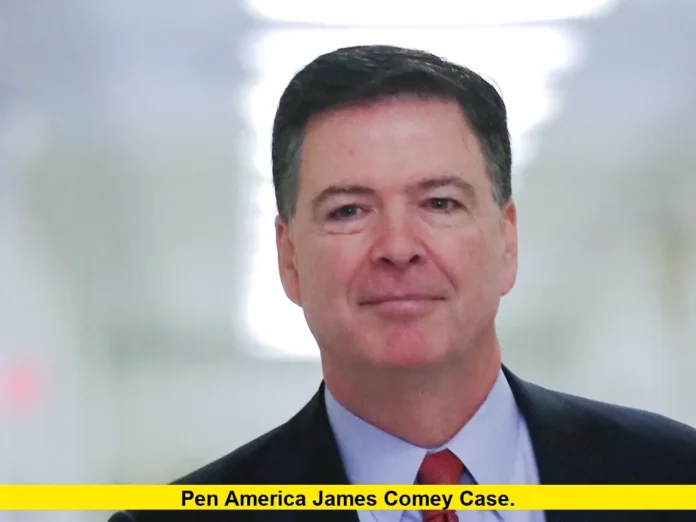

The pen america james comey case has drawn renewed national attention after PEN America criticized federal prosecutors for using James Comey’s novel FDR Drive as part of their argument in the criminal case against the former FBI director. The organization says courts should exercise extreme caution when prosecutors use creative fiction to support criminal charges, warning that the move raises serious First Amendment concerns.
PEN America’s Response to the DOJ Filing
PEN America, a major U.S. free-expression organization representing writers and other literary professionals, responded after the Justice Department cited passages from Comey’s 2025 legal thriller in a recent court filing.
Mara Gassmann, PEN America’s legal director, strongly criticized the government’s approach. She argued that prosecutors should not rely on a fictional work to strengthen what she described as a constitutionally questionable prosecution.
PEN America’s position centers on the distinction between political expression and an actual criminal threat. The organization says Comey’s photograph of seashells displaying “86 47” should not be transformed into a criminal threat simply because prosecutors connect it with themes from a novel he wrote.
The organization also warned that using creative work in a criminal case could have implications beyond Comey. Writers often create fictional characters, violent scenarios and controversial political situations without intending those ideas to represent their own beliefs or conduct.
For PEN America, that distinction is particularly important when prosecutors attempt to connect an author’s fictional characters with allegations about the author’s real-world intentions.
Why James Comey Is Facing Federal Charges
The criminal case began with an Instagram post Comey made on May 15, 2025.
The post showed seashells arranged on a beach to form the numbers “86 47.” Comey captioned the image as a comment about a shell formation he encountered during a beach walk.
The image quickly became controversial because “47” can refer to Donald Trump, the 47th president of the United States. Prosecutors argue that “86” can be used as slang meaning to remove, eliminate or kill someone.
The Justice Department eventually presented the post to a federal grand jury in North Carolina.
On April 28, 2026, a federal grand jury in the Eastern District of North Carolina indicted Comey on two counts. The Justice Department said the first count alleges that Comey knowingly and willfully threatened to take the life of and inflict bodily harm upon President Trump.
The second count alleges that Comey knowingly transmitted a communication containing a threat to injure another person through interstate commerce.
The indictment does not establish guilt. Comey remains entitled to the presumption of innocence unless the government proves the charges in court.
What Prosecutors Say About the “86 47” Image
Federal prosecutors argue that the meaning of the photograph cannot be evaluated in isolation.
In filings submitted during the current pretrial dispute, the government argued that there is no serious dispute that the image could be interpreted as a threat against Trump.
Prosecutors pointed to several circumstances surrounding the post. They discussed the meaning of “86,” Trump’s status as the 47th president, the reaction to the photograph and Comey’s professional background.
The government also challenged Comey’s explanation that he encountered the arrangement of shells during a beach walk.
According to prosecutors, the surrounding circumstances are relevant to determining whether Comey understood how other people could interpret the message.
The government has also argued that Comey had a possible financial reason to generate attention because the Instagram post appeared shortly before the publication of FDR Drive.
That argument has become one of the most unusual elements of the case because prosecutors are now using the content of the novel itself to support their interpretation of the social media post.
How FDR Drive Entered the Case
FDR Drive is a legal thriller written by Comey and published in 2025.
The novel includes a fictional character who attempts to confront a far-right media personality. Prosecutors have highlighted portions of the book involving coded language, political enemies and suggestions that violence could be directed toward opponents.
The government argues that similarities between the fictional story and the circumstances surrounding Comey’s Instagram post are relevant to the question of intent.
Prosecutors also cited a Publishers Weekly review of the novel in their filing. The filing reportedly used the book and the review to argue that Comey understood the implications of coded political messages.
That argument has produced the sharpest response from PEN America.
The organization says fiction should not be treated as evidence that an author intended to commit an act described or implied in that fiction. It argues that doing so could create a dangerous precedent for writers whose fictional characters express extreme political views or engage in criminal conduct.
PEN America Raises First Amendment Concerns
PEN America’s criticism is rooted in its broader mission to defend freedom of expression.
The organization has previously participated in major First Amendment litigation involving the government and press freedom. Its litigation program focuses on protecting the rights of writers, journalists, teachers, students and others whose speech or access to information may be restricted.
The organization’s position in the Comey matter is not the same as joining the criminal defense as a party. Instead, PEN America is publicly criticizing the government’s use of creative expression as part of its evidentiary argument.
Gassmann said the use of Comey’s fiction compounds the constitutional concerns surrounding the prosecution. She also urged courts to exercise extreme caution whenever creative works become part of a criminal case.
That distinction matters because criminal prosecutions based on speech must address constitutional protections surrounding expression.
The Supreme Court has recognized that not every offensive, disturbing or politically provocative statement qualifies as a criminal “true threat.” The government must meet the legal requirements applicable to threatening speech.
Comey’s Defense Seeks Dismissal
Comey’s lawyers have asked the court to dismiss the North Carolina indictment.
The defense argues that the Instagram post was protected expression rather than a genuine threat. His lawyers also dispute the government’s interpretation of the numbers.
They maintain that a reasonable observer would not necessarily interpret “86 47” as a statement that Comey himself intended to harm Trump.
The defense has additionally accused prosecutors of pursuing a vindictive and selective prosecution. Comey’s lawyers argue that the case is part of a broader effort to punish him because of his history with Trump.
Those allegations remain disputed. The Justice Department has rejected the claim that Trump or senior department officials improperly directed the prosecution.
Prosecutors have said the decision to seek the indictment was made independently by the U.S. attorney for the Eastern District of North Carolina.
The Government Disputes Political-Retaliation Claims
The political background makes the case unusually contentious.
Trump fired Comey as FBI director in 2017. Their relationship became even more hostile after Comey became a prominent figure in disputes surrounding the FBI’s investigation into Russian interference in the 2016 presidential election.
Comey has repeatedly denied that the 2025 Instagram post represented a threat.
The Justice Department, however, says the case rests on evidence beyond a simple disagreement over political speech. Prosecutors have emphasized the circumstances surrounding the post and the government’s interpretation of the message.
That dispute will ultimately require the court to distinguish protected political expression from criminally punishable threatening communication.
A Second Federal Prosecution of Comey
The North Carolina case is not the first time federal prosecutors have attempted to criminally prosecute Comey during the current period.
In September 2025, Comey faced a separate federal indictment in Virginia involving allegations that he made false statements to Congress and obstructed a congressional proceeding.
That earlier prosecution was later dismissed after a federal judge ruled that the prosecutor who obtained the indictment had been unlawfully appointed. The North Carolina threat case is separate and concerns the Instagram post.
The distinction is important. The dismissal of the earlier case did not eliminate the separate charges now pending in North Carolina.
The current case therefore remains active unless Judge Louise Wood Flanagan grants Comey’s motions to dismiss or the parties reach another resolution.
Current Status of the North Carolina Case
As of the latest confirmed updates, the federal threat case remains pending in the Eastern District of North Carolina.
Judge Flanagan has set the case for trial on October 21, 2026, in New Bern, North Carolina, if it proceeds that far. Comey’s arraignment is scheduled for September 30.
The court previously moved the schedule after the defense requested additional time to review discovery and prepare constitutional arguments.
The case has also experienced a change in the prosecution team. Assistant U.S. Attorney Matthew Petracca withdrew from the case in May, and Assistant U.S. Attorney Timothy Severo took over. The Justice Department described the change as a routine allocation of resources and did not link it to the merits of the prosecution.
At this stage, there has been no final ruling dismissing the North Carolina indictment.
What Happens Next
The immediate legal question is whether Comey’s motions to dismiss will succeed.
The defense is challenging the prosecution on constitutional and procedural grounds. The government has responded by defending the indictment and presenting additional arguments about the meaning and context of the Instagram post.
The recent dispute over FDR Drive adds another layer to that fight.
If the court allows the prosecution to proceed, the parties will continue preparing for the October trial. If the court dismisses the charges, the case could end before a jury considers whether the Instagram post constituted a criminal threat.
The court, rather than PEN America, the Justice Department or Comey himself, will ultimately determine whether the charges survive the pretrial stage.
For now, the central issue remains whether the government can legally transform the meaning of a brief social media image into proof of a criminal threat.
Why the PEN America James Comey Case Matters for Writers
The controversy extends beyond the personalities involved.
PEN America’s objection highlights a broader question about the relationship between authors and their fictional work. Writers frequently create characters who commit crimes, advocate violence or hold political beliefs that differ from their own.
Using those fictional elements as evidence of an author’s real-world intent could affect how prosecutors approach novels, screenplays and other creative works in future cases.
The Justice Department argues that the novel is relevant because of its similarities to the conduct alleged in the indictment. PEN America takes the opposite view, warning that the government’s approach risks blurring the line between fiction and real-world intent.
That disagreement is now part of one of the most closely watched free-expression disputes surrounding a federal criminal prosecution.
As of August 23, 2026, the charges against Comey remain unresolved. The court has not entered a final judgment on the allegations, and the October trial date remains the next major scheduled milestone.
The latest PEN America criticism therefore does not decide Comey’s case. It does, however, underscore the constitutional stakes surrounding the government’s attempt to use a novelist’s fictional work to support a criminal prosecution based on political expression.
The Comey case remains active, and readers can follow the next court developments as the First Amendment fight moves toward its next major ruling.