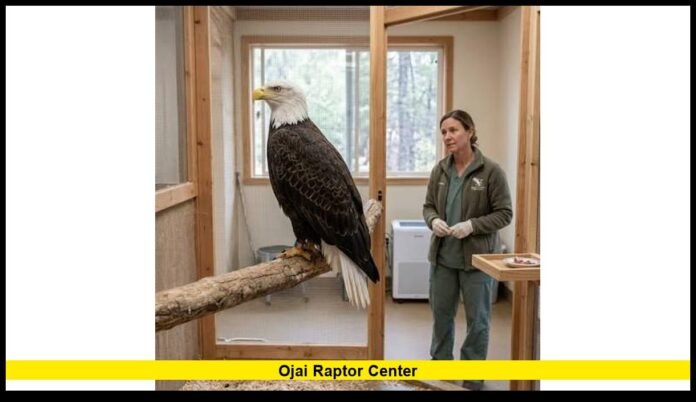

Ojai Raptor Center is continuing intensive treatment for Jackie, the well-known Big Bear bald eagle whose blood values have fallen sharply again. Identified by the rehabilitation facility as Patient 26-519, Jackie remains in critical condition and is receiving oxygen therapy, supportive treatment and round-the-clock monitoring as veterinarians evaluate the results of advanced testing.
The latest update, released Friday, August 7, brought difficult news for people following Jackie’s recovery. Her packed cell volume, commonly called PCV, has dropped below 10 percent. The decline represents another serious setback after several weeks of fluctuating blood values and intensive medical care.
Veterinarians recently performed a contrast CT scan and bone marrow biopsy. Those procedures produced new medical information, but additional specialized testing remains pending. The veterinary team is also consulting specialists across the country while determining the next steps in her treatment.
For now, the medical team remains focused on keeping Jackie stable and providing the care she needs.
Jackie Remains in Critical Condition
The newest update confirms that Jackie remains in intensive care.
She is receiving supplemental oxygen, supportive treatment and continuous monitoring. Her medical team is closely watching her blood values because severe anemia has remained one of the central concerns during her hospitalization.
Her PCV has now fallen below 10 percent. The measurement represents the percentage of blood made up of red blood cells. A low PCV indicates anemia, and Jackie’s level has required repeated monitoring throughout her treatment.
The latest decline follows a period in which her blood values showed signs of improvement before falling again.
The veterinary team has not announced a final diagnosis for the underlying illness. It also has not provided a recovery timetable or a possible release date.
Those decisions depend on how Jackie responds to treatment and what the remaining diagnostic results reveal.
Advanced Testing Took Place This Week
Jackie underwent two major diagnostic procedures on Wednesday, August 5.
Veterinarians performed a contrast CT scan and a bone marrow biopsy while she was under anesthesia. The team reported that she recovered from anesthesia and returned to her recovery enclosure with supplemental oxygen.
The procedures were intended to provide more information about the medical problems affecting her.
A CT scan can provide detailed images of internal structures, while a bone marrow biopsy allows veterinarians to examine the tissue responsible for producing blood cells.
The tests have already provided important new information, but the center said additional specialized testing remains pending.
Veterinary specialists from around the country are participating in the evaluation. The team is taking time to assess the findings before determining what comes next.
That process is especially important because Jackie’s condition has changed several times during her hospitalization.
Jackie’s Blood Values Have Fluctuated
The latest decline follows several changes in Jackie’s PCV during the past few weeks.
On July 27, her PCV had increased from 8 percent to 16 percent after a blood transfusion and other supportive treatment. At that point, the rehabilitation team reported improvements in her energy and alertness.
She was also eating on her own.
Those developments provided encouraging signs, although her condition remained serious.
On July 29, Jackie moved from the intensive care unit to a regular hospital care area. The move marked progress because she no longer required the same level of intensive oxygen support at that moment.
However, veterinarians continued to describe her as a very sick patient.
Her condition changed again shortly afterward.
By July 31, her PCV had reached 17 percent. The medical team considered the increase encouraging, although it remained below the level veterinarians wanted to see.
On August 3, another blood test showed that her PCV had dropped to 13 percent.
The decline indicated that her anemia had worsened. The medical team responded by pursuing additional advanced diagnostic testing and expedited laboratory work.
The August 7 update brought another sharp decline, with her PCV falling below 10 percent.
Read More – Jackie Bald Eagle Recovery Journey: What We Know About Her Condition in August 2026
Why the PCV Level Matters
PCV is an important measurement when veterinarians evaluate anemia.
Red blood cells carry oxygen throughout the body. When their concentration becomes severely reduced, the body can struggle to deliver enough oxygen to tissues and organs.
That makes close monitoring particularly important for a critically ill animal.
Jackie’s veterinary team has repeatedly checked her blood values throughout treatment. Changes in those measurements have helped the doctors assess whether her condition was improving or deteriorating.
Her earlier increase to 17 percent offered a positive sign. The subsequent fall to 13 percent and then below 10 percent showed that the improvement had not continued.
The medical team is now using the new diagnostic information to better understand what is happening.
No definitive explanation has been publicly announced yet.
The Medical Team Is Continuing Specialized Care
Jackie’s treatment involves more than routine observation.
She remains under intensive veterinary supervision, with staff monitoring her condition around the clock. Oxygen therapy and supportive care continue while specialists review the results from the recent procedures.
The center has also emphasized that decisions will remain focused on Jackie’s medical condition and welfare.
That means the immediate goal is not release. The priority is stabilization.
If her health improves sufficiently, veterinarians can later evaluate whether she is physically capable of returning to the wild. That decision would require substantial evidence that she can survive independently.
At this stage, Jackie remains too ill for any such determination.
How Jackie Became a Well-Known Big Bear Eagle
Jackie became one of the most recognizable bald eagles in the United States through years of public interest in the Big Bear Lake nest.
Viewers have followed Jackie and her mate, Shadow, through a widely watched nest camera operated by Friends of Big Bear Valley.
The livestream allowed people to observe the eagles’ nesting activity and young birds from a distance.
That connection made Jackie’s disappearance especially concerning when she was found unable to fly near Big Bear Lake.
She was eventually rescued and transferred for specialized treatment.
The Ojai Raptor Center identified the bird in its care as Bald Eagle Patient 26-519. Supporters and wildlife observers subsequently connected the patient with Jackie.
Her treatment has since attracted widespread attention across Southern California and beyond.
The Ojai Raptor Center Has Become Central to Jackie’s Care
The current medical case has placed the spotlight on the rehabilitation facility responsible for Jackie’s treatment.
Ojai Raptor Center specializes in the rehabilitation of birds of prey and other wildlife. Its work includes treating injured, sick and orphaned animals and preparing releasable patients for a return to the wild.
The facility handles a large number of wildlife patients each year.
Its operations include veterinary care, recovery areas, flight enclosures and specialized housing for different species.
Birds that arrive in poor condition may require medical stabilization before they can begin the rehabilitation process.
Some animals recover quickly, while others need weeks or months of care.
Critically ill patients require an even higher level of attention.
Jackie’s case demonstrates the complexity of treating a wild raptor with serious medical problems. Her care requires veterinary medicine, rehabilitation expertise and consultation with specialists.
The Center’s Work Extends Beyond One Eagle
Although Jackie’s condition has attracted significant attention, the rehabilitation center treats many other wildlife patients.
Its primary work involves birds of prey, including hawks, owls, falcons, eagles and other raptors.
Young birds can arrive after falling from nests or becoming separated from their parents. Adult birds may need help after injuries, illness or other emergencies.
The ultimate goal for releasable animals is independence.
Rehabilitation therefore does not end when an animal’s immediate medical problem improves. Birds must also regain strength and develop the skills needed to function in their natural environment.
Flight conditioning can become a major part of that process for raptors.
Large flight areas give recovering birds opportunities to build strength and improve their ability to maneuver.
For Jackie, however, those later stages remain distant while she continues to battle her current medical problems.
Jackie’s Future Remains Undetermined
There is currently no confirmed release date for Jackie.
The veterinary team has also not announced a recovery timeline.
Those details cannot be determined until her condition becomes more stable and the medical team has a clearer understanding of the illness affecting her.
The latest testing may help answer some of those questions.
The CT scan and bone marrow biopsy have already provided new information. Additional laboratory testing could add further details.
Veterinarians and consulting specialists are reviewing the findings before deciding on the next steps.
That means future updates could depend heavily on the results of the pending tests and Jackie’s response to continued treatment.
Supporters Continue Watching for Updates
Jackie’s story has generated a strong emotional response from people who have watched her and Shadow over the years.
Many supporters have followed each medical update closely.
The rehabilitation center has expressed appreciation for the public’s concern and support while also asking people to give its staff enough time and space to focus on patient care.
That request is particularly important while Jackie remains in intensive care.
Medical teams need to devote their attention to treatment, monitoring and decision-making rather than responding to repeated requests for information.
The center has indicated that another update will be shared when the veterinary team has a clearer understanding of the latest findings.
What the Latest Ojai Raptor Center Update Confirms
The most recent information provides several clear facts about Jackie’s condition:
- Jackie is identified by the facility as Bald Eagle Patient 26-519.
- She remains in critical condition.
- She is receiving intensive care.
- Oxygen therapy continues.
- Her care includes supportive treatment and around-the-clock monitoring.
- Her PCV has fallen below 10 percent.
- A contrast CT scan was completed on August 5.
- A bone marrow biopsy was also completed on August 5.
- The procedures provided important new medical information.
- Additional specialized testing remains pending.
- Veterinary specialists from across the country are helping evaluate the findings.
- No final diagnosis has been announced.
- No release date has been announced.
- The veterinary team continues to prioritize her health and welfare.
These points represent the latest confirmed status available as of August 8.
Why the Next Medical Update Could Be Important
The next update could provide greater clarity about the information gathered through the CT scan, bone marrow biopsy and additional testing.
For now, the rehabilitation team is still reviewing the findings.
Jackie’s declining PCV has made the situation more serious. Her earlier improvement demonstrated that her condition could change, but the latest bloodwork shows that she remains in a dangerous medical state.
The veterinary team continues to provide supportive care while searching for clearer answers.
The focus remains on her immediate welfare rather than predictions about the outcome.
That approach is especially important in wildlife medicine, where decisions must account for both survival and the animal’s ability to function independently after treatment.
The Latest Chapter in Jackie’s Recovery
Jackie’s treatment has now entered another difficult stage.
She has undergone advanced testing, received intensive care and continued to receive close monitoring from veterinarians and specialists.
Her PCV has fallen below 10 percent, making her current condition critical.
At the same time, the medical team continues to investigate the underlying cause and evaluate available treatment options.
There is no confirmed outcome yet.
The next meaningful development will come from the veterinary team’s assessment of the recent diagnostic findings and Jackie’s response to continued care.
Until then, the focus remains firmly on keeping her comfortable, supporting her body and making decisions based on her medical needs.
Jackie’s condition remains critical at the Ojai Raptor Center, and readers can continue following verified updates as her veterinary team works through the latest test results and ongoing treatment.