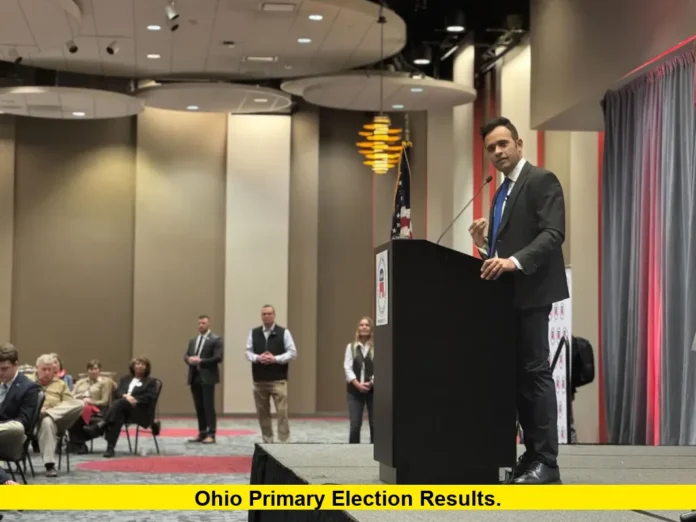

Ohio voters headed to the polls on May 5, casting ballots in one of the most closely watched primary elections the Buckeye State has seen in years. Polls were open from 6:30 a.m. to 7:30 p.m., with Republican and Democratic voters choosing their candidates for the November general election. On the ballot were nominees for governor, U.S. Senate, the U.S. House, the Ohio legislature, the Ohio Supreme Court, and a range of local races. Here is a complete breakdown of the Ohio primary election results.
Vivek Ramaswamy Wins Republican Gubernatorial Primary
The headline result of the night: Vivek Ramaswamy, the biotech billionaire and former presidential candidate, easily won the Republican gubernatorial primary. Incumbent GOP Gov. Mike DeWine is term-limited and cannot seek re-election.
Ramaswamy defeated rival Casey Putsch, an automotive entrepreneur and nonprofit founder, to secure the GOP nomination. A third Republican candidate, Heather Hill, was ruled ineligible after her running mate withdrew from the race before primary day.
Ramaswamy entered the race as the clear frontrunner, having secured endorsements from President Donald Trump, Governor DeWine, and the Ohio Republican Party as far back as May 2025. Before launching his gubernatorial campaign, he briefly served as co-chair of the Department of Government Efficiency (DOGE) alongside Elon Musk.
At his victory celebration, Ramaswamy told supporters: “I’m proud to officially say that today it is our pleasure to become the Republican nominee for the governor of Ohio.” He pledged to focus on lagging population growth, a looming energy shortage, and gaps in educational achievement.
His running mate for Lieutenant Governor is Robert A. McColley, President of the Ohio Senate.
The Democratic Nominee: Dr. Amy Acton
On the Democratic side, Dr. Amy Acton — a physician and researcher who served as Ohio’s state health director under Governor DeWine during the COVID-19 pandemic — ran unopposed and is the confirmed Democratic nominee for governor.
Ramaswamy and Acton will face off in November’s general election. Despite Ohio trending heavily Republican in recent cycles, polls suggest the race will be surprisingly competitive. Democrats have not won a gubernatorial election in Ohio since 2006. The winner will be inaugurated on January 11, 2027.
Sherrod Brown Wins Democratic Senate Nomination
In the other marquee race of the evening, former U.S. Senator Sherrod Brown won the Democratic nomination in Ohio’s special Senate election, setting up a high-profile general election matchup against Republican incumbent Jon Husted.
Brown, 73, defeated political newcomer and software consultant Ron Kincaid in the Democratic primary. The win marks the first step in Brown’s political comeback after losing his Senate seat in 2024 to Republican Bernie Moreno, who had been backed by President Trump.
Democrats view Brown as their strongest possible candidate to reclaim the seat in a state that leans Republican at the federal level. As of mid-April, Brown’s campaign reported $17 million in the bank — more than double Husted’s $8.1 million — signaling an aggressive general election push.
Jon Husted Runs Unopposed in GOP Senate Primary
On the Republican side, Senator Jon Husted ran unopposed in the GOP primary. Husted, the former Ohio Lieutenant Governor, was appointed to the Senate by Governor DeWine after Vice President JD Vance vacated the seat upon assuming the vice presidency in January 2025. Trump endorsed Husted, effectively clearing the Republican field of any primary challengers.
Husted will now face Brown in what is expected to be one of the most expensive and closely watched Senate races in the country this fall. It is also the first U.S. Senate special election in Ohio since 1954.
Congressional Races: Key Results
Eric Conroy won the Republican primary for Ohio’s 1st Congressional District, advancing to the November general election.
Several incumbents ran unopposed through their respective primaries. Incumbent Bob Latta advanced unchallenged in Ohio’s 5th Congressional District, and incumbent Troy Balderson did the same in Ohio’s 12th Congressional District. Cleophus Dulaney ran unopposed on the Republican side in Ohio’s 3rd Congressional District.
Attorney General, Treasurer, and Other Statewide Races
Down the ballot, Keith Faber ran unopposed as the Republican candidate for Ohio Attorney General. On the Democratic side, Seth Walsh advanced as the party’s candidate for Ohio Treasurer of State.
Incumbent Jennifer Brunner ran unopposed in the Democratic primary for the Ohio Supreme Court, securing her spot on the November ballot.
State legislative primaries also concluded across Ohio, with several incumbents advancing without opposition in both chambers.
What’s at Stake in November
Ohio’s November general election is shaping up to be a major national battleground. Republicans currently control all statewide offices, hold majorities in both chambers of the Ohio legislature, and hold both U.S. Senate seats. Trump carried the state by 11 points in the 2024 presidential election.
Yet the governor’s race between Ramaswamy and Acton, along with the Senate showdown between Husted and Brown, are expected to draw enormous national attention, massive outside spending, and could signal the broader mood of the country heading into the midterm cycle.
The general election is scheduled for November 3.