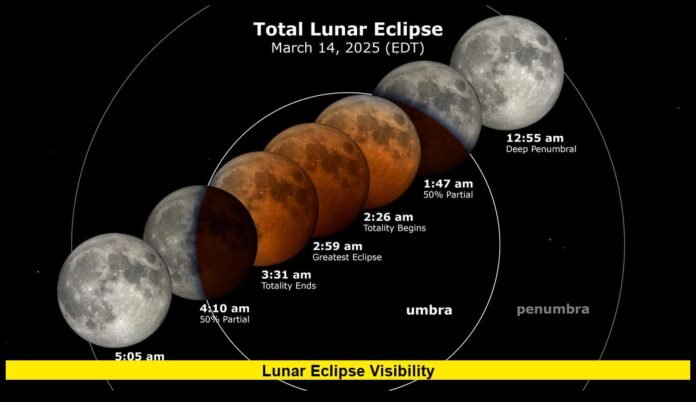

Near total lunar eclipse visibility will be a major skywatching opportunity across much of the United States on August 27–28, 2026. The event is officially a deep partial lunar eclipse, with 96.3% of the Moon’s disk entering Earth’s darkest shadow at maximum eclipse. NASA says the deepest stage occurs at 4:13 a.m. UTC on August 28.
For U.S. viewers, the eclipse will unfold during the evening of August 27 and after midnight in many locations. The event will look remarkably close to a total lunar eclipse because only a small portion of the Moon remains outside the umbra.
The classification is important. This is not a total lunar eclipse because the entire lunar disk does not enter Earth’s umbra. Instead, it is an exceptionally deep partial eclipse.
That distinction does not make the event less interesting. During the deepest stage, most of the Moon will be immersed in shadow, while the remaining illuminated section creates a dramatic contrast.
Why This Lunar Eclipse Is So Close to Totality
A lunar eclipse occurs when the Moon passes through Earth’s shadow.
Earth produces two main shadow regions during an eclipse. The penumbra is the lighter outer shadow, while the umbra is the darker central region.
The August 2026 eclipse becomes especially impressive when the Moon enters the umbra.
At maximum eclipse, 96.3% of the Moon’s disk will be inside the umbra, according to NASA.
That leaves only a small portion outside the darkest shadow.
Astronomers therefore classify the event as a partial eclipse. The Moon never reaches complete coverage by the umbra.
For casual observers, however, the difference between 96% and 100% coverage can be visually striking. Most of the lunar surface will appear much darker than during a typical partial eclipse.
The eclipsed region can also take on a coppery or reddish appearance. NASA notes that this color can become noticeable after the partial phase gets underway as the remaining bright portion becomes small enough for observers’ eyes to adapt to the darker scene.
When the August 2026 Eclipse Takes Place
The global eclipse begins with the penumbral phase at 1:23:58 a.m. UTC on August 28.
The partial phase begins at 2:33:54 a.m. UTC. Maximum eclipse occurs at 4:12:53 a.m. UTC.
The partial phase ends at 5:51:59 a.m. UTC, followed by the conclusion of the penumbral phase at 7:01:47 a.m. UTC.
The date changes for some observers because the event crosses midnight.
In the Eastern time zone, the penumbral stage starts on August 27. The partial phase begins at 10:33 p.m. EDT.
Maximum eclipse occurs shortly after midnight on August 28.
That makes the event a Thursday-night skywatching opportunity for millions of Americans.
Important eclipse times
| Eclipse stage | UTC | Eastern Time |
|---|---|---|
| Penumbral phase begins | 1:23:58 a.m. Aug. 28 | 9:23:58 p.m. Aug. 27 |
| Partial phase begins | 2:33:54 a.m. Aug. 28 | 10:33:54 p.m. Aug. 27 |
| Maximum eclipse | 4:12:53 a.m. Aug. 28 | 12:12:53 a.m. Aug. 28 |
| Partial phase ends | 5:51:59 a.m. Aug. 28 | 1:51:59 a.m. Aug. 28 |
| Penumbral phase ends | 7:01:47 a.m. Aug. 28 | 3:01:47 a.m. Aug. 28 |
Local times can vary by location, so viewers should check their specific city before planning the observation.
Near Total Lunar Eclipse Visibility Across the United States
Much of the United States has an opportunity to see the deep partial eclipse.
NASA says the deepest part is visible across the Americas, except Alaska and northwestern Canada, as well as western Europe and western Africa.
For the continental United States, the event’s timing is favorable in many areas.
The East Coast gets the deepest portion around midnight. Central states see the event during the late evening and around midnight. Farther west, the eclipse occurs earlier in the evening.
This difference is caused by time zones rather than different astronomical events.
Every location experiences the same eclipse. The local clock simply shows a different time.
Clear skies remain essential. Even the best geographic location cannot provide a good view when clouds cover the Moon.
New York and the Eastern United States
New York is among the locations with excellent visibility.
Local calculations place the beginning of the penumbral phase at 9:23 p.m. EDT on August 27. The partial phase begins at 11:12 p.m. on the same evening in the city-specific timetable, with maximum eclipse at 12:12 a.m. on August 28.
The partial phase continues until about 1:13 a.m., while the penumbral stage ends around 3:01 a.m.
The Moon remains above the horizon during the important stages.
That gives New York observers an opportunity to watch the eclipse develop from its early stages through the deepest point and into the final partial phase.
Washington, D.C., has essentially the same broad timing because it shares the Eastern time zone and is geographically close to New York.
For East Coast observers, the most dramatic part will be around midnight.
Central United States Viewing
Central states also have favorable conditions.
In Tennessee, for example, the penumbral phase begins at 8:23 p.m. CDT on August 27. The partial phase starts at 10:12 p.m., and the partial stage ends shortly after midnight.
The deepest part occurs before midnight in Central Time.
That timing makes the eclipse accessible to people who want to watch the most impressive portion without staying awake into the early morning.
Other Central Time locations will have similar timing, although the Moon’s altitude and local horizon can differ.
An unobstructed eastern or southeastern view can be useful, especially during the earlier portion of the event.
Western U.S. Viewing Conditions
The western United States experiences the eclipse earlier in the evening.
Timeanddate’s eclipse information shows the partial phase beginning at 7:33 p.m. PDT on the West Coast.
That timing can create an important viewing consideration.
Because a full Moon rises around sunset, observers in parts of the western United States may see the Moon relatively low above the eastern horizon when the partial phase begins.
A clear view toward the east can therefore make a significant difference.
Tall buildings, hills, trees and other obstructions may hide the Moon during the first portion of the eclipse.
As the evening progresses, the Moon rises higher and becomes easier to observe.
Alaska and Other Limited-Visibility Areas
Not every part of the United States has the same eclipse experience.
NASA specifically excludes Alaska from the area where the deepest stage is visible.
That means viewers should not assume that every U.S. location will see the same portion of the event.
The visibility map is based on whether the Moon is above the horizon during each stage.
This is one reason local eclipse information matters more than simply knowing the national date.
For any particular city, the key questions are when the Moon is above the horizon and which eclipse stages occur during that time.
Will the Moon Turn Red During the Eclipse?
The Moon can appear coppery, orange or reddish during a deep lunar eclipse.
That color comes from sunlight passing through Earth’s atmosphere before reaching the Moon.
Earth’s atmosphere scatters shorter blue wavelengths more effectively. Some of the longer red and orange wavelengths pass through the atmosphere and can be redirected toward the lunar surface.
The result can be a warm color across the portion of the Moon inside Earth’s umbra.
The August 2026 eclipse will not produce a completely red lunar disk because it does not reach totality.
Instead, observers can see a reddish or copper-colored region covering most of the Moon, while a narrow portion remains brighter.
NASA specifically notes that the coppery appearance can become visible during the partial phase as the illuminated portion becomes small.
Atmospheric conditions can affect the exact shade.
What the Eclipse Will Look Like at Maximum
Maximum eclipse is the moment when the largest percentage of the Moon is inside Earth’s umbra.
For the August event, that percentage reaches 96.3%.
The Moon will therefore look dramatically different from an ordinary full Moon.
Only a small section remains outside the umbra. The rest of the lunar surface will sit inside Earth’s darkest shadow.
The curved boundary of the shadow will also be visible.
That curved edge is one of the easiest features to recognize during the partial phase. It gradually moves across the lunar disk as the eclipse progresses.
The transformation happens slowly, giving observers plenty of time to compare the Moon’s appearance before, during and after maximum eclipse.
Is Special Equipment Required?
No special equipment is required to safely watch a lunar eclipse.
The Moon can be viewed directly with the naked eye.
Binoculars can make the transition between the bright and dark portions easier to see. A telescope can provide an even closer view of the lunar surface and the moving shadow.
A camera can also capture the event.
For photography, a tripod can help reduce movement. Smartphone cameras may require manual exposure adjustments because the bright portion of the Moon and the much darker eclipsed region can challenge automatic settings.
Unlike a solar eclipse, a lunar eclipse does not require special protective glasses.
Viewers can safely watch the Moon throughout the entire event.
How Weather Affects Eclipse Viewing
Weather will determine whether an individual observer gets a clear view.
The astronomical timing is predictable, but cloud cover can change quickly.
A cloudy sky can hide the Moon completely during the most important portion of the eclipse.
For that reason, checking the local forecast before August 27 is important. Forecasts become more useful as the event approaches.
If clouds are expected in one area, viewers may consider another nearby location with better conditions.
A location with an unobstructed horizon is especially valuable in areas where the Moon is low in the sky.
Light pollution is less of a problem for lunar eclipses than for faint stars and deep-sky objects. The Moon remains bright enough to observe from most cities.
Why This Is Not a Total Lunar Eclipse
The most important terminology point is simple: this is a partial lunar eclipse.
A total lunar eclipse requires the entire lunar disk to enter Earth’s umbra.
During the August 2026 event, the Moon passes very deeply into the umbra, but a small section remains outside it.
The eclipse magnitude is about 0.930, meaning Earth’s umbra covers 93% of the Moon’s diameter at the maximum point. The percentage of the Moon’s area inside the umbra is about 96%.
This explains why descriptions can use different percentages without contradicting one another.
One number describes the fraction of the Moon’s diameter covered by the umbra. The other describes the portion of the lunar disk’s area inside the shadow.
For everyday skywatching, the important point is that approximately 96% of the Moon’s disk will be immersed in the umbra.
Where Around the World Will It Be Visible?
The eclipse has a broad international visibility region.
NASA lists the Americas, Europe and Africa among the areas where the August 27–28 partial lunar eclipse can be seen. Its future-eclipse information also lists Western Asia within the broader visibility region.
Not every location sees the full sequence.
The Moon may rise after the eclipse has already started. In other areas, it may set before the final stages.
The exact experience therefore depends on local geography and time.
For U.S. observers, much of the continental country has favorable opportunities to watch the deepest portion.
How Long Will the Event Last?
The complete eclipse sequence lasts several hours.
In New York, for example, the event begins with the penumbral phase at 9:23 p.m. EDT and concludes at 3:01 a.m. EDT.
However, the most obvious part is the partial phase.
The penumbral phase can be difficult to notice because Earth blocks only part of the sunlight reaching the Moon during that stage.
Once the Moon begins entering the umbra, the visual change becomes much more apparent.
Observers who have limited time should prioritize the partial phase and maximum eclipse.
What Makes the August Eclipse Worth Watching?
The depth is the biggest reason.
A 96% partial eclipse comes unusually close to totality without actually reaching it.
That creates a distinctive appearance. Most of the Moon enters Earth’s umbra, but a narrow bright section survives.
The event also occurs at convenient times for large portions of the United States.
East Coast viewers can watch maximum near midnight. Central Time viewers see it before midnight, while West Coast viewers can observe the deepest phase during the evening.
That combination of depth and timing makes this one of the most notable lunar viewing opportunities of 2026 for U.S. observers.
What Comes After the August 2026 Eclipse?
The August event is not the final lunar eclipse listed for 2026, but it is the last lunar eclipse of the year.
NASA’s future eclipse schedule lists the next lunar eclipse for February 20–21, 2027. That event will be penumbral rather than partial or total.
A penumbral eclipse is much subtler because the Moon passes through Earth’s outer shadow instead of entering the central umbra.
That makes the August 2026 event particularly noteworthy for people looking for a dramatic lunar eclipse.
It offers a much stronger visual effect than a typical penumbral event.
Best Strategy for Watching the Eclipse
The best approach is straightforward.
Choose a location with an unobstructed view of the Moon. Check the local timetable. Then go outside before the partial phase begins.
Watching the Moon before the shadow reaches it provides a useful reference point.
As Earth’s umbra moves across the lunar disk, the change becomes increasingly obvious.
During maximum eclipse, look closely at the small illuminated portion and the darker region surrounding it.
Binoculars can enhance the view, but they are not essential.
If you plan to photograph the eclipse, use a stable surface or tripod and take several exposures. The Moon’s brightness changes substantially during the event, so one camera setting may not work equally well throughout the entire sequence.
Near Total Lunar Eclipse Visibility: The Bottom Line for U.S. Viewers
The August 27–28, 2026 lunar event offers an unusually deep partial eclipse across much of the United States.
NASA calculates that 96.3% of the Moon’s disk will enter Earth’s umbra at maximum. The event remains officially partial because a small portion of the Moon stays outside the central shadow.
The partial phase begins at 10:33 p.m. EDT on August 27, with maximum occurring at about 12:13 a.m. EDT on August 28.
Western observers see the event earlier, while Central and Eastern locations experience the deepest stages later in their local evening.
The Moon can develop a coppery or reddish appearance as most of its surface moves into Earth’s shadow.
No special eye protection is necessary, and the eclipse can be enjoyed without a telescope or other specialized equipment.
Weather and local horizon conditions will ultimately determine the quality of the view.
For Americans searching for near total lunar eclipse visibility, the key date is August 27–28, 2026. The Moon will not completely enter Earth’s umbra, but it will come remarkably close, creating an unusually deep and visually dramatic partial lunar eclipse.
Are you planning to watch this deep lunar eclipse from your part of the United States? Share your viewing plans and keep watching for the latest confirmed eclipse updates.