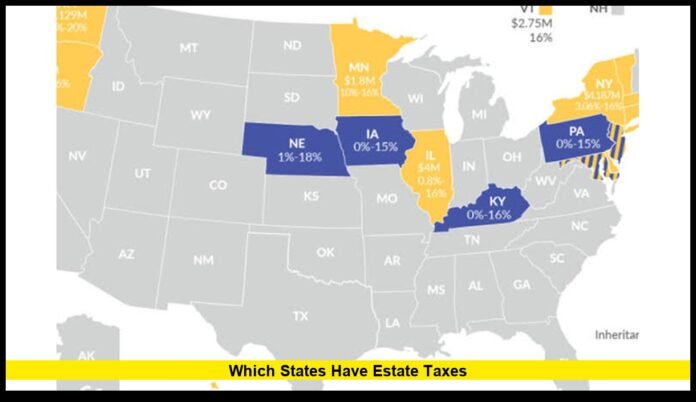

Estate taxes can significantly affect how much wealth a family passes to its heirs. Understanding which states have estate taxes is especially important for people with valuable homes, investment portfolios, retirement assets, and other substantial property. As of the latest available information for 2026, 12 states and the District of Columbia impose a state-level estate tax, while several other states impose a separate inheritance tax.
The distinction matters because estate taxes and inheritance taxes work differently. An estate tax generally applies to the taxable estate before assets pass to beneficiaries. An inheritance tax, by contrast, generally applies to certain assets received by individual beneficiaries. The applicable rules depend on the state, the value of the assets, available exemptions, and the circumstances of the transfer.
For families planning an inheritance, the location of real estate and the deceased person’s legal residence can affect the final tax calculation. State exemptions also differ substantially. An estate that owes no federal estate tax may still face a state estate tax.
This guide explains the states that impose estate taxes in 2026, how their rules differ, which exemptions matter, and what families should understand when preparing an estate plan.
Which 12 States Have an Estate Tax in 2026?
The 12 states that impose an estate tax in 2026 are:
- Connecticut
- Hawaii
- Illinois
- Maine
- Maryland
- Massachusetts
- Minnesota
- New York
- Oregon
- Rhode Island
- Vermont
- Washington
The District of Columbia also imposes an estate tax, bringing the total to 13 U.S. jurisdictions with their own estate taxes.
Each jurisdiction establishes its own exemption and tax rates. Some begin taxing estates valued at $1 million, while others exempt substantially more wealth.
The following table summarizes the principal 2026 exemption amounts and tax rates.
| State or jurisdiction | 2026 estate tax exemption | Tax rate |
|---|---|---|
| Connecticut | $15,000,000 | 12% |
| Hawaii | $5,490,000 | 10%–20% |
| Illinois | $4,000,000 | 0.8%–16% |
| Maine | $7,160,000 | 8%–12% |
| Maryland | $5,000,000 | 0.8%–16% |
| Massachusetts | $2,000,000 | 0.8%–16% |
| Minnesota | $3,000,000 | 13%–16% |
| New York | $7,350,000 | 3.06%–16% |
| Oregon | $1,000,000 | 10%–16% |
| Rhode Island | $1,838,056 | 0.8%–16% |
| Vermont | $5,000,000 | 16% |
| Washington | Approximately $3 million; the applicable inflation adjustment must be verified | 10%–20% |
| District of Columbia | $4,988,400 | 11.2%–16% |
Figures reflect published 2026 tax summaries available as of October 29, 2026. Exact filing requirements, taxable-estate calculations, deductions, and applicable exemption adjustments depend on the jurisdiction and date of death. Washington’s exemption is subject to adjustment, so its precise applicable amount should be confirmed before calculating a tax liability.
Important: An exemption is not necessarily a deduction that works the same way in every state. Some states calculate the tax using graduated brackets, while others apply special rules that can change the final liability. New York, for example, has an estate-tax cliff that can eliminate the exemption when the estate exceeds a specified threshold.
Connecticut Estate Tax
Connecticut has one of the highest estate tax exemptions in the country. For 2026, its exemption is $15 million, matching the federal basic exclusion amount for the year.
The state generally imposes a flat estate tax rate of 12% on taxable amounts above the applicable exemption. Connecticut also has a gift tax, making it important to consider certain lifetime transfers alongside estate planning.
The combined Connecticut estate and gift tax liability is subject to a $15 million cap under current law.
Connecticut’s high exemption means many estates will not owe estate tax. However, families with substantial assets should still consider the value of their property, prior taxable gifts, and applicable filing obligations.
Hawaii Estate Tax
Hawaii imposes an estate tax with a 2026 exemption of $5.49 million. Its tax rates range from 10% to 20%, depending on the taxable estate’s value.
The exemption is substantially lower than the federal exemption. Consequently, an estate may escape federal estate tax while still owing Hawaii estate tax.
Hawaii’s rules can be particularly important for families with valuable residential property, investment holdings, and other significant assets.
Property ownership and residency also matter. A person who lives elsewhere but owns real estate in Hawaii may need to consider whether the property creates a state estate tax obligation.
Illinois Estate Tax
Illinois has a $4 million estate tax exemption and tax rates ranging from 0.8% to 16%.
One important feature of Illinois law is that the state exemption is much lower than the federal exemption. A large estate can therefore face Illinois estate tax even when no federal estate tax is due.
Illinois generally determines whether an estate exceeds its exemption by applying state-specific valuation and deduction rules. The calculation does not simply involve subtracting $4 million from every estate’s gross value.
Families with property, business interests, or substantial investment portfolios should evaluate the potential Illinois tax exposure before distributing assets to beneficiaries.
Maine Estate Tax
Maine’s estate tax exemption for 2026 is $7.16 million. The state applies graduated estate tax rates ranging from 8% to 12%.
Maine’s relatively high exemption protects many estates from state estate tax. However, the exemption remains below the federal threshold.
The value of a person’s taxable estate can include real estate, financial accounts, business interests, and other assets, subject to applicable deductions and exclusions.
People who own property in Maine but live elsewhere should also determine whether state rules apply to their holdings. A nonresident’s estate may face different filing considerations from that of a Maine resident.
Maryland Estate Tax
Maryland is distinctive because it imposes both an estate tax and an inheritance tax.
For 2026, Maryland’s estate tax exemption is $5 million. Its estate tax rates range from 0.8% to 16%.
The inheritance tax operates separately. It generally applies to certain property transferred to beneficiaries who do not qualify for an exemption. The applicable treatment depends on the beneficiary’s relationship to the deceased and the nature of the transfer.
This distinction matters because an estate can have an estate tax obligation, an inheritance tax obligation, both, or neither, depending on the circumstances.
Maryland families should review both taxes rather than assuming that satisfying the estate tax rules resolves every potential tax liability.
Massachusetts Estate Tax
Massachusetts imposes an estate tax on qualifying estates with a $2 million exemption. Its rates range from 0.8% to 16%.
The relatively low threshold makes Massachusetts particularly important for families with valuable homes and retirement savings. Real estate appreciation can increase an estate’s total value even when the owner has not accumulated substantial liquid assets.
The state’s taxable-estate calculation and available deductions determine whether a tax is due. A property’s market value alone does not establish the final tax liability.
People planning to transfer Massachusetts property should assess their potential exposure under state law instead of relying solely on the federal exemption.
Minnesota Estate Tax
Minnesota imposes an estate tax with a $3 million exemption and rates ranging from 13% to 16%.
The state’s exemption is considerably lower than the federal threshold. This difference can expose estates to Minnesota tax even when federal estate tax does not apply.
Minnesota’s estate tax rules can affect families with investment accounts, business ownership, valuable property, and other assets.
The state also has rules concerning certain lifetime gifts and transfers that may affect estate-tax calculations. Individuals should evaluate their full financial circumstances rather than focusing exclusively on the assets held in their names at death.
New York Estate Tax
New York’s 2026 estate tax exemption is $7.35 million, with rates ranging from 3.06% to 16%.
However, New York has an important feature known as the estate-tax cliff.
When a taxable estate exceeds 105% of the applicable basic exclusion amount, the exclusion can disappear under New York’s calculation rules. This can produce a substantially larger tax liability than a simple comparison with the exemption might suggest.
For 2026, 105% of the $7.35 million exemption is $7,717,500.
Estates approaching that threshold require careful calculations. Families should not assume that a small amount above the exemption will result in tax only on the excess.
New York’s rules can also affect nonresidents who own qualifying property in the state. The treatment depends on residency, asset classification, and other applicable provisions.
Oregon Estate Tax
Oregon has the lowest estate tax exemption among the 12 states, at $1 million.
Its estate tax rates range from 10% to 16%. This relatively low threshold makes Oregon an important consideration for homeowners and families whose assets have appreciated over time.
An estate worth more than $1 million does not automatically owe tax on every dollar of its value. The final liability depends on Oregon’s taxable-estate calculation, available deductions, and applicable rate schedule.
Nevertheless, Oregon’s exemption is far below the federal threshold. That difference makes state-specific estate planning particularly relevant for residents with substantial property or financial assets.
Rhode Island Estate Tax
Rhode Island’s 2026 estate tax exemption is $1,838,056, with tax rates ranging from 0.8% to 16%.
The exemption is adjusted for inflation, which means the applicable amount can change over time. Families should verify the threshold for the actual year of death rather than relying on an older estate-planning document or tax estimate.
Rhode Island’s estate tax may affect people whose assets include real estate, investments, and other property. The state also has its own rules for calculating taxable estates and determining filing requirements.
Vermont Estate Tax
Vermont imposes an estate tax with a $5 million exemption and a flat 16% rate.
Because the exemption is lower than the federal threshold, some Vermont estates may owe state tax without owing federal estate tax.
Vermont’s estate tax should be evaluated alongside the value and location of the deceased person’s property. Residency and ownership of property in the state can affect whether the rules apply.
Families should also review applicable deductions and filing deadlines before determining the amount payable.
Washington Estate Tax
Washington imposes an estate tax with rates ranging from 10% to 20%. Its exemption is approximately $3 million, subject to the applicable inflation adjustment and current state rules.
The state exemption is substantially lower than the federal $15 million threshold. As a result, Washington estate tax can apply to estates that remain below the federal estate-tax threshold.
Washington’s tax is particularly relevant to families with valuable homes, investment portfolios, and privately owned businesses. Property appreciation can increase an estate’s value and bring it closer to the state threshold.
Because Washington has adjusted its estate tax rules and exemption amounts, taxpayers should confirm the precise exemption and applicable rate schedule for the relevant year before estimating a liability.
Does the District of Columbia Have an Estate Tax?
Yes. The District of Columbia imposes its own estate tax, separate from the federal estate tax.
For 2026, the District’s estate tax exemption is $4,988,400, and its tax rates range from 11.2% to 16%.
The District’s exemption is considerably lower than the federal threshold. Therefore, an estate may owe District estate tax even when it does not owe federal estate tax.
People who live in Washington, D.C., or own qualifying property there should consider the District’s requirements when evaluating their estate plans. The applicable rules determine whether a return must be filed and whether the estate owes tax.
The District is not a state, but it belongs on any complete list of U.S. jurisdictions that impose estate taxes.
Which States Have an Inheritance Tax Instead of an Estate Tax?
Estate taxes are not the only state-level taxes that can affect an inheritance. Five states impose an inheritance tax: Kentucky, Maryland, Nebraska, New Jersey, and Pennsylvania.
Iowa previously imposed an inheritance tax but eliminated it for deaths occurring on or after January 1, 2025.
Unlike an estate tax, an inheritance tax generally depends on the assets received by an individual beneficiary. The beneficiary’s relationship to the deceased often determines whether the inheritance qualifies for an exemption or a reduced rate.
| State | Inheritance tax status | Key consideration |
|---|---|---|
| Kentucky | Yes | Rates and exemptions depend on the beneficiary’s relationship to the deceased. |
| Maryland | Yes | Maryland also imposes an estate tax. |
| Nebraska | Yes | Tax treatment varies by beneficiary class. |
| New Jersey | Yes | Rates and exemptions depend on the beneficiary category. |
| Pennsylvania | Yes | Tax rates depend on the beneficiary’s relationship to the deceased. |
Some close relatives qualify for favorable treatment, while more distant relatives and unrelated beneficiaries may face higher rates. Spouses generally receive favorable treatment under these states’ inheritance tax laws.
Maryland is the only state that currently imposes both an estate tax and an inheritance tax. Families with connections to Maryland should evaluate both rules separately.
Which States Do Not Have an Estate Tax?
Most states do not impose their own estate tax. The absence of a state estate tax, however, does not mean that every inheritance is free from all taxes.
States without a separate estate tax include:
- Alabama
- Alaska
- Arizona
- Arkansas
- California
- Colorado
- Delaware
- Florida
- Georgia
- Idaho
- Indiana
- Iowa
- Kansas
- Louisiana
- Michigan
- Mississippi
- Missouri
- Montana
- Nebraska
- Nevada
- New Hampshire
- New Jersey
- New Mexico
- North Carolina
- North Dakota
- Ohio
- Oklahoma
- Pennsylvania
- South Carolina
- South Dakota
- Tennessee
- Texas
- Utah
- Virginia
- West Virginia
- Wisconsin
- Wyoming
This list identifies states without a separate estate tax, not states without an inheritance tax. Nebraska, New Jersey, and Pennsylvania, for example, impose inheritance taxes even though they do not impose estate taxes.
Kentucky also has an inheritance tax, and Maryland has both types of tax. Therefore, residents should distinguish between the two categories when assessing their state’s rules.
How Does the Federal Estate Tax Differ From State Estate Taxes?
The federal government imposes an estate tax under its own rules. States establish separate estate taxes where applicable.
For deaths occurring in 2026, the federal estate tax basic exclusion amount is $15 million per person under current law. The federal top marginal estate tax rate is 40%.
State exemptions can be much lower. Oregon’s $1 million threshold and Massachusetts’ $2 million threshold illustrate why families cannot rely solely on the federal exemption.
Consider an estate valued at $3 million. The estate would generally fall below the federal $15 million threshold, but it could exceed the applicable state exemption in Oregon, Massachusetts, Illinois, or other jurisdictions.
That does not mean the estate automatically owes tax in every state listed. Deductions, asset ownership, residency, and other state-specific rules affect the final result.
The key lesson is that federal estate tax eligibility and state estate tax eligibility must be assessed separately.
What Determines Whether an Estate Owes State Tax?
Several factors influence whether a state imposes estate tax on a particular estate.
1. The deceased person’s legal residence
The state where a person was domiciled at death can determine which estate tax rules apply to the estate’s assets.
Domicile generally refers to a person’s permanent legal home, rather than simply the location where the person spent the most recent night.
2. The value of the taxable estate
The estate’s value must be calculated under the relevant state’s rules. Certain deductions and exclusions may reduce the amount subject to tax.
3. The location of real estate
A person who lives in a state without an estate tax may still need to consider estate tax exposure on real estate located in a state that imposes one.
Nonresident estate tax rules differ by jurisdiction, so the property’s location and ownership structure matter.
4. Applicable exemptions and deductions
Each state establishes its own exemption, and some adjust the amount annually. Other provisions can affect deductions, transfers between spouses, and the treatment of certain assets.
5. Filing requirements
An estate may need to file a state return even when the ultimate tax liability is zero. Filing thresholds and deadlines vary.
These factors explain why the estate’s total value alone cannot establish whether a tax return or payment is required.
Can Married Couples Avoid State Estate Taxes?
Married couples may have planning options that help preserve exemptions and manage estate tax exposure. However, the rules vary by state.
Some states allow a surviving spouse to use certain unused exemptions from a deceased spouse. Others have different rules or require particular elections and timely filings.
Couples should also understand the distinction between jointly owned property, assets passing directly to a surviving spouse, and property held in a trust.
The federal estate tax system and individual state systems do not always treat these arrangements identically. A strategy that works under federal law may not produce the same result under state law.
Estate planning documents should therefore account for the rules in the relevant jurisdiction and be reviewed when major tax laws change.
How Can Families Determine Their Estate Tax Exposure?
Families can begin by identifying the states connected to the deceased person’s residence and property ownership.
Next, they should estimate the value of assets that may be included in the taxable estate. These can include real estate, investment accounts, business interests, and other property.
The family should then compare that amount with the relevant state’s exemption and review any deductions, exclusions, or special provisions.
For estates with property in multiple states, the analysis may require additional attention. Each state has its own rules for determining whether a nonresident’s property creates a tax obligation.
Finally, families should confirm filing deadlines and applicable tax rates. A qualified estate-planning attorney or tax professional can help evaluate complicated ownership arrangements and cross-state obligations.
Frequently Asked Questions
1. Which states have estate taxes in 2026?
The 12 states are Connecticut, Hawaii, Illinois, Maine, Maryland, Massachusetts, Minnesota, New York, Oregon, Rhode Island, Vermont, and Washington. The District of Columbia also imposes an estate tax.
2. Which state has the lowest estate tax exemption?
Oregon has the lowest state estate tax exemption among the 12 states, at $1 million for 2026.
3. Which states have both estate taxes and inheritance taxes?
Maryland is the only state that imposes both an estate tax and an inheritance tax.
4. Do states without estate taxes still tax inheritances?
Some do. Kentucky, Maryland, Nebraska, New Jersey, and Pennsylvania impose inheritance taxes. These taxes follow different rules from estate taxes.
5. Can an estate owe state tax but no federal estate tax?
Yes. Many state exemptions are lower than the federal exemption of $15 million for deaths in 2026. An estate may therefore owe state estate tax without owing federal estate tax.
Understanding the differences between state estate taxes, inheritance taxes, and federal rules can help families evaluate their obligations more accurately.
In addition to understanding state estate tax requirements, families may need to know who handles the estate’s affairs. Read our guide on what an executor of an estate is to learn about this important role.
Have you checked how your state’s estate tax rules could affect your family’s inheritance? Share your thoughts in the comments and stay informed about the latest estate tax updates.