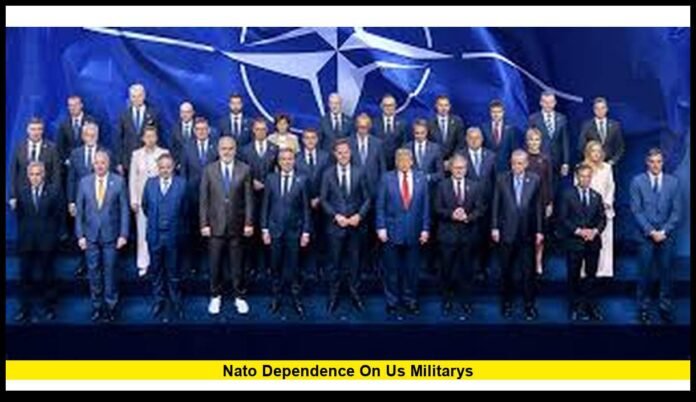

The issue of nato dependence on us military has become one of the defining geopolitical debates of the year as European governments rapidly expand defense spending, rebuild military stockpiles, and prepare for a future where Washington expects allies to shoulder far more responsibility for continental security. Across NATO capitals, leaders now openly acknowledge that Europe can no longer rely indefinitely on overwhelming American military support while global threats continue to grow.
The alliance is undergoing one of the most significant strategic transformations since the end of the Cold War. Russia’s continuing war in Ukraine, rising tensions in the Middle East, expanding Chinese military influence, and political pressure inside the United States have forced NATO members to rethink how the alliance operates. European governments are responding with major investments in troops, weapons systems, missile defense, cyberwarfare, and military manufacturing capacity.
Security analysts say the next decade could fundamentally reshape the balance of military power inside NATO as Europe attempts to reduce its long-standing reliance on Washington without weakening the alliance itself.
Global defense policy is changing faster than many experts predicted, and NATO’s future structure is now at the center of international political debate.
Europe Launches Massive Defense Spending Surge
European NATO members dramatically increased military spending over the past year as governments rushed to strengthen national defense systems. Several countries announced record military budgets, accelerated weapons procurement programs, and expanded troop recruitment campaigns.
Poland has emerged as one of NATO’s most aggressive military spenders. The country continues investing heavily in tanks, missile systems, fighter aircraft, artillery, and troop expansion. Polish leaders have repeatedly argued that NATO allies must move much faster to strengthen deterrence against Russia and prepare for long-term security challenges.
Germany has also undergone a major military transformation. For decades, Berlin faced criticism for underinvesting in defense while depending heavily on American protection. That position has changed dramatically. German officials now support large-scale military modernization programs designed to rebuild combat readiness and expand defense production capacity.
Spain recently increased military spending sharply after years of lagging behind NATO targets. Italy, the Netherlands, and several Nordic nations have also approved new defense investment plans as alliance-wide military spending reaches levels not seen in generations.
Many NATO governments are now discussing long-term defense commitments far beyond the old 2% of GDP benchmark that previously dominated alliance discussions. The debate has shifted toward significantly higher targets as military planners warn that Europe must prepare for prolonged geopolitical instability.
Eastern European countries remain especially vocal about the urgency of military expansion. Nations bordering Russia or located near NATO’s eastern flank continue warning that Europe must move faster to strengthen deterrence capabilities.
Why Europe Still Relies on Washington
Despite the surge in European military investment, NATO continues to depend heavily on the United States in several critical areas.
The U.S. military still provides much of the alliance’s advanced intelligence capabilities, satellite surveillance systems, strategic transport aircraft, missile defense infrastructure, cyberwarfare operations, and nuclear deterrence umbrella. American forces also maintain major troop deployments, military bases, naval operations, and logistics networks throughout Europe.
Military analysts say Europe currently lacks the operational systems required to fully replace American capabilities in a large-scale conflict. Even countries rapidly increasing defense budgets will require years to develop equivalent military infrastructure.
The Ukraine war exposed several weaknesses in Europe’s defense structure. European nations supplied large quantities of military aid and financial assistance to Kyiv, but the United States remained central to intelligence sharing, logistics coordination, advanced air-defense support, and long-range weapons supply.
Many European militaries also face shortages in ammunition stockpiles, missile inventories, transport aircraft, and industrial production capacity. Governments are now investing heavily in rebuilding these capabilities after decades of reduced military focus following the Cold War.
Several NATO members continue purchasing American-made military systems because those platforms already integrate smoothly with alliance command structures. U.S.-manufactured fighter jets, missile defense systems, drones, and armored vehicles remain central to NATO interoperability.
This reality explains why European leaders continue emphasizing that stronger European defense capabilities are meant to complement NATO rather than replace the alliance.
Washington Increases Pressure on Allies
American officials have become increasingly direct in demanding that European allies take more responsibility for regional defense.
The United States has repeatedly argued that Europe possesses the economic strength necessary to support far larger military forces. American policymakers have also questioned why Washington continues carrying such a large share of NATO’s military burden while European nations historically spent less on defense.
Political pressure inside the United States has intensified this debate. Calls for reducing overseas military commitments and prioritizing domestic concerns continue gaining support among segments of the American electorate.
Recent disputes involving troop deployments and transatlantic policy disagreements have heightened concerns inside Europe about long-term American reliability. European governments are increasingly preparing for scenarios in which future U.S. administrations reduce military commitments on the continent.
The possibility of additional American troop reductions in Germany has already triggered new discussions about Europe’s ability to maintain deterrence independently if necessary.
At the same time, NATO leaders continue stressing that the alliance remains the cornerstone of European security. Most European governments do not want a separation from Washington. Instead, they want a stronger European military role within NATO itself.
This delicate balance now shapes nearly every major NATO defense discussion.
Russia’s War Reshaped NATO Strategy
Russia’s invasion of Ukraine fundamentally altered Europe’s security calculations.
Before the conflict, many European governments viewed large-scale war on the continent as unlikely. Defense budgets remained relatively low, military recruitment struggled, and stockpiles declined after years of limited investment.
That changed rapidly after the outbreak of war.
Countries closest to Russia reacted first. Poland, Estonia, Latvia, Lithuania, and Finland moved quickly to expand defense spending and strengthen border security. Finland and Sweden later joined NATO, significantly expanding the alliance’s northern military footprint.
Germany announced one of the largest military investment programs in its postwar history. Britain increased deployments across Eastern Europe. France accelerated weapons production and military modernization plans.
The conflict also forced Europe to reconsider industrial preparedness. Governments realized many countries lacked sufficient ammunition production capacity for prolonged warfare. Defense manufacturers across Europe are now expanding factories and increasing output to replenish military reserves.
The war additionally highlighted NATO’s dependence on rapid logistics coordination and intelligence-sharing systems largely led by the United States.
As a result, European governments are simultaneously trying to strengthen domestic military industries while maintaining close cooperation with Washington.
NATO’s New Spending Era
The alliance’s evolving defense targets are creating political and economic debates across Europe.
Some governments strongly support rapid military expansion, arguing that Europe faces its most dangerous security environment in decades. Others worry about the economic strain of maintaining extremely high defense budgets while managing inflation, public debt, and slower economic growth.
Still, momentum behind military spending remains strong.
Several NATO countries are already spending well above the alliance’s traditional 2% benchmark. Poland has become one of the leading advocates for significantly higher long-term targets and faster implementation timelines.
Military spending growth across Europe has accelerated at a pace not seen since the Cold War era. Defense procurement now dominates political discussions in many NATO countries as governments debate fighter aircraft purchases, missile systems, naval modernization, cybersecurity investment, and drone warfare capabilities.
Defense contractors across Europe and North America are benefiting from surging demand as NATO governments place new orders for tanks, ammunition, missile-defense systems, submarines, and advanced aircraft.
Military planners are also focusing heavily on artificial intelligence, autonomous systems, cyber defense, and space-based surveillance technologies.
These investments reflect growing recognition that future warfare will involve far more than conventional troop deployments.
Can Europe Truly Replace American Military Power?
Many defense experts believe Europe cannot fully replace U.S. military capabilities in the short term.
Building advanced intelligence networks, nuclear deterrence systems, strategic airlift capacity, and integrated command infrastructure requires enormous investment and years of development. The United States currently possesses unmatched global military reach that no single European nation can replicate.
However, European governments are not necessarily trying to duplicate American military power entirely.
Instead, many policymakers want Europe to become strong enough to handle more regional defense responsibilities independently while preserving NATO cooperation with Washington.
This goal has fueled new discussions about joint European weapons programs, coordinated defense procurement, and deeper military cooperation between EU members.
France continues advocating for greater European strategic autonomy, arguing that Europe must possess stronger independent capabilities in an increasingly unpredictable geopolitical environment.
Britain has also begun reassessing its own military dependence on American systems and support structures. Former NATO officials recently warned that excessive reliance on U.S. military capabilities may no longer be sustainable in the long run.
The debate extends beyond troop numbers and weapons purchases. European governments are now discussing industrial resilience, supply-chain security, energy infrastructure protection, and cybersecurity preparedness as part of broader defense planning.
China Is Influencing NATO’s Future
Another major factor driving changes inside NATO is China.
American defense strategy increasingly prioritizes the Indo-Pacific region and long-term competition with Beijing. U.S. military planners want greater flexibility to focus resources on Asia while encouraging Europe to manage more of its own regional security responsibilities.
This strategic shift has become increasingly visible in recent American defense policy discussions.
Washington still considers NATO essential, but U.S. officials increasingly argue that Europe must become capable of defending itself against regional threats with less direct American involvement.
European governments understand this shift. Many now openly discuss preparing for a future in which the United States remains NATO’s most powerful member while playing a somewhat smaller operational role in Europe.
That transition is already influencing defense spending decisions across the alliance.
Military planners in Europe are investing more heavily in rapid deployment forces, long-range strike capabilities, integrated air defense systems, and domestic military manufacturing precisely because they anticipate greater regional responsibility in the years ahead.
NATO Faces a Defining Decade
The alliance remains the most powerful military coalition in the world, but it is entering a period of historic change.
NATO must now adapt to Russian aggression, rising Chinese influence, shifting American priorities, and Europe’s push for stronger military independence all at the same time.
For decades, the alliance relied heavily on overwhelming American military dominance. That structure is beginning to evolve as European governments dramatically increase defense investment and prepare for a larger security role.
The challenge for NATO will be maintaining alliance unity while redistributing military responsibilities more evenly between North America and Europe.
For now, the United States still anchors NATO’s military power. But Europe’s accelerating rearmament efforts show that alliance members are preparing for a future in which European forces play a much larger role in protecting the continent.
How quickly Europe can close the military capability gap with Washington may determine the future shape of NATO for decades to come.