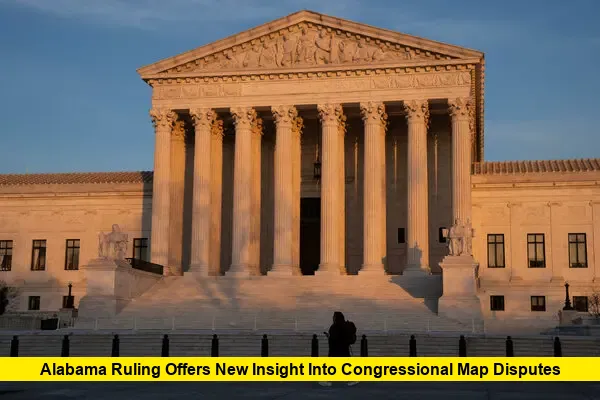

In a dramatic late-night emergency ruling on Tuesday, June 2, 2026, the U.S. Supreme Court’s conservative majority delivered a sweeping decision in the Alabama redistricting case that legal experts say fundamentally curtails the power of federal courts to intervene in congressional district battles. The 6-3 decision cleared the way for Alabama to use a Republican-drawn congressional map that a lower federal court had blocked as intentionally racially discriminatory — offering the nation a stark first glimpse of how redistricting fights will unfold under a significantly weakened Voting Rights Act.
The ruling, part of a case that has stretched across five years of litigation, has sent shockwaves through election law circles and civil rights organizations, with experts warning it could embolden other states to pursue aggressive gerrymandering strategies in the run-up to the 2026 midterm elections.
Background: Years of Legal Battles Over Alabama’s Congressional Map
The 2021 Map and Its Aftermath
The roots of this ruling trace back to 2021, when Alabama’s Republican-controlled legislature redrew its congressional districts following the 2020 census. According to SCOTUSblog, a group of Black voters and civil rights organizations filed suit in federal court, alleging that the new map violated Section 2 of the Voting Rights Act by spreading Black voters in southern Alabama across three congressional districts — leaving them a minority in each — despite Black residents making up roughly 27% of the state’s population.
A three-judge federal district court agreed that the map likely violated Section 2 and barred Alabama from using it. The Supreme Court upheld that lower court decision in 2023 in Allen v. Milligan.
Alabama’s Defiance and Round Two
Rather than comply with the mandate to draw a second majority-Black district, Alabama’s legislature adopted a new 2023 redistricting plan that still contained only one such district. As reported by SCOTUSblog, a federal court again found that the 2023 map likely violated the Voting Rights Act and barred its use. The Supreme Court declined to intervene at that stage. A court-appointed special master ultimately created a remedial map, which the district court ordered into effect. After an 11-day trial in 2025 — with 51 witnesses and nearly 800 exhibits — the district court ruled that Alabama’s 2023 plan was “an intentional effort to dilute Black Alabamians’ voting strength and evade the unambiguous requirements of court orders.”
The June 2026 Ruling: What the Court Decided
A One-Paragraph Order With Major Consequences
In an unsigned, one-paragraph order, the Supreme Court granted Alabama’s emergency appeal and vacated the lower court’s ruling, sending the case back for reconsideration in light of Louisiana v. Callais — the Court’s April 29, 2026 decision that dramatically narrowed the scope of the Voting Rights Act. The justices provided no further written explanation for their decision.
The immediate effect, as noted by Democracy Docket, is that Alabama is now free to use its 2023 gerrymandered map — which eliminates one of the two districts where Black voters had successfully elected a representative of their choice — for upcoming 2026 primary and midterm elections.
The Purcell Principle Inverted
Central to the ruling is the Court’s application of the so-called “Purcell principle” — a legal doctrine holding that courts should avoid changing election rules close to an upcoming election to prevent voter confusion. In a notable twist, the conservative majority invoked Purcell not to protect voters from a last-minute switch, but rather to allow the state to reinstate its blocked Republican map just days before Alabama’s scheduled primary.
According to Democracy Docket, the Court cited concerns that the lower court had erred by “changing election rules close to an upcoming election, risking confusion for voters and election administrators.” Critics, however, argue the Court selectively applied this doctrine. As election law scholar Richard L. Hasen of UCLA noted, per the Election Law Blog, the Court’s willingness to act at “breakneck speed” — combined with the partisan direction of every redistricting ruling — is difficult to characterize as neutral jurisprudence. Hasen observed that it is hard to avoid the impression that the Republican-appointed justices are acting to benefit the Republican Party when every ruling in the election cycle favors Republicans.
The Louisiana v. Callais Connection: A Weakened Voting Rights Act
What Callais Changed
The Alabama ruling cannot be understood without grasping the seismic shift brought about by Louisiana v. Callais, decided April 29, 2026. In a 6-3 majority opinion authored by Justice Samuel Alito and joined by Chief Justice Roberts and Justices Thomas, Gorsuch, Kavanaugh, and Barrett, the Court held that Louisiana’s congressional map — which had been drawn to include a second majority-Black district in compliance with Section 2 orders — was itself an unconstitutional racial gerrymander. The Court ruled that compliance with the Voting Rights Act did not require Louisiana to use race as the predominant basis for redistricting.
As reported by Alabama Reflector, Callais established that racial discrimination with intent does violate Section 2, but redistricting undertaken in the name of partisan advantage does not. Alabama leaned heavily on this ruling in its emergency application, arguing that the lower court’s determination that the state had intentionally discriminated against Black voters could not survive in the post-Callais legal landscape.
Alabama’s Attorney General Celebrates
Alabama Attorney General Steve Marshall, in a statement released on June 2, 2026, called the ruling “a major victory for Alabama and for the principle of self-governance.” According to the Alabama Attorney General’s office, Marshall stated that the Court confirmed “Alabama’s elected representatives, not federal judges, have the primary authority to draw the maps under which Alabamians choose their own leaders.” He framed the ruling as the end of Alabama being treated, in his words, as though it “never moved beyond the 1960s.”
Liberal Justices Dissent: A Stinging Rebuke
All three of the Court’s liberal justices — Sonia Sotomayor, Elena Kagan, and Ketanji Brown Jackson — dissented sharply from the majority’s decision.
Justice Sotomayor, writing for the dissenters, argued there was “no reason” to vacate the lower court ruling because the district court had separately found that Alabama violated the Fourteenth Amendment by intentionally diluting Black voters’ votes — a constitutional finding that is independent of, and unaffected by, the legal questions addressed in Callais, as noted by SCOTUSblog. She further pointed out the practical chaos that the ruling would cause: forcing county elections officials to reassign hundreds of thousands of voters — approximately 600,000 registered voters across three counties — to new congressional districts at a time when voting had already begun.
Sotomayor’s dissent noted that “to switch to the 2023 Redistricting Plan now, county elections officials will have to reassign hundreds of thousands of voters across the State to new congressional districts,” according to Democracy Docket, calling the disruption both avoidable and unjustifiable.
Broader Impact: A Map for Other States
Southern States Scramble
Experts warn that the Alabama ruling is not an isolated outcome. According to NPR’s reporting, the Court’s repudiation of the lower court’s decision is only the latest in a series of cases where it has played a role in reshaping congressional maps in Louisiana, Texas, Virginia, and California. Following the Callais decision in April, several Southern states launched a scramble to roll back redistricting maps that had given minority voters a meaningful voice, seeking to exploit the newly relaxed legal landscape.
Perverse Incentives for State Legislatures
Legal experts have warned that the ruling creates deeply problematic incentives for state legislatures. As reported by NPR, election law scholars now describe a new legal reality in which federal courts cannot interfere with election maps in the period before an election — but if a state wants to make a last-minute change, there is effectively no judicial check. Notre Dame law professor Derek Muller called these “perverse incentives,” warning that states now understand they can make last-minute, potentially unconstitutional changes to maps with limited judicial recourse.
Muller noted that Congress retains the ability to act — for instance, by passing legislation barring redistricting more than a year before an election, or prohibiting the deliberate splitting of heavy concentrations of minority voters across multiple districts.
A New Anti-Canon in Voting Rights Law
The Election Law Blog, citing legal scholars, described the ruling as the latest entry in what it called the Supreme Court’s “voting rights anti-canon” — a line of decisions from Shelby County to Rucho to Brnovich to Callais — that collectively signal the conservative justices’ desire to withdraw federal courts from policing the redistricting process altogether. As one analyst put it, the Court is “affording greater legal weight to Republican lawmakers’ desire to subvert democracy than Black voters’ right to participate in it.”
What Happens Next
The case returns to the lower federal district court, which must now reconsider its findings in light of Callais. However, Justice Sotomayor’s dissent noted that the district court remains free to determine whether Callais has any bearing on its Fourteenth Amendment analysis — meaning the constitutional finding of intentional racial discrimination may yet survive on remand.
In the meantime, Alabama is expected to use the 2023 congressional map for the 2026 midterm elections, restoring a delegation that had included a second Black Democrat to one dominated entirely by Republicans.
Advocates are calling on Congress to pass new voting protections legislation to fill the vacuum left by the Court’s steady dismantling of the 1965 Voting Rights Act. Civil rights organizations have vowed to continue fighting in courts and statehouses alike.
Key Takeaways
- The Supreme Court’s 6-3 emergency ruling on June 2, 2026 cleared the way for Alabama to use a congressional map a lower court found to be intentionally racially discriminatory.
- The decision signals the Court’s intent to sharply limit the power of federal courts to intervene in redistricting disputes.
- The ruling builds on Louisiana v. Callais (April 29, 2026), which significantly narrowed the Voting Rights Act’s protections for minority voters.
- All three liberal justices dissented, calling the ruling legally indefensible and practically chaotic.
- Legal experts warn the decision will encourage other states to aggressively gerrymander congressional maps ahead of the 2026 midterms with diminished fear of federal judicial intervention.
This ruling marks a pivotal turning point in American democracy — share your thoughts below and stay tuned as this story continues to develop ahead of the 2026 midterm elections.