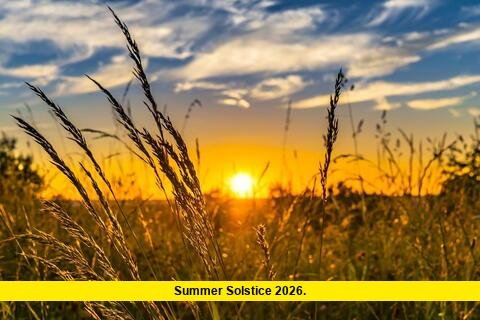

The Summer Solstice 2026 will take place on Sunday, June 21, 2026, marking the official beginning of astronomical summer in the Northern Hemisphere. Known as the longest day and shortest night of the year, this annual event has fascinated cultures, scientists, and skywatchers for centuries.
As millions of people welcome warmer weather, outdoor activities, and longer daylight hours, the summer solstice remains one of the most significant moments in Earth’s yearly journey around the Sun.
What Is the Summer Solstice?
The summer solstice is the moment when the Earth’s Northern Hemisphere is tilted most directly toward the Sun, causing the Sun to reach its highest point in the sky for the year. This astronomical event results in the greatest amount of daylight and the shortest night of the year for locations north of the equator. Although it is often called the “longest day of the year,” the term refers to the length of daylight rather than the total number of hours in the day, which remains 24 hours.
The summer solstice typically occurs on June 20 or June 21 each year in the Northern Hemisphere and marks the official beginning of astronomical summer. During this time, the Sun’s rays strike the Northern Hemisphere more directly, increasing daylight hours and warming temperatures. The farther north a location is, the more noticeable the effect becomes, with some regions near the Arctic Circle experiencing nearly continuous daylight.
At the same time, the Southern Hemisphere is tilted away from the Sun and experiences its winter solstice, the shortest day and longest night of the year. For centuries, cultures around the world have celebrated the summer solstice with festivals, ceremonies, and traditions that honor the Sun, nature, and the arrival of the summer season.
When Is Summer Solstice 2026?
The Summer Solstice 2026 occurs on:
- Date: Sunday, June 21, 2026
- Season: Official start of astronomical summer in the Northern Hemisphere
- Significance: Longest day and shortest night of the year
- Sun’s Position: Highest point in the sky for the year
During the summer solstice, the Earth’s Northern Hemisphere is tilted most directly toward the Sun. This allows locations north of the equator to receive their maximum amount of daylight, making it the brightest day of the year in terms of time between sunrise and sunset.
For many people, the summer solstice represents the beginning of the summer season and has long been celebrated with festivals, cultural traditions, and outdoor events. The farther north a location is, the more dramatic the increase in daylight becomes, with some areas experiencing nearly 24 hours of sunlight.
Although June 21 provides the most daylight, it is usually not the hottest day of the year. This is because the Earth’s land, atmosphere, and oceans continue to absorb and store heat after the solstice. As a result, the warmest temperatures often arrive in July or August, a phenomenon known as seasonal lag.
After June 21, daylight hours gradually begin to decrease each day. However, the change is slow at first, and long summer days continue for several weeks before the approach of autumn becomes noticeable. Meanwhile, the Southern Hemisphere experiences its winter solstice and shortest day of the year.
Why Does the Summer Solstice Happen?
The summer solstice occurs because the Earth is tilted at approximately 23.5 degrees on its axis. As the Earth travels around the Sun throughout the year, this tilt causes different parts of the planet to receive varying amounts of sunlight, creating the seasons.
During the June solstice:
- The Northern Hemisphere leans toward the Sun.
- Sunlight strikes the region more directly.
- Days become longer and nights become shorter.
- The Sun reaches its highest annual position in the midday sky.
- The Northern Hemisphere receives its maximum amount of daylight for the year.
Because the Sun’s rays are more direct during this time, the Northern Hemisphere experiences longer daylight hours and increased solar energy. The effect becomes more noticeable at higher latitudes, where daylight can last for many extra hours compared to winter months.
The summer solstice marks the point at which the Northern Hemisphere is most fully oriented toward the Sun. After this date, the Earth’s position in its orbit continues to change, and daylight hours gradually begin to decrease until the winter solstice in December.
Without the Earth’s 23.5-degree axial tilt, the amount of daylight would remain nearly the same throughout the year. There would be no seasons, no summer or winter solstices, and no dramatic changes in day length. The tilt of the Earth is therefore the primary reason the summer solstice—and the seasonal cycle itself—exists.
How Much Daylight Will There Be?
The amount of daylight on the summer solstice depends on a location’s latitude. In general, places farther north experience much longer days, while locations closer to the equator see relatively little change in day length throughout the year.
On the summer solstice:
- Cities farther north receive significantly more daylight.
- Locations near the equator experience only modest seasonal changes.
- Areas close to the Arctic Circle may have nearly 24 hours of daylight.
- The farther north you travel, the more dramatic the effect becomes.
Examples include:
- Seattle: More than 16 hours of daylight
- New York City: Around 15 hours of daylight
- London: Over 16 hours of daylight
- Northern Scandinavia: Experiences Midnight Sun conditions, where the Sun remains visible late at night or does not set at all
In some parts of Alaska, Canada, Greenland, and northern Scandinavia, the Sun can remain above the horizon for nearly 24 hours during the summer solstice period. This phenomenon occurs because the Northern Hemisphere is tilted most directly toward the Sun at this time of year.
The closer a location is to the Arctic Circle, the longer the daylight period becomes. As a result, the summer solstice creates some of the most extended daylight hours and most spectacular evening skies of the year.
Historical Significance of the Summer Solstice
The summer solstice has been observed and celebrated for thousands of years by civilizations around the world. Long before modern calendars existed, people carefully tracked the Sun’s movements to understand seasonal changes and plan important agricultural activities.
For many ancient societies, the summer solstice marked:
- The arrival of the summer season
- Important planting and harvesting periods
- Religious and spiritual ceremonies
- Community festivals and celebrations
- A way to measure the passage of time
Because agriculture depended heavily on predictable seasonal patterns, understanding the Sun’s annual cycle was essential for survival. As a result, many cultures developed sophisticated astronomical knowledge and built monuments aligned with key solar events.
Some of the world’s most famous solstice-related sites include:
- Stonehenge
- Newgrange
- Chichén Itzá
- Ancient solar observatories found throughout Europe, Asia, and the Americas
These remarkable sites demonstrate the advanced understanding of astronomy possessed by early civilizations. Many were carefully designed so that sunlight would align with specific structures during solstices or other significant dates.
Today, these historic locations continue to attract visitors from around the world. Thousands gather each year to watch the sunrise, participate in cultural traditions, and celebrate the arrival of summer, keeping alive customs that have endured for generations.
Summer Solstice Traditions Around the World
Different cultures celebrate the summer solstice in unique ways, blending ancient customs with modern festivities. While traditions vary from region to region, many focus on honoring the Sun, welcoming summer, and bringing communities together.
Stonehenge Gatherings
Thousands of people travel to Stonehenge each year to witness the sunrise on the summer solstice. The monument’s alignment with the rising Sun creates one of the world’s most famous solstice events, attracting visitors, historians, spiritual groups, and photographers from around the globe.
Midsummer Festivals
Many Northern European countries celebrate Midsummer, one of the region’s most cherished seasonal traditions. Common activities include:
- Music and dancing
- Flower crown making
- Traditional foods and feasts
- Community gatherings
- Outdoor games and celebrations
These festivals are especially popular in countries such as Sweden, Finland, and Norway, where long daylight hours are a defining feature of summer.
Bonfire Celebrations
Bonfires have been associated with solstice celebrations for centuries and often symbolize the strength, warmth, and life-giving power of the Sun.
Traditional bonfire events may include:
- Community gatherings
- Folk music and dancing
- Storytelling and cultural ceremonies
- Evening festivities under the extended daylight
Many communities across Europe and other parts of the world continue these traditions today.
Nature and Wellness Activities
Modern solstice celebrations often focus on spending time outdoors and appreciating nature. Popular activities include:
- Sunrise yoga sessions
- Hiking and nature walks
- Outdoor festivals
- Community picnics
- Meditation and wellness events
- Camping and stargazing
These activities embrace the year’s longest day and encourage people to enjoy the extra daylight while reconnecting with nature and the changing seasons.
Scientific Importance of the Summer Solstice
The summer solstice is more than a cultural celebration—it is one of the most important astronomical events of the year. It marks the moment when the Earth’s Northern Hemisphere is tilted most directly toward the Sun, resulting in the longest day and shortest night of the year.
Scientists use solstices and equinoxes to track seasonal changes and better understand the relationship between the Earth and the Sun. These events provide valuable insights into how the planet’s axial tilt affects daylight, temperature patterns, and seasonal transitions.
The summer solstice helps scientists study and explain:
- Earth’s orbit around the Sun
- The causes of seasonal cycles
- Solar positioning throughout the year
- Daylight distribution across different latitudes
- Climate and weather variations
- Astronomical observations and measurements
The event also demonstrates the effects of the Earth’s 23.5-degree axial tilt, which is responsible for the changing seasons. By observing the solstice, researchers can monitor how sunlight reaches different regions of the planet and how this influences environmental conditions.
In addition, the summer solstice serves as an excellent educational tool. Schools, observatories, museums, and science organizations often use it to teach concepts related to astronomy, geography, and climate science. By observing the Sun’s position and the length of daylight, people can gain a better understanding of the natural processes that shape life on Earth.
As a result, the summer solstice remains both a significant scientific milestone and a valuable opportunity to explore the mechanics of our planet and its place in the solar system.
Common Myths About the Summer Solstice
Myth: It Is the Hottest Day of the Year
Not necessarily. While the solstice receives the most daylight, peak summer temperatures often occur later due to seasonal lag.
Myth: The Sun Is Closest to Earth
The Earth’s distance from the Sun does not cause the seasons. Instead, Earth’s tilt is responsible for seasonal changes.
Myth: The Day Is Exactly the Same Length Everywhere
Daylight duration varies significantly depending on latitude and geographic location.
How to Celebrate Summer Solstice 2026
The Summer Solstice 2026 offers the perfect opportunity to enjoy the year’s longest day and welcome the arrival of summer. Whether you prefer outdoor adventures, relaxation, or learning something new, there are many ways to celebrate this special event.
Consider the following activities:
- Watch the sunrise or sunset to appreciate the extra daylight.
- Spend time outdoors at a park, beach, lake, or nature reserve.
- Host a summer gathering with family and friends.
- Visit a historical landmark associated with solstice traditions.
- Go camping and enjoy a night under the stars.
- Practice yoga or meditation during sunrise or sunset.
- Learn about astronomy and the science behind the solstice.
- Take nature photographs to capture the beauty of the season.
- Enjoy a hike or nature walk in a local scenic area.
- Attend a community festival or outdoor event celebrating summer.
Many people also use the solstice as a time for reflection, setting personal goals, and reconnecting with nature. The extended daylight hours create more opportunities to explore, relax, and appreciate the natural world.
Whether you choose an active adventure or a peaceful moment outdoors, the Summer Solstice 2026 is a great chance to celebrate the changing seasons and make the most of the longest day of the year.
Looking Ahead After the Solstice
Although the Summer Solstice marks the beginning of astronomical summer, many of the season’s warmest and most enjoyable days still lie ahead. In fact, temperatures often continue to rise for weeks after the solstice because the Earth’s land, oceans, and atmosphere gradually absorb and retain heat.
During the weeks and months following the solstice, many people take advantage of the season by:
- Planning family vacations
- Attending summer festivals and community events
- Enjoying outdoor sports and recreational activities
- Visiting beaches, lakes, and national parks
- Going camping and hiking
- Spending more time in nature
Even though daylight begins to decrease after June 21, the change is gradual and often goes unnoticed at first. Long, bright evenings remain a hallmark of summer throughout much of July and August, providing ample opportunities for outdoor activities and travel.
Key dates to remember:
- June 21, 2026: Summer Solstice and longest day of the year
- July–August: Typically the warmest period of summer
- September 22, 2026: Autumnal Equinox, marking the start of astronomical fall in the Northern Hemisphere
As daylight slowly shortens and the seasons progress, summer continues for several months after the solstice. The period between the solstice and the autumn equinox remains one of the most popular times of the year for travel, outdoor adventures, and enjoying the beauty of the natural world.
Final Thoughts
The Summer Solstice 2026 on June 21 represents a remarkable moment in Earth’s annual cycle. As the longest day and shortest night of the year, it combines science, history, culture, and natural beauty into a single event celebrated around the world. Whether you choose to watch the sunrise, attend a festival, or simply spend more time outdoors, the solstice offers a meaningful reminder of our planet’s connection to the Sun.
How do you plan to celebrate the Summer Solstice 2026? Share your thoughts in the comments and stay tuned for more seasonal and astronomy updates!