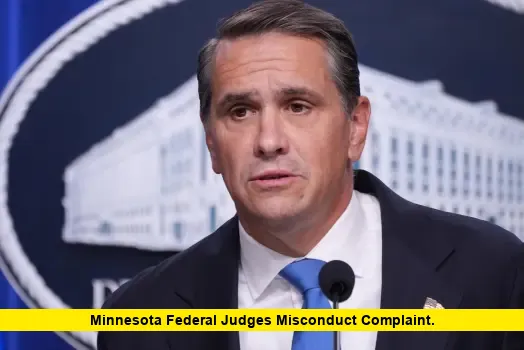

The Justice Department has filed a judicial misconduct complaint involving nearly the entire active federal bench in Minnesota, escalating a dispute over judges’ public comments about the Trump administration’s immigration enforcement operations.
The Minnesota federal judges misconduct complaint was filed September 30, 2026, with the U.S. Court of Appeals for the Eighth Circuit. The complaint names Senior Judge Patrick J. Schiltz and Judge John R. Tunheim and also refers to anonymous district judges from the U.S. District Court for the District of Minnesota.
The action follows interviews that Minnesota federal judges gave to The New York Times concerning the effects of the administration’s immigration enforcement surge, known as Operation Metro Surge. The Justice Department argues that the judges’ comments crossed ethical boundaries because they addressed matters involving pending or related litigation and could create questions about judicial impartiality.
The judges and their representatives have maintained that judges may speak publicly about judicial independence and the rule of law and that their comments were consistent with applicable ethical standards.
What is the Minnesota federal judges misconduct complaint about?
At the center of the dispute is a September 17 New York Times report examining the Minnesota federal judiciary’s experience during the immigration enforcement surge.
Judge Patrick Schiltz, who served as chief judge of the District of Minnesota until June 2026, gave the newspaper an extensive interview. Six other members of Minnesota’s federal bench also spoke with the newspaper. The Times reported that six of the seven judges who held active status in Minnesota during the winter participated.
The Justice Department subsequently argued that the judges improperly discussed matters connected to cases before the federal courts.
The DOJ complaint states that the department considers the conduct particularly serious because judges are expected to maintain impartiality and avoid public statements that could reasonably raise questions about their ability to fairly handle matters involving particular parties or agencies.
Which Minnesota judges are named in the complaint?
The filed complaint specifically identifies Patrick J. Schiltz and John R. Tunheim. It also refers to anonymous district judges.
The Justice Department did not publicly identify every judge covered by its allegations. Reports indicate that the complaint concerns six of the seven Minnesota federal judges who held active status during the period discussed in the New York Times report.
Judge Schiltz is a longtime federal judge who was appointed by President George W. Bush. Judge Tunheim was appointed by President Bill Clinton. Other judges who spoke publicly included judges appointed by presidents from both political parties.
That background is significant because the controversy is not limited to judges appointed by one administration or political party.
Why did the DOJ file the complaint?
The Justice Department says the judges’ comments created an appearance of partiality toward the Department of Homeland Security and immigration defendants.
Attorney General Todd Blanche argued that judges should not publicly comment on pending cases or make political or policy statements concerning matters that have come before them. The department is particularly concerned about comments involving immigration enforcement because DHS regularly appears before the Minnesota federal courts.
The complaint asks the Eighth Circuit to investigate the allegations and seeks recusal of the affected judges from cases involving the Department of Homeland Security.
The filing, however, is an allegation of misconduct, not a judicial finding that misconduct occurred. The judges have not been found to have violated the judicial code merely because the complaint was filed.
What did the Minnesota judges say?
The dispute arose after the judges discussed the extraordinary pressure placed on Minnesota’s federal courts during the immigration enforcement surge.
The New York Times reported that Judge Schiltz described serious concerns about compliance with federal court orders. The article also reported that the Minnesota federal courts handled a large number of habeas corpus petitions filed by detained immigrants.
Judge John Tunheim discussed the government’s immigration arrests and questioned whether the people being arrested fit the administration’s characterization of particularly dangerous offenders.
Judge Nancy E. Brasel, who was appointed by President Donald Trump, also defended the ability of judges to speak about judicial independence.
The judges’ position is that discussing the institutional role of the judiciary is not necessarily the same as improperly commenting on the merits of individual cases.
The dispute over court orders
The background to the complaint includes a conflict between Minnesota federal judges and federal immigration authorities over compliance with court orders.
During the immigration enforcement surge, the Minnesota federal courts received a substantial number of habeas corpus petitions involving detained immigrants. Judges issued orders concerning detention and the handling or release of individuals.
The Justice Department and Department of Homeland Security have disputed characterizations that federal officials intentionally disregarded court orders. Government officials have argued that, in some instances, the underlying requirements of orders were satisfied even when procedural or timing issues created disputes.
The judges’ public comments brought those disagreements into a much broader public debate about the relationship between the federal judiciary and executive branch agencies.
Why is recusal being requested?
The DOJ is asking that judges covered by its complaint recuse themselves from cases involving DHS.
Recusal generally means that a judge steps aside from a particular matter because circumstances could raise a question about impartiality.
The Justice Department argues that public statements about immigration enforcement could cause a reasonable observer to question whether the affected judges can approach DHS-related cases impartially.
The judges’ position, as reported in connection with the dispute, is that speaking about judicial independence does not automatically establish bias against a particular party or agency.
Whether recusal is appropriate is therefore one of the important issues that could emerge as the complaint proceeds.
How does a federal judicial misconduct complaint work?
Federal judicial misconduct complaints are governed by the Judicial Conduct and Disability Act of 1980 and the Rules for Judicial-Conduct and Judicial-Disability Proceedings.
A complaint against a federal district judge is handled through the appropriate federal circuit. Because Minnesota is part of the Eighth Circuit, the complaint was filed with the U.S. Court of Appeals for the Eighth Circuit.
The process does not operate like an ordinary lawsuit. A misconduct complaint is designed to address qualifying conduct by a federal judge rather than to provide another way to appeal a judicial ruling.
The circuit’s chief judge can review the complaint and determine whether it should be dismissed, concluded, or referred for further investigation. In appropriate circumstances, a special committee can be established to investigate the allegations and report to the circuit judicial council.
Depending on the circumstances and findings, the judicial council has several possible options under the federal rules, including dismissal, corrective action, reprimand or other measures authorized by the judicial-conduct system.
Does the complaint mean the judges will lose their positions?
No.
The filing of the Minnesota federal judges misconduct complaint does not automatically remove any judge from office.
Federal district judges appointed under Article III of the Constitution generally hold office during good behavior. The judicial misconduct process can result in various forms of discipline or corrective action, but removal of an Article III judge from office involves the constitutional impeachment process through Congress.
At this stage, the important distinction is between an allegation, an investigation and a final finding.
The Eighth Circuit has not, based on the latest available information, issued a final finding that the judges committed misconduct.
What happens next?
The next stage will involve consideration of the DOJ’s filing under the federal judicial-conduct rules.
The Eighth Circuit’s leadership will have to determine how the complaint should proceed. That could include preliminary review of the allegations and supporting information.
The process may take time because judicial misconduct complaints are governed by formal procedures designed to distinguish legitimate misconduct allegations from complaints that do not meet the statutory requirements.
The final outcome could therefore differ substantially from the allegations contained in the initial DOJ filing.
Why the complaint matters beyond Minnesota
The dispute has broader implications for the relationship between federal judges and the executive branch.
Federal judges routinely avoid public discussion of pending cases because statements outside the courtroom can create questions about impartiality. At the same time, judges and judicial organizations have long recognized the importance of protecting judicial independence and public understanding of the courts.
The Minnesota controversy places those two principles directly against one another.
The Justice Department’s position is that the judges went beyond appropriate discussion of the judiciary and publicly criticized government policies and conduct in a manner that could affect perceptions of impartiality.
The judges’ position is that public discussion of judicial independence and the rule of law can be necessary when the judiciary faces institutional pressure.
The eventual handling of the complaint could provide additional guidance on where federal judicial ethics draw the line between permissible public discussion and prohibited commentary.
Minnesota federal judges misconduct complaint latest update
As of the latest available information, the Justice Department has formally filed the complaint with the Eighth Circuit. Judge Patrick Schiltz and Judge John Tunheim are specifically named, while other judges are referenced anonymously.
The DOJ is seeking an investigation and recusal from DHS-related matters involving the judges covered by its allegations.
There has been no final determination that the judges committed judicial misconduct. The allegations will have to be considered through the federal judicial-conduct process.
The controversy remains closely connected to the larger dispute over immigration enforcement, court orders, judicial independence and the constitutional relationship between the executive and judicial branches.
What readers should watch next
The most important developments will be any response from the Eighth Circuit, further statements from the affected judges, decisions concerning recusal requests and any formal determination under the judicial-conduct process.
Because the complaint was only recently filed, additional procedural decisions could significantly clarify which allegations will be investigated and what consequences, if any, could follow.
The Minnesota judges case is still developing, so share your thoughts below and stay tuned for the latest verified updates.