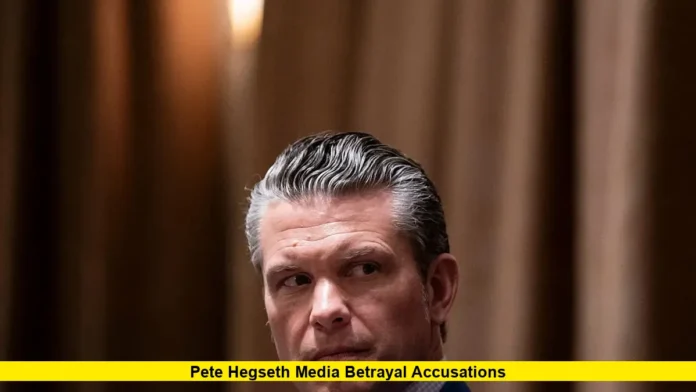

The latest Pete Hegseth media betrayal accusations have put the Defense Secretary’s increasingly confrontational relationship with journalists back in the spotlight. During his latest State of the Force address at Marine Corps Base Quantico in Virginia, Hegseth sharply criticized sections of the U.S. news media and accused some journalists of undermining American troops through their reporting.
Hegseth’s comments came as he outlined a broad series of changes to the U.S. military, including a planned reduction in senior military leadership positions, the creation of a new autonomous warfare command and a new initiative focused on the future of warfare.
His comments about the media, however, quickly became one of the most widely discussed parts of the address.
What Pete Hegseth Said About the Media
During his September 30 State of the Force speech, Hegseth acknowledged that a free press is important but argued that some reporting about the military had crossed a line.
He accused what he described as partisan media activism of intentionally smearing U.S. troops and the military mission. He characterized such reporting as “anti-American” and described it as a “national betrayal” and, more forcefully, “treason.”
Hegseth also criticized reporting concerning the U.S. military’s weapons and ammunition supplies during the ongoing conflict involving Iran.
According to Hegseth, reports about weapons stockpiles and other military issues can reveal information that could potentially benefit America’s adversaries. He argued that inaccurate or misleading reporting could put service members at risk.
The comments represent a significant escalation in the Defense Department’s criticism of journalists and news organizations that have reported negatively on military operations and Pentagon policies.
Why the Media Dispute Has Intensified
The dispute between Hegseth and the Pentagon press corps did not begin with the latest speech.
The Defense Department has faced an extended confrontation with journalists over access to the Pentagon, press credentials and rules governing the gathering and publication of information.
During Hegseth’s tenure, the Pentagon introduced restrictions affecting journalists working inside the building. The changes prompted major news organizations to challenge the department’s policies and raised broader arguments over press freedom, national security and the government’s authority to control access to sensitive military facilities.
More than 30 news organizations previously rejected Pentagon rules that journalists argued placed unacceptable limits on newsgathering. Several major outlets subsequently lost or surrendered their traditional physical presence inside the Pentagon.
The department has argued that the restrictions are necessary to protect classified information and national security.
Critics have argued that broad restrictions can interfere with ordinary journalism, particularly when reporters are investigating government decisions or seeking information from officials.
The Legal Fight Over Pentagon Press Rules
The confrontation has also moved into federal court.
A federal judge ruled in March 2026 that portions of the Pentagon’s restrictions on journalists violated constitutional protections. The ruling focused on First Amendment concerns involving freedom of the press and Fifth Amendment issues.
The Pentagon subsequently revised its media policy while maintaining that it disagreed with parts of the court’s decision and intended to continue pursuing legal remedies.
The legal dispute remains an important part of the larger conflict because it demonstrates that the disagreement is not simply a political argument between Hegseth and individual journalists.
At issue is the balance between legitimate national-security protections and the ability of journalists to independently gather information about the Defense Department.
Hegseth’s Latest Claims About Wartime Reporting
Hegseth’s latest criticism of the media is closely connected to coverage of the war involving Iran.
News organizations have reported on issues including military deployments, weapons availability, operational challenges and the condition of U.S. forces.
Hegseth has repeatedly objected to what he considers overly negative reporting about American military operations.
In his latest address, he argued that journalists sometimes focus on information that could make the military appear weaker while failing to recognize what he views as the successes of U.S. forces.
His criticism is particularly significant because the United States remains involved in active military operations, making accurate information about deployments, weapons and military readiness a matter of public interest as well as national security.
At the same time, claims about classified information or operational security must be distinguished from ordinary reporting based on interviews, public records, observations or other lawful newsgathering methods.
What News Organizations Say About the Restrictions
News organizations and press-freedom advocates have pushed back against the Pentagon’s approach.
Their central argument is that government officials should not be able to determine which reporting is acceptable by threatening journalists with loss of access or credentials.
Press-freedom groups have also argued that journalists routinely ask government employees questions and seek information that officials may prefer not to discuss publicly. They contend that restrictions must be narrowly designed to protect genuinely sensitive information rather than broadly limiting independent reporting.
The Pentagon, meanwhile, has maintained that national security and protection of classified information justify tighter controls.
That disagreement is likely to remain at the center of the ongoing legal and political debate surrounding Hegseth’s relationship with the press.
Hegseth’s Broader Criticism of the Press
The latest accusations are part of a broader pattern in Hegseth’s public comments.
The Defense Secretary has frequently criticized mainstream media coverage of the Pentagon and military operations. He has argued that some journalists approach the military through an ideological or political lens rather than focusing on military effectiveness and the interests of service members.
During the Quantico speech, Hegseth again told troops that they should expect the media to portray them negatively.
His message to service members was that unfavorable coverage should not necessarily be interpreted as evidence that the military’s mission is failing.
That approach has further intensified the debate over whether Hegseth is defending the military against inaccurate reporting or using strong rhetoric to discredit legitimate scrutiny.
What Is Confirmed and What Remains an Accusation?
It is important to separate Hegseth’s statements from independently established facts.
It is confirmed that Hegseth accused portions of the media of engaging in what he called anti-American behavior and described certain reporting as a national betrayal and treason.
It is also established that the Pentagon has implemented significant restrictions affecting journalists and that those restrictions have faced legal challenges.
However, Hegseth’s broader assertion that critical reporting is intentionally designed to harm U.S. troops is an accusation rather than an established fact applying to journalists generally.
Likewise, reporting about weapons supplies, military readiness or operational difficulties cannot automatically be characterized as treason simply because it is critical of government policy. The circumstances surrounding each report, including the source of the information and whether classified information was improperly disclosed, are separate questions.
Why the “Betrayal” Language Matters
The use of words such as “betrayal” and “treason” is significant because those terms carry much stronger implications than ordinary political criticism.
Treason is also a specific constitutional and criminal concept, not simply a synonym for criticism of government officials.
Hegseth used the term rhetorically while attacking media coverage that he believes harms the military. His comments do not by themselves establish that journalists committed the legal offense of treason.
That distinction is important as the debate continues because the public discussion surrounding Hegseth’s comments involves both constitutional press protections and national-security concerns.
The Pentagon’s Changing Relationship With Journalists
The controversy comes during a major transformation in how the Defense Department communicates with the public.
Traditional Pentagon press access has historically allowed reporters to speak with officials, attend briefings and develop relationships with military personnel and civilian employees.
Under Hegseth, the department has pursued tighter control over physical access and information-sharing.
The Pentagon has argued that modern warfare, classified operations and the growing threat of information leaks require a different approach.
Journalists and press-freedom organizations have responded that the government cannot use national security as a blanket justification for restricting legitimate reporting.
The disagreement therefore goes beyond one speech or one Defense Secretary. It raises broader questions about how much access reporters should have to government institutions during wartime.
Hegseth’s State of the Force Speech Included Major Military Changes
The media controversy was only one part of Hegseth’s latest address.
He announced plans for a 20% reduction in the number of generals and admirals across the military. Hegseth presented the reduction as an accountability and organizational reform effort rather than a political purge.
He also announced the creation of an Autonomous Warfare Command, designed to accelerate the military’s development and deployment of autonomous systems, drones and other emerging technologies.
Another major initiative, Project Meridian, is intended to examine the future of warfare and emerging military technologies. Hegseth announced that Elon Musk, Newt Gingrich and Palmer Luckey would help lead the effort.
The speech also included plans involving military bases, energy independence, religious affairs and changes to military culture and personnel policies.
Why the Media Dispute Could Continue
The disagreement between Hegseth and the media is unlikely to disappear quickly.
The Pentagon is still dealing with legal challenges over press-access rules, while journalists continue reporting on U.S. military operations and the Defense Department’s decisions.
As military operations continue, reporting about weapons supplies, deployments, casualties, strategy and battlefield developments is likely to remain a major focus of the news media.
That creates an inherent tension between the government’s responsibility to protect sensitive information and the press’s role in independently scrutinizing government actions.
The latest Pete Hegseth media betrayal accusations therefore represent another chapter in a much larger dispute over national security, press freedom and government transparency.
What to Watch Next
The next developments are likely to involve the continuing legal challenges over Pentagon press policies, further changes to journalist access and Hegseth’s response to reporting about U.S. military operations.
Any new court rulings could affect how reporters interact with Pentagon officials and whether certain restrictions remain in place.
Congressional scrutiny could also become important if lawmakers seek additional information about Pentagon communications policies or the treatment of journalists.
For now, Hegseth’s latest remarks make clear that the relationship between the Defense Department and much of the American news media remains deeply contentious.
The central issue is not simply whether Hegseth likes or dislikes particular news reports. It is whether the government can protect classified information and military operations while still allowing journalists enough independence and access to report on matters of public importance.
As the debate continues, distinguishing verified facts from political accusations will remain essential for understanding what is actually happening at the Pentagon.
What do you think about Pete Hegseth’s latest comments about the media? Share your thoughts below and stay tuned for the latest verified developments.