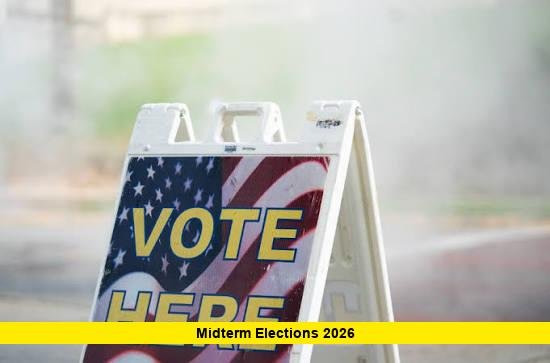

The midterm elections 2026 are entering a critical stage as voters across the United States begin casting ballots in some states ahead of the November 3 general election. The elections will determine the members of the next Congress and could reshape the political balance in Washington for the final two years of President Donald Trump’s current term.
The 2026 election includes every voting seat in the U.S. House of Representatives and 35 Senate seats. Voters in many states will also choose governors, state legislators and other state or local officials.
With the primary season now concluded nationally, attention is shifting toward the general election, early voting, absentee ballots, voter registration deadlines and the competitive congressional contests that will determine the makeup of the 120th Congress.
╔════════════════════════════════════════════════════════════════════╗
║ Key Points Summary ║
║ ║
║ – The midterm elections 2026 general election is scheduled ║
║ for Tuesday, November 3, 2026. ║
║ – All 435 voting seats in the U.S. House and 35 Senate seats ║
║ are scheduled to be on the ballot. ║
║ – Early and absentee voting is already underway in some states. ║
║ – Republicans currently hold 53 Senate seats, while the House ║
║ currently has 218 Republicans, 214 Democrats, one independent ║
║ and two vacancies. ║
║ – State-specific voter registration, early voting and absentee ║
║ ballot rules vary, so voters should check their state election ║
║ office for deadlines and procedures. ║
╚════════════════════════════════════════════════════════════════════╝
When Are the 2026 Midterm Elections?
The federal general election will take place on Tuesday, November 3, 2026. The Federal Election Commission lists November 3 as the next regularly scheduled federal general election date.
Federal law establishes Election Day as the Tuesday following the first Monday in November in even-numbered years. The same election selects members of Congress whose terms begin with the next Congress.
However, November 3 is not necessarily the only day voters can cast their ballots.
Many states offer:
- Early in-person voting
- Absentee voting
- Vote-by-mail
- In-person absentee voting
- Election Day voting
The availability and deadlines for these options differ substantially from state to state.
Early Voting Has Already Started in Some States
The 2026 election voting period is already underway in parts of the country.
Early in-person voting began in Virginia on September 18, while absentee voting has also begun in states including Minnesota and South Dakota. Other states have their own schedules for early voting and mail ballots.
This means voters should not assume that November 3 is the first opportunity to vote.
The exact start date for early voting depends on state law. Voters should check their state or local election authority for information about polling locations, early voting centers, identification requirements and ballot-return deadlines.
How Many Congressional Seats Are Up for Election in 2026?
The 2026 federal elections will decide the membership of the next Congress.
House of Representatives
All 435 voting seats in the House are scheduled for election in 2026. House representatives serve two-year terms, meaning the entire voting membership of the chamber is elected every two years.
As of September 17, 2026, the House had 218 Republicans, 214 Democrats, one independent and two vacancies.
Because all House districts are contested during a midterm election, control of the chamber can change through a relatively small number of competitive races.
Senate
There are 35 Senate elections scheduled for 2026.
The Senate has 100 members serving six-year terms, with roughly one-third of the chamber up for election every two years. The 2026 contests include the regularly scheduled Class II elections as well as two special elections associated with vacancies created earlier in the current Congress.
The Senate’s current party division is 53 Republicans, 45 Democrats and two independents who caucus with Democrats.
The seats being contested include senators from states such as Maine, North Carolina, Georgia, Michigan, New Hampshire, Texas, Alaska, Iowa and Ohio, among many others.
Which Senate Seats Are Being Contested?
The Senate’s Class II seats include 13 Democratic-held seats and 20 Republican-held seats, according to the Senate’s list of senators whose terms expire in January 2027.
Among the senators whose terms are expiring are:
- Cory Booker of New Jersey
- Chris Coons of Delaware
- Dick Durbin of Illinois
- John Hickenlooper of Colorado
- Ben Ray Luján of New Mexico
- Ed Markey of Massachusetts
- Jeff Merkley of Oregon
- Jon Ossoff of Georgia
- Gary Peters of Michigan
- Jack Reed of Rhode Island
- Jeanne Shaheen of New Hampshire
- Tina Smith of Minnesota
- Mark Warner of Virginia
The Republican-held seats include those of Susan Collins of Maine, Thom Tillis of North Carolina, Joni Ernst of Iowa, Mitch McConnell of Kentucky, Steve Daines of Montana, Tommy Tuberville of Alabama and several others.
Several incumbents are not seeking another term, while others lost their party primaries or are facing new general-election opponents. The final candidate field varies by state.
House Races Are Also Under Close Attention
Because every voting House seat is on the ballot, the 2026 congressional election includes hundreds of individual contests.
The House landscape has also been affected by retirements, primary defeats, redistricting and other changes in candidate fields.
A recent Pew Research Center analysis found that 74 House members will not return to the next Congress, representing the largest pre-election House turnover before a general election since 1992.
That turnover creates a significant number of open-seat contests in which voters will choose a new representative rather than deciding whether to return an incumbent.
What Issues Are Shaping the 2026 Election?
The issues discussed by candidates vary by state and district, but several national subjects are prominent in the 2026 campaign.
These include:
Economy and Cost of Living
Household expenses, inflation, energy prices, wages and the broader cost of living remain important campaign issues.
Candidates are presenting different approaches to taxation, government spending, energy policy and economic regulation.
Immigration
Immigration and border policy remain major subjects in congressional campaigns.
Candidates differ over border enforcement, immigration enforcement, legal immigration, asylum policy and the federal government’s role in immigration.
Healthcare
Healthcare costs, insurance coverage, Medicare, Medicaid and prescription drug prices are also part of the national political debate.
Individual congressional candidates may emphasize different proposals depending on their state or district.
Government Spending and Taxes
Federal spending, deficits, taxes and the national debt are additional issues being discussed during the campaign.
Congress elected in November will have a role in legislation affecting federal revenues and expenditures.
Election Administration
Voting rules and election administration have also become prominent political issues.
States maintain substantial responsibility for conducting elections, which means voters encounter different registration requirements, ballot procedures and voting methods depending on where they live.
2026 Midterm Election Primaries Are Complete
The national primary calendar has now reached its final stage, with the last congressional primary contests taking place in September.
The Bipartisan Policy Center identifies the 2026 congressional primary period as running from March 3 through September 15.
Primary elections are important because they determine which candidates advance to the November general election.
However, primary rules differ by state. Some states use closed primaries, while others use open or other primary systems.
Voters should therefore check their state’s rules rather than assuming that the process is the same nationwide.
Who Controls Congress Before the 2026 Election?
The Republican Party currently controls both chambers of Congress.
The Senate has 53 Republicans, 45 Democrats and two independents who caucus with Democrats.
The House’s official September 17 breakdown was:
- 218 Republicans
- 214 Democrats
- 1 independent
- 2 vacancies
That leaves the House closely divided.
The November elections will determine which members serve in the 120th Congress beginning in January 2027.
When Will the New Congress Begin?
The newly elected members of Congress are scheduled to begin the 120th Congress on January 3, 2027, subject to the constitutional and statutory rules governing congressional terms.
This creates a transition period between Election Day in November and the beginning of the new Congress in January.
During that period, election officials certify results and address any recounts, contests or other post-election procedures required under state law.
How Can You Register to Vote in 2026?
Voter registration rules are determined by individual states and territories.
There is no single national voter-registration deadline for the 2026 election. Some states require voters to register weeks before Election Day, while others allow registration closer to Election Day or on Election Day itself.
Vote.gov provides state-by-state information for:
- Registering to vote
- Checking registration status
- Updating an address
- Updating party affiliation where applicable
- Finding state-specific registration information
Voters should verify their registration before voting, particularly if they have recently moved or changed their name.
How Does Absentee or Mail Voting Work?
Absentee and mail-voting rules also differ by state.
Some states automatically send ballots to certain voters, while others require voters to request an absentee ballot. Deadlines for requesting and returning ballots vary.
Military voters and eligible U.S. citizens living overseas have separate federal assistance available for registration and absentee voting.
Anyone planning to vote by mail should allow enough time for the ballot to be requested, received, completed and returned under the applicable state deadline.
What Should Voters Check Before Election Day?
Before voting in the 2026 election, voters may want to verify several pieces of information.
Voter Registration
Check that your registration is active and that your address is correct.
Voting Location
Polling locations can change, particularly after redistricting or local election administration changes.
Congressional District
Redistricting can place voters in a different congressional district than the one they previously lived in.
Ballot Options
Check whether your state offers early voting, absentee voting or vote-by-mail and determine the applicable deadlines.
Identification Requirements
Review your state’s identification rules before going to vote.
Candidate and Ballot Information
Review the official ballot information provided by your state or local election authority.
Redistricting Is Part of the 2026 Election Landscape
Redistricting is another important factor in the 2026 House elections.
Congressional districts can change after redistricting, which means some voters may find themselves in a different district or represented by a different incumbent than in previous elections.
Changes to district boundaries can also affect which communities are grouped together and which candidates appear on the ballot.
Because district maps vary by state, voters should confirm their congressional district using official state election resources.
What Happens After Election Day?
The November 3 election does not necessarily mean that every result will be finalized immediately.
Election officials must count ballots, including eligible absentee and provisional ballots, according to state law. Some states may conduct recounts when required by law or when results fall within specified margins.
The post-election period runs into January, when the new Congress is seated.
The 120th Congress is scheduled to begin on January 3, 2027.
Why the 2026 Midterms Matter for Congress
The congressional elections determine which lawmakers will write and vote on federal legislation during the next two-year congressional term.
The results can affect:
- Congressional leadership
- Committee control
- Legislative priorities
- Federal spending legislation
- Oversight activities
- Confirmation and legislative processes
- The administration’s ability to advance its agenda
The precise consequences depend on the final composition of the House and Senate and on the legislation considered by the new Congress.
Latest Status of the 2026 Midterm Elections
As of September 20, 2026, the primary season has concluded, early voting has begun in some states, and the campaign is moving toward the November 3 general election.
The current congressional balance is Republican-controlled in both chambers, but the November elections will determine the membership of the next Congress. The House currently has 218 Republicans, 214 Democrats, one independent and two vacancies, while the Senate has 53 Republicans, 45 Democrats and two independents who caucus with Democrats.
For voters, the most important immediate steps are checking registration, confirming the congressional district, reviewing the ballot and learning the applicable early-voting or absentee-ballot deadlines in their state.
Because election rules are state-specific, voters should rely on their state or local election authority for the final details of when, where and how they can vote.