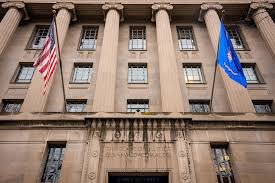

The legal battle over Michigan’s voter registration data has reached a pivotal moment. On June 24, 2026, a federal appeals court handed the Trump administration its most significant defeat yet in its sweeping campaign to obtain unredacted voter rolls from states across the country. Here is a complete breakdown of how this case unfolded and what it means for voters, elections, and privacy rights going forward.
Background: Why the DOJ Wanted Michigan’s Voter Data
According to Democracy Docket, the dispute began in the summer of 2025 when the U.S. Department of Justice sent data demands to more than 40 states and Washington, D.C., requesting copies of sensitive voter registration files. The DOJ’s primary justification was rooting out noncitizen voters — a concern that election experts widely describe as extremely rare.
As per the League of Women Voters of Michigan (LWVMI), the DOJ sent a formal letter on July 21, 2025, to Michigan Secretary of State Jocelyn Benson requesting the current electronic copy of the state’s statewide voter registration list, known as the Qualified Voter File (QVF), along with documentation of Michigan’s compliance with voter list maintenance procedures.
The QVF is not an ordinary public document. According to Votebeat, it contains highly sensitive personal information, including dates of birth, partial Social Security numbers, and driver’s license numbers of every registered voter in the state.
Secretary Benson’s Refusal and the DOJ’s Legal Escalation
Secretary Benson did not comply with the full demand. As per reporting by Votebeat, Michigan provided the public version of its voter file on September 2, 2025, but refused to hand over the unredacted version, citing both privacy concerns and obligations under Michigan Election Law and the state’s Freedom of Information Act.
According to the Michigan Secretary of State’s office, the state argued that turning over the unredacted voter database would breach state and federal privacy protections. Benson’s position was that the DOJ’s interpretation of its legal authority was incorrect.
In response, the DOJ sent a follow-up letter on August 14, 2025, doubling down on its demands and invoking Title III of the Civil Rights Act of 1960 as the legal basis for its request. Michigan again refused.
On September 25, 2025, according to Democracy Docket, the United States filed a formal lawsuit against Michigan and Secretary Benson in the U.S. District Court for the Western District of Michigan. The complaint alleged violations of the National Voter Registration Act (NVRA), the Help America Vote Act (HAVA), and the Civil Rights Act of 1960. The DOJ asked the court to compel Michigan to produce the requested records.
Other States Caught in the Same Fight
Michigan was not alone. According to Raw Story, the DOJ sent similar demands to more than 40 states and ultimately filed lawsuits against 30 of them after most refused to comply. As per Democracy Docket, by the time Michigan’s case reached the appeals court, nine federal district courts had already dismissed similar DOJ suits on the merits — including cases against California, Oregon, Massachusetts, Rhode Island, Arizona, Wisconsin, Maine, and Maryland.
Advocacy Groups Step In: LWVMI and MARA
The case drew immediate intervention from advocacy groups. According to the League of Women Voters of Michigan, the organization filed a motion to intervene in the case on October 30, 2025, arguing that its members’ personal information could be unlawfully shared if the DOJ’s demands were granted. LWVMI also contended that federal collection of personal data could harm its ability to register voters in the future.
Also on September 30, 2025, as per Democracy Docket, the Michigan Alliance for Retired Americans (MARA) and two individuals filed a motion to intervene as defendants. On December 9, 2025, the court denied LWVMI’s motion to intervene but allowed MARA, finding that the two organizations’ interests were effectively identical.
District Court Rules: The Case Is Dismissed
The case took a decisive turn in February 2026. According to Votebeat, U.S. District Court Chief Judge Hala Y. Jarbou — a Trump-appointed judge — dismissed the DOJ’s lawsuit on February 10, 2026. Judge Jarbou found that none of the three federal laws cited by the DOJ — the Civil Rights Act of 1960, the NVRA, or HAVA — legally required Michigan to disclose the unredacted voter registration data.
According to The Hill, Judge Jarbou issued a narrow but clear ruling: the Civil Rights Act of 1960’s “come into possession” language excluded records created by Michigan’s own election officials, as the QVF was built and maintained by the state rather than received from outside parties.
As per Democracy Docket, the DOJ filed its notice of appeal on February 25, 2026, escalating the case to the U.S. Court of Appeals for the Sixth Circuit.
The Historic Sixth Circuit Ruling — June 24, 2026
The most consequential development in the Michigan voter registration data appeal came just yesterday. According to Votebeat, on June 24, 2026, the Sixth Circuit Court of Appeals became the first federal appeals court in the country to rule on the DOJ’s voter roll cases — and it sided firmly with Michigan.
A three-judge panel issued a 2-1 decision upholding the district court’s dismissal. As per The Epoch Times, the majority ruled that Title III of the Civil Rights Act of 1960 does not authorize the DOJ to compel Michigan to hand over its full, unredacted statewide voter registration database.
According to reporting by The Hill, the majority opinion was authored by Judge Andre Mathis, a Biden appointee, joined by Senior Judge R. Guy Cole, a Clinton appointee. Judge John Nalbandian, a Trump first-term appointee, dissented.
What the Court Actually Said
The Sixth Circuit’s majority opinion rested on a straightforward interpretation of language. According to El-Balad’s coverage of the ruling, the court concluded that an ordinary English speaker would not say a person has “come into possession” of something they themselves created, established, and maintained — meaning the QVF, built entirely by Michigan officials, did not meet Title III’s threshold.
As per the majority opinion, the court also noted that the DOJ failed to satisfy Title III’s requirement that the attorney general specify both the “basis” and “purpose” of the data request in a single demand letter. The DOJ had split these across two separate letters, which the majority found legally insufficient.
According to El-Balad, Judge Mathis wrote that the government originally used the power of Title III to ensure that everyone who had the right to vote could freely exercise that right — but that the DOJ was now invoking that same law for an essentially inverse purpose.
The court further warned, as per El-Balad, that if the DOJ’s reading of Title III were accepted, it would place election officials in an impossible position — federal law requires them to regularly update voter rolls, while the DOJ’s interpretation would require those same rolls to be preserved unchanged for 22 months.
Why This Ruling Matters Beyond Michigan
The Sixth Circuit’s ruling carries weight far beyond the borders of Michigan. According to the State Democracy Research Initiative at the University of Wisconsin Law School, Michigan’s case is the first and, so far, only DOJ voter-roll appeal to have been resolved at the appellate level.
As per El-Balad, the ruling is binding precedent in the Sixth Circuit, which also covers Kentucky. That gives the decision immediate force in the DOJ’s pending voter-roll lawsuit in that state, where the same Title III legal theory now faces the same appellate court’s reading.
According to Raw Story, the DOJ still has active lawsuits against more than 20 states, and the Sixth Circuit’s decision hands all of those defendants a powerful new legal weapon to fight back.
Michigan’s Record on Voter Roll Maintenance
Supporters of Benson’s stance have also pointed out that Michigan does not neglect its voter roll maintenance responsibilities. According to the Michigan Secretary of State’s office, since 2019, state and local election officials have removed more than 1.4 million registrations from the Qualified Voter File in compliance with the NVRA.
As per the Michigan SOS, the state ranks among the most active in the nation for removing registrations of deceased voters — placing sixth nationally in 2024 and fifth in both 2022 and 2020, based on data from the U.S. Election Assistance Commission. Michigan also participates in the Electronic Registration Information Center (ERIC), a nonpartisan tool that compares voter files across multiple states.
Secretary Benson has stated, according to the Michigan SOS website, that the DOJ’s claims were not supported by evidence and amounted to partisan attacks aimed at undermining public confidence in Michigan’s secure elections.
What Comes Next: Supreme Court?
With the Sixth Circuit now on the books, the ball is in the DOJ’s court. According to Votebeat, the next step would be to appeal to the U.S. Supreme Court — but DOJ officials did not immediately respond to requests for comment following Wednesday’s ruling.
Even if the Supreme Court agrees to hear the case, according to Votebeat, a resolution that could be meaningfully implemented before the 2026 midterm elections is considered unlikely. Michigan’s primary election is already underway, with absentee ballots beginning to go out as of Thursday, June 25, 2026.
Related battles are ongoing elsewhere. According to the State Democracy Research Initiative at UW Law School, voting rights groups have filed a separate suit — Common Cause v. U.S. Department of Justice — alleging that the DOJ’s effort to collect states’ sensitive voter data violates the federal Privacy Act and the Administrative Procedure Act.
Key Takeaways
- The DOJ began demanding unredacted voter registration data from states in the summer of 2025.
- Michigan’s Secretary of State Jocelyn Benson refused, providing only the public version of the voter file.
- A federal district court dismissed the DOJ’s lawsuit in February 2026.
- The Sixth Circuit Court of Appeals upheld that dismissal in a 2-1 ruling on June 24, 2026.
- The ruling is binding appellate precedent — the first of its kind in the country on this issue.
- The Supreme Court remains a possible next step, though a pre-midterm resolution is unlikely.
- Michigan is regarded as one of the most active states in maintaining accurate and up-to-date voter rolls.
Stay informed and share your thoughts — do you think the DOJ should pursue this case all the way to the Supreme Court? Drop your comment below and bookmark this page for the latest updates.