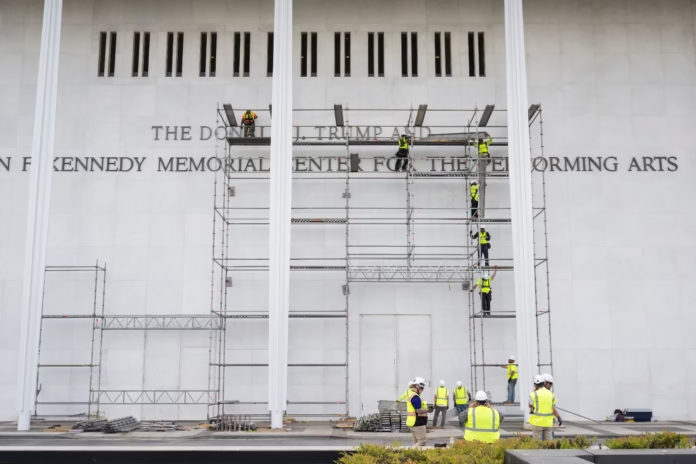

New images show what’s behind the tarp at the Kennedy Center — and for the first time, the public is getting visual confirmation of what has been hidden from view since mid-June 2026. The photos, obtained by CNN and first reported by The Washington Post, reveal the iconic performing arts venue’s facade without President Donald Trump’s name, answering weeks of speculation about whether the court-ordered removal had actually taken place.
How the Photos Were Obtained
The images were acquired and shared by the activist organization “Hands Off the Arts,” whose co-founder Mallory Miller, a former assistant manager of dance programming at the Kennedy Center, confirmed how they came to light. Miller told CNN that the group obtained the photos through its network of community members who had access to the tarp-covered scaffolding area. In sharing them publicly, Miller was direct: the organization wanted the world to see what was hidden behind the covering. As she put it, the tarp was concealing bare marble — and the images revealed exactly that.
The photos confirmed a sworn court declaration filed by Kennedy Center executive director Matt Floca, who stated that all physical signage referring to Trump had been removed from the building and its grounds, including the front portico.
What the Images Reveal
The new images show the Kennedy Center facade stripped of the “Donald J. Trump” lettering that had been affixed to the building after the center’s board voted in late 2025 to rename it the “Trump Kennedy Center.” What remains is bare marble — the original surface of the landmark without any presidential branding. The original designation, “The John F. Kennedy Center for the Performing Arts,” is expected to be restored once the scaffolding and tarp come down.
Trump’s name was officially removed from the facade on June 13, 2026, following a court order issued by U.S. District Judge Christopher R. Cooper. Judge Cooper had ruled in May 2026 that the renaming was unlawful, writing that Congress — not the board of trustees — holds the authority to change the Kennedy Center’s name.
Why the Tarp Is Still There
Despite the confirmed removal, a large tarp has remained draped over the front of the building since the early morning hours of June 13, more than ten days after the name came down. Kennedy Center officials say the covering is necessary while crews address maintenance work involving the marble and soffit panels. The center has not provided a specific timeline for when the tarp will be removed.
Critics, however, have been far less charitable. Attorneys representing Rep. Joyce Beatty, the Ohio Democrat who originally filed the lawsuit against Trump and the Kennedy Center board, have characterized the tarp as a deliberate act of obstruction. In court filings, Beatty’s legal team accused the administration of “willfully sabotaging Kennedy Center’s iconic facade to assuage Defendants’ vanity or massage broken egos,” calling it a “clear breach of fiduciary duty.” Beatty herself described it in court as the administration “still hanging a tarp over the Kennedy Center’s restored facade in petulant defiance.”
The Legal Battle Intensifies
The tarp has now become a focal point of the ongoing litigation. On June 24, 2026, Judge Cooper issued a new order demanding that the Kennedy Center explain the “purpose for and status of the tarp and scaffolding” that remain on the front portico. The judge denied the center’s request for an extension and mandated that a status report be filed within seven days of the center’s July board meeting, or by July 31 at the latest — whichever comes first.
The broader legal battle stretches well beyond the tarp. Judge Cooper previously blocked a Trump administration plan to close the Kennedy Center on July 5, 2026, for what was described as extensive renovation work spanning two years. Beatty’s lawyers argued the closure was an attempt to bypass congressional oversight and effectively dismantle a federally designated “living memorial” to President John F. Kennedy. Court filings from the Kennedy Center have since outlined three possible paths forward: a complete closure with no programming, a partial closure with limited programming, or phased closures while maintaining a full schedule of performances. As of late June 2026, no final decision has been made, and the center says it will present options to its board at the upcoming July meeting.
Beatty’s legal team has pushed back hard on the ambiguity, arguing that the absence of any concrete programming commitment means the Kennedy Center will “have no meaningful operations after July 5, 2026” in violation of the court’s preliminary injunction.
Public Reaction and Growing Scrutiny
Crowds have gathered outside the Kennedy Center in the days since Trump’s name was removed, drawn by the unusual sight of a tarp-covered national landmark. One volunteer tour guide who spent two years welcoming visitors to the venue expressed deep frustration, noting that visitors from across the country and around the world had long been awed by the beauty of the building — and that the current state stood as a stark contrast to that legacy.
The story has drawn significant national media attention, with outlets including CNN, The Washington Post, WUSA9, NPR, CBS News, and Newsweek all covering developments as they unfold. What began as a dispute over naming authority has widened into a high-stakes conflict over governance, transparency, and the future of one of America’s most prominent cultural institutions.
What Comes Next
With a July board meeting on the horizon and a federal judge demanding answers, the coming weeks are likely to bring further developments. The court’s order means the Kennedy Center must not only explain the tarp but also outline concrete steps to keep the venue operational. Judge Cooper has been clear that “meaningful operations” are required to satisfy the preliminary injunction — and that vague filings and extension requests will not be accepted as substitutes for action.
For now, the tarp remains. But thanks to the new images obtained by Hands Off the Arts, the public finally has a glimpse of what lies beneath it: bare marble where a president’s name once stood, and a building still waiting for its full story to be told.
What do you think about what the new images revealed at the Kennedy Center — does the tarp story change how you see this ongoing legal battle? Drop your thoughts in the comments below.