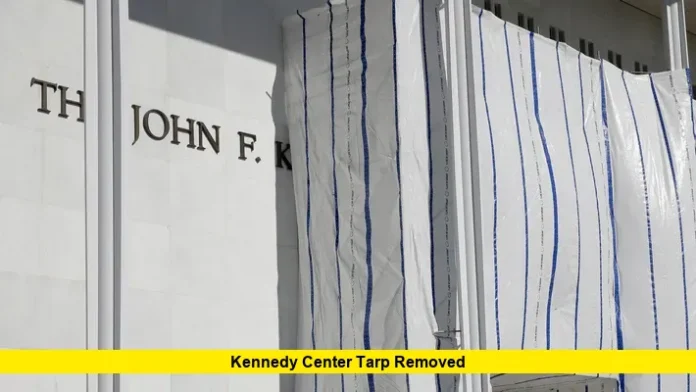

The Kennedy Center tarp removed story has become one of the most closely watched legal and cultural battles of 2026 — a saga involving a federal court order, a defiant administration, leaked photos, and protesters chanting outside a national landmark. As of June 25, 2026, a large tarp continues to conceal the building’s front facade, even though President Donald Trump’s name was officially removed from the structure on June 13. A federal judge is now demanding answers, and the controversy is far from over.
How It Started: The Renaming and the Lawsuit
The drama began late last year when the Kennedy Center’s board of trustees voted to add President Trump’s name to the institution, renaming it “The Donald J. Trump And John F. Kennedy Center for the Performing Arts.” Representative Joyce Beatty, a Democrat from Ohio and an ex officio member of the board, filed a lawsuit arguing that only Congress has the legal authority to rename the institution, which was designated by statute as a living memorial to President John F. Kennedy.
U.S. District Judge Christopher R. Cooper, an Obama appointee serving on the U.S. District Court for the District of Columbia, sided with Beatty. In a sweeping ruling issued on May 29, 2026, Cooper found that renaming the center violated federal law. “The Kennedy Center’s organic statute makes crystal clear that the Center is to be named for President Kennedy,” he wrote, noting that only Congress could authorize a name change. The ruling required all Trump-related signage to be removed within 14 days and also preliminarily blocked a planned two-year closure for a $275 million renovation project that was set to begin on July 5.
The Name Removal and the Tarp
With the court-mandated deadline set for June 12, the Kennedy Center’s leadership slow-walked compliance. After last-minute appeals to keep Trump’s name on the building were rejected by the courts, workers finally began the removal process — but only under the cover of darkness and scaffolding.
Overnight into the morning of June 13, crews erected scaffolding across the front portico of the arts complex and hung large, flame-retardant tarps that completely blocked the public’s view of the facade. The letters spelling out “The Donald J. Trump And” were removed from the building’s sign, leaving behind the original inscription: “The John F. Kennedy Memorial Center for the Performing Arts.” Matt Floca, the center’s executive director and chief operating officer, confirmed in a court filing that all physical signage referencing Trump had been removed from the building and grounds.
But the tarp stayed up. For the thousands of onlookers, protesters, and curious passersby who gathered on the plaza in the days that followed, it was impossible to confirm the removal with their own eyes. The tarp was pulled tightly against the wall, blocking any view of what lay beneath.
Photos Leak, Protests Grow
Nearly ten days after the removal, the activist organization “Hands Off the Arts” obtained photographs taken from inside the tarp-covered scaffolding and provided them to CNN and the Washington Post. The images offered the first visual confirmation that Trump’s name was indeed gone from the facade. Mallory Miller, co-founder of the group and a former assistant manager of dance programming at the Kennedy Center, confirmed the photos came from community members within their network.
The images provided closure for many — but the tarp remained. Weekly protests outside the Kennedy Center grew louder, with demonstrators chanting “Take down the tarp!” Forrest Robinette, a former volunteer tour guide at the center, voiced the sentiment of many in the crowd, telling WUSA9 the covering appeared designed to hide an embarrassing political defeat from public view.
Actor Tommy Gedrich, appearing in the ongoing production of Moulin Rouge! The Musical at the Kennedy Center, cast further doubt on the official explanation for the delay, telling The New York Times that marble preservation does not typically require weeks of coverage. He also noted that the tarps block two backstage entrances, forcing cast members to walk around the building — spanning roughly two football fields — to reach the Opera House stage.
The Official Explanation and the “Broken Egos” Filing
Kennedy Center spokesperson Roma Daravi told CNN that the tarps were being kept in place while crews addressed “maintenance needs of the marble and soffit panels.” Internal renovation documents referenced “decades of deferred maintenance,” including marble deterioration and soffit panels weighing more than 2,000 pounds that have reportedly reached end-of-life status. Officials did not provide a timeline for when the tarp would come down.
Beatty’s legal team challenged this explanation directly. In a court filing submitted June 19, her attorneys described the tarp as effectively “semi-permanent” and argued it appeared designed not to facilitate repairs, but to obscure whether the court’s order had been fully carried out. The filing alleged that “broken egos” within Kennedy Center leadership were driving the decision, and suggested the ongoing cover-up could represent a breach of fiduciary duty to the institution.
Democrats were more blunt. Some characterized the tarp as “a literal cover-up,” accusing the Trump administration of trying to hide what they called an embarrassing legal defeat. Beatty herself described it as “petulant defiance” of previous court orders.
Judge Cooper Steps In Again
On June 24, 2026 — just one day before this writing — Judge Cooper issued a new order requiring the Kennedy Center to formally explain the tarp. In the court’s directive, Cooper demanded that a joint status report be filed within seven days of the Kennedy Center’s mid-July Board of Trustees meeting, or by July 31, whichever comes first. The report must “indicate the purpose for and status of the tarp and scaffolding that Defendants have erected on the front portico of the Center, to the extent they remain at that time.”
The judge simultaneously denied a request from Kennedy Center leadership for an extension on a separate status report covering the center’s programming and operational plans. The Trump administration had also sought to keep Trump’s name on the building pending an appeal, but that request was denied by the appeals court as well.
The Kennedy Center’s Uncertain Future
Beyond the tarp, the Kennedy Center faces a deeply uncertain future. Plummeting ticket sales, mass staff departures through layoffs and resignations, and a wave of artist cancellations tied to the venue’s politicization have left the programming calendar nearly bare. In years past, the center hosted more than 2,000 arts and education events annually. Today, its calendar lists a handful of outdoor movie screenings and children’s workshops.
Floca, who was promoted to president and CEO in March and whose background is in facilities management rather than arts administration, told the court that the board is weighing three options at its mid-July meeting: a complete two-year closure for renovations; a partial closure with limited programming; or phased closures that allow a full performance schedule to continue. The judge has blocked a total closure for now.
Among the center’s remaining scheduled events are Moulin Rouge! The Musical and Bluey’s Big Play, along with the Mark Twain Prize ceremony on June 28 honoring comedian Bill Maher, which will be broadcast on Netflix. A patriotic celebration called The Freedom Gathering is planned for July 3. Beyond these, the calendar is largely empty.
The Washington National Opera, a longtime tenant, has further complicated matters by filing a $17 million lawsuit against the Kennedy Center on June 12.
What Comes Next
The legal case filed by Rep. Beatty continues on two tracks — before Judge Cooper at the district level and before the appeals court — with the Trump administration still contesting the underlying ruling. The July Board of Trustees meeting is expected to be a pivotal moment, with Beatty’s participation as an ex officio trustee now restored by court order. Whether the tarp comes down before then, or whether it remains as a symbol of the ongoing dispute, will depend in part on how Kennedy Center leadership responds to the judge’s latest demand.
For now, the tarp stands — and so does the controversy it represents.
Will the Kennedy Center tarp finally come down before July? Drop your thoughts in the comments and keep checking back for the latest updates on this unfolding story.