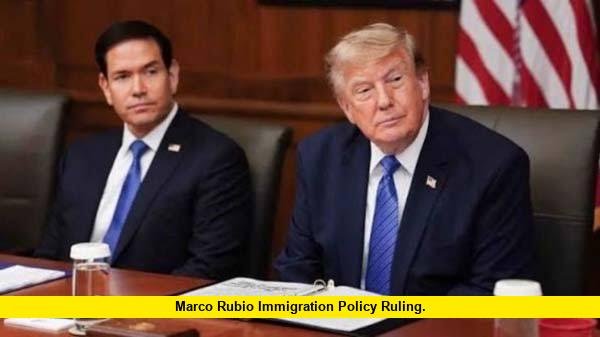

Marco Rubio immigration policy ruling developments have taken a major turn after a federal judge struck down a State Department policy that suspended immigrant visa issuance for nationals of 75 countries. The August 21, 2026 decision found that the policy exceeded Secretary of State Marco Rubio’s statutory authority and conflicted with federal immigration law. A formal judgment followed on August 24, while plaintiffs later asked the court to enforce the ruling after alleging that visa interviews were still being canceled or denied.
What the Federal Court Ruled
U.S. District Judge Jeannette Vargas of the Southern District of New York issued the central ruling on August 21. The case was brought by the Catholic Legal Immigration Network, African Communities Together, affected immigrant visa applicants and U.S. citizens sponsoring relatives.
The lawsuit challenged a State Department announcement issued January 14, 2026. That announcement said immigrant visa issuance for nationals of 75 countries would be suspended beginning January 21.
The administration defended the policy through concerns about applicants potentially becoming dependent on U.S. public assistance. The policy therefore applied broadly to nationals of designated countries rather than relying solely on individual assessments.
Judge Vargas rejected that approach.
The court concluded that the policy was contrary to law and exceeded the authority Congress gave the secretary of state. The ruling therefore vacated the policy under the Administrative Procedure Act.
The court also declared that the policy violated provisions of the Immigration and Nationality Act and related regulations governing immigrant visa issuance.
That finding is important because the ruling was not simply a temporary pause. The court ordered the challenged policy itself to be set aside.
Why the 75-Country Policy Became a Legal Issue
The State Department’s January policy created a nationality-based suspension covering 75 countries.
Rather than evaluating every applicant individually, the policy categorically suspended immigrant visa issuance for nationals of the listed countries.
The plaintiffs argued that this conflicted with federal immigration law, which contains protections against nationality-based discrimination in immigrant visa issuance.
Judge Vargas agreed with the plaintiffs on key portions of the case.
The court specifically concluded that the policy violated 8 U.S.C. § 1201(g), 8 U.S.C. § 1152(a)(1)(A), and 22 C.F.R. § 40.6. It also found that the policy exceeded Rubio’s authority under 8 U.S.C. § 1104(a).
The ruling therefore established a clear legal distinction between individualized visa review and a blanket nationality-based suspension.
The Court’s Order on Visa Refusals
The ruling went beyond stopping the policy going forward.
Judge Vargas ordered that visa refusals based solely on the challenged policy be set aside. Those cases were remanded for further proceedings consistent with the court’s decision.
That means an applicant who was refused solely because the 75-country policy applied to their nationality could not simply remain subject to that policy after the court vacated it.
The State Department must instead process affected cases under applicable immigration law and regulations.
The court’s August 24 judgment formally implemented this portion of the August 21 opinion. It stated that the policy was vacated and that refusals based solely on the policy had to be set aside and remanded.
Which Immigration Policy Was Struck Down?
The ruling specifically concerned the State Department’s suspension of immigrant visa issuance for nationals of 75 countries.
It did not eliminate U.S. immigration law or invalidate every immigration restriction adopted by the Trump administration.
That distinction matters.
The court addressed the legality of this particular policy and its implementation. Other immigration policies remain subject to their own legal standards, statutes, regulations and court proceedings.
The decision also did not automatically guarantee visas to everyone affected.
Applicants must still satisfy the legal requirements for immigrant visas. The court required lawful, individualized consideration rather than automatic refusal under the vacated policy.
The Public Charge Issue at the Center of the Case
The policy arose from the administration’s concern that some immigrants could become dependent on public benefits.
Public-charge considerations can play a role in U.S. immigration law. However, the court found that the State Department could not use that concern as the basis for a categorical suspension covering nationals of 75 countries.
The difference between individual assessment and nationality-based exclusion became central to the case.
Under the policy challenged in court, applicants from designated countries faced a broad suspension before individual circumstances could be evaluated in the ordinary manner.
Judge Vargas concluded that this approach went beyond the secretary of state’s legal authority.
A Separate Case Also Challenged the Public Charge Policy
The August ruling was not the only recent court decision involving Rubio’s immigration policies and public-charge assessments.
On July 31, 2026, U.S. District Judge Amit Mehta of the District of Columbia ruled in a separate case involving a Brazilian EB-5 applicant and his family.
The court declared the State Department’s public-charge policy unlawful as applied to the plaintiffs. It also ordered the government to reconsider the family’s immigrant visa application on an individualized basis.
The order required the application to be re-adjudicated under the Immigration and Nationality Act and applicable regulations.
The decision did not order that the family automatically receive visas. Instead, it required lawful reconsideration of the application.
That distinction mirrors the broader legal issue raised in the New York litigation: immigration officials retain authority to assess eligibility, but they must exercise that authority within the limits established by Congress and federal law.
What Happened After the August 21 Ruling
The legal dispute did not end with the court’s decision.
On August 26, plaintiffs in the New York case filed an emergency motion seeking enforcement and monitoring of the ruling. They alleged that administration officials continued to deny or cancel visa interviews despite the court’s decision vacating the 75-country policy.
This created a new question for the court: whether government implementation of its broader immigrant visa procedures complied with the August 21 judgment.
The plaintiffs’ enforcement request is significant because a court ruling and its practical implementation are separate stages of litigation.
The August 21 judgment clearly vacated the challenged policy. The subsequent enforcement dispute concerns how the government is applying immigration procedures after that ruling.
The State Department Also Paused Immigrant Visa Appointments
Another development has complicated the situation for immigrant visa applicants.
In late August, the Trump administration temporarily paused immigrant visa appointments at U.S. embassies and consulates worldwide while consular officers underwent training connected to new public-charge screening procedures.
The pause affected immigrant visa applicants, including people who already had interviews scheduled.
Reuters reported that the State Department described the training as an effort to improve officers’ ability to identify applicants who could become dependent on public benefits and to promote consistent evaluations.
The pause is separate from the specific 75-country policy struck down by Judge Vargas.
That distinction is important for applicants trying to understand the latest immigration developments.
The federal court invalidated the 75-country suspension. The later worldwide appointment pause involved a separate administrative action concerning consular processing and training.
Why the Ruling Matters for Legal Immigration
The ruling carries broader significance because it reinforces the importance of individualized immigration decisions.
For affected applicants, the immediate issue is whether their applications can proceed without the nationality-based suspension.
For U.S. citizens sponsoring relatives, the decision may also affect family-based immigration cases that were delayed under the policy.
The court’s judgment specifically ordered the government to set aside visa refusals that were based solely on the now-vacated policy.
However, applicants should not interpret the decision as an automatic approval of every delayed or refused visa.
Other statutory grounds for refusal can still apply. Applicants also remain subject to the ordinary requirements for immigrant visa eligibility.
The Role of Marco Rubio in the Litigation
Marco Rubio was named as a defendant in his official capacity as secretary of state.
The lawsuit challenged actions taken by the State Department under his leadership. The court’s ruling therefore directly addressed whether the secretary had sufficient statutory authority to impose the categorical suspension.
Judge Vargas concluded that he did not have that authority for the challenged policy.
The court’s decision stated that the policy exceeded the secretary’s authority under 8 U.S.C. § 1104(a).
The ruling does not mean Rubio personally was found liable for individual immigration decisions. The case concerns official government action and the legal authority used to establish and implement the policy.
What the Ruling Does Not Change
The decision does not end the administration’s broader immigration agenda.
It also does not prevent the State Department from applying lawful immigrant visa requirements or conducting individualized screening.
The court specifically left room for lawful adjudication of individual applications.
Applicants can therefore still face visa refusals for independent legal reasons. The ruling instead removes the challenged categorical suspension as a basis for refusing immigrant visas.
This distinction is especially important because immigration cases often involve multiple statutory requirements.
What Happens Next in the Case
The litigation remains active.
Judge Vargas ordered the parties to submit a joint letter by September 11, 2026, explaining how they propose to proceed with the remaining claims.
The court had already entered partial judgment on key claims while leaving other portions of the litigation unresolved.
The emergency enforcement request filed August 26 adds another immediate issue.
The court may need to determine whether additional action is necessary to ensure that the government follows the August ruling.
As of August 31, 2026, the key confirmed legal position is that the 75-country immigrant visa suspension has been vacated by the Southern District of New York.
What Immigrant Visa Applicants Should Know
People affected by the former policy should distinguish between several different situations.
- Applicants whose cases were refused solely because of the 75-country policy may be entitled to further consideration.
- Applicants who have other grounds for visa refusal are not automatically approved.
- Applicants with canceled or postponed interviews may face separate processing issues.
- The August ruling does not guarantee an immigrant visa.
- The State Department’s later worldwide appointment pause is a separate development.
- Individual applications must still satisfy U.S. immigration requirements.
These distinctions can prevent confusion as the administration and courts continue dealing with overlapping immigration policies.
The Broader Legal Significance
The latest Marco Rubio immigration policy ruling highlights a recurring issue in U.S. immigration law: how far executive agencies can go when Congress has established specific rules for visa issuance.
The federal court found that the State Department crossed that boundary when it imposed a categorical suspension based on nationality.
The judgment also emphasized the importance of individualized adjudication.
That principle could remain important as other immigration policies face legal challenges.
At the same time, the ruling does not settle every dispute involving immigration enforcement, visa processing or public-charge assessments.
Several separate policies and lawsuits remain active.
Latest Status as of August 31, 2026
The most important developments are clear:
| Development | Latest confirmed status |
|---|---|
| 75-country immigrant visa suspension | Vacated by federal court |
| August 21 ruling | Policy declared contrary to law and beyond Rubio’s authority |
| August 24 judgment | Formal partial judgment entered |
| Visa refusals based solely on policy | Set aside and remanded |
| Plaintiffs’ August 26 enforcement request | Pending |
| Worldwide immigrant visa appointment pause | Separate State Department action |
| September 11 court deadline | Parties must propose next steps on remaining claims |
The court’s decision represents a significant judicial limit on the State Department’s use of nationality-based restrictions in immigrant visa processing.
For applicants, however, the practical situation remains fluid because implementation, appointment scheduling and other immigration policies continue to develop.
The central takeaway is straightforward: the federal court has invalidated the specific 75-country suspension, but affected immigrants must still navigate the normal legal requirements and any separate, lawful processing procedures that apply to their cases.
The latest court developments could continue shaping legal immigration policy in the weeks ahead, so share your thoughts below and stay informed as the case moves forward.