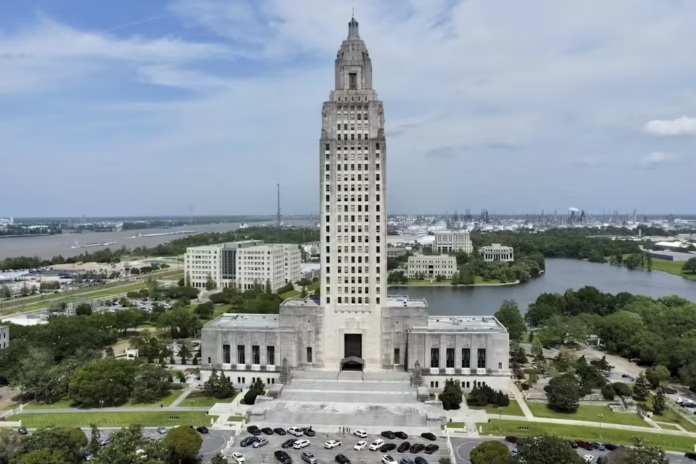

Louisiana’s May 16 primary elections are hanging in the balance after a seismic Supreme Court decision forced Governor Jeff Landry to weigh halting the vote entirely.
In a stunning development that could reshape not only Louisiana politics but the entire national electoral landscape, Governor Jeff Landry is preparing to suspend the state’s upcoming U.S. House primary elections. The move comes just days before early voting was scheduled to begin — and it all stems from one of the most consequential Supreme Court decisions on voting rights in decades.
What Triggered the Primary Suspension?
On April 29, the United States Supreme Court ruled that Louisiana had unlawfully discriminated by race when it created a second majority-Black congressional district — effectively striking down the state’s existing congressional map. The 6-3 decision, written by Justice Samuel Alito, sent shockwaves through the political establishment and forced state leaders into immediate crisis mode.
Governor Landry wasted little time. He privately informed Republican House candidates of his intention to suspend the May 16 primaries so that the state legislature could first pass a new congressional map. His formal announcement was expected as early as Friday, April 30 — just one day before early voting was set to begin — making the disruption to voters all the more jarring given that absentee ballots had already been mailed out.
The Supreme Court’s Callais Decision Explained
The case, known as Louisiana v. Callais, centers on a years-long battle over how Louisiana drew its six congressional districts following the 2020 census.
In its landmark 6-3 ruling, the Court struck down Louisiana’s second majority-Black congressional district and declared that race-conscious redistricting under Section 2 of the Voting Rights Act of 1965 is unconstitutional. The majority held that compliance with Section 2 — as it had been understood for four decades — does not provide a sufficiently compelling interest to justify the use of race in drawing legislative maps.
Justice Alito, writing for the majority, stated that allowing race to play any part in government decision-making departs from the constitutional rule that governs virtually every other context. The ruling was joined by Chief Justice Roberts and Justices Thomas, Gorsuch, Kavanaugh, and Barrett.
Justice Elena Kagan wrote a sharp dissent, accusing the majority of eviscerating the Voting Rights Act and rendering Section 2 all but a dead letter.
Background: How Louisiana Got Here
Louisiana’s redistricting saga has been unfolding for years. The state has six congressional seats, yet prior to 2024, only one district was drawn to give Black voters a meaningful opportunity to elect a candidate of their choice — despite Black residents making up roughly one-third of the state’s population.
After a federal court ruled in 2022 that Louisiana’s original post-census map likely violated the Voting Rights Act, the state legislature was ordered to redraw the map to include a second majority-Black district. That new map, known as SB8, created Louisiana’s 6th Congressional District as the second majority-Black seat and was used in the 2024 elections. But it was immediately challenged by a group of non-Black voters who argued the map constituted an unconstitutional racial gerrymander.
Adding further complexity, Louisiana switched in 2024 from its traditional “jungle primary” system — where all candidates regardless of party compete on a single ballot — to a closed party primary system. This is the first time since 2010 the state has held party-specific primary elections, which is part of why suspending the May 16 date creates such legal and logistical complications.
What Happens Next for Louisiana Elections?
State leaders are now weighing a narrow set of options under intense time pressure.
The state Attorney General confirmed that the legislature has the authority to suspend the current primary dates and reschedule them for later in the year, noting that the actual general election does not take place until November. Legislative leaders indicated they are reviewing the ruling and consulting legal counsel to determine the best path forward.
Senate redistricting committee leadership suggested that existing bills moving through the legislature could be amended to postpone the U.S. House primaries and create a new congressional map before the session ends on June 1. However, the timeline is extremely tight — lawmakers were not scheduled to reconvene until the following week, and early voting was already underway.
Democratic lawmakers raised pointed questions about whether suspending primaries that had already begun would be legally permissible, signaling that any suspension would face immediate court challenges.
Notably, the suspension is expected to affect only the U.S. House races. Elections for the state school board, Louisiana Supreme Court, Public Service Commission positions, and five constitutional amendments on the May 16 ballot are not expected to be delayed.
National Ripple Effects: Other States Are Already Moving
The Callais ruling set off a swift chain reaction nationwide. Republican-led states had been watching the case closely and were prepared to act the moment the decision came down.
Florida’s Republican-controlled legislature approved new congressional maps within hours of the ruling. Mississippi’s Republican governor had pre-emptively announced a special legislative session contingent on the Court ruling in this direction. Alabama’s attorney general pledged to move as quickly as possible to apply the ruling to his state’s own redistricting efforts.
The broader consequences for Congress could be historic. Analysts have estimated that the ruling could help Republicans redraw enough maps to flip nearly 19 majority-minority seats currently held by Democrats. Separate research suggested the decision could result in white candidates winning approximately 15 House seats currently represented by Black members of Congress — a level of racial demographic shift in congressional representation not seen since the end of Reconstruction.
What the Ruling Means for the Voting Rights Act
For civil rights advocates, the Callais decision represents the culmination of decades of steady erosion of the landmark 1965 law.
Section 2 of the Voting Rights Act had served as the primary nationwide protection against discriminatory voting practices ever since the Supreme Court’s 2013 decision in Shelby County v. Holder gutted the Act’s preclearance requirement, which had previously forced states with a history of discrimination to obtain federal approval before changing voting laws. With preclearance gone, Section 2 was the last major enforcement tool available to challenge racially discriminatory maps in court.
The Callais decision has now dramatically narrowed that tool by requiring proof of intentional racial discrimination — a standard Congress never wrote into the law and one that legal experts say is extraordinarily difficult to meet in practice. Civil rights organizations, including the ACLU and the NAACP Legal Defense Fund, called the ruling a devastating blow and vowed to continue fighting for fair representation through whatever legal avenues remain.
Legal scholars have also noted that the ruling, combined with the Court’s 2019 decision allowing partisan gerrymandering to go unchecked, effectively renders all forms of gerrymandering constitutional — closing off both the racial and partisan avenues through which voters could previously seek relief in federal court.
What to Watch
As Louisiana’s May 16 primary date approaches, several developments are expected in rapid succession: a formal gubernatorial announcement suspending the primaries; emergency legislative action to redraw the congressional map; and legal challenges from civil rights groups that are almost certainly already being prepared.
The political and legal battle over who draws America’s electoral maps — and whose voices those maps amplify or silence — has entered a new and deeply uncertain chapter. What happens in Louisiana over the coming days will serve as the first test case for how states navigate the post-Callais redistricting landscape heading into the November midterm elections.
This article reflects the latest developments as of April 30. Check back for updates as the situation continues to evolve.