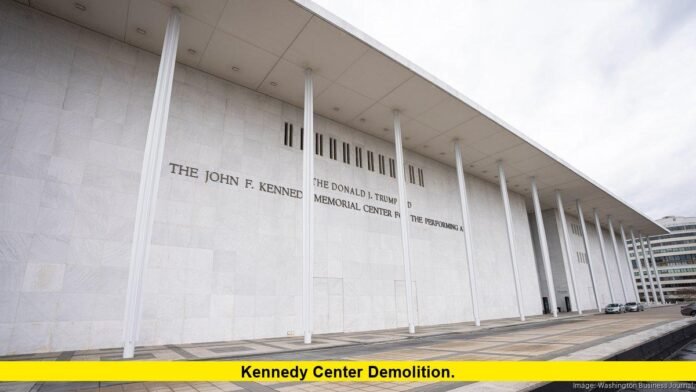

Kennedy Center demolition has become a serious issue in a new federal court filing, with the Trump administration warning that the Washington, D.C., performing arts complex could eventually be taken down if major renovations do not move forward. The warning came as the administration defended a proposed two-year closure and renovation plan while facing a legal challenge over efforts to place President Donald Trump’s name on the building.
The filing does not announce an immediate demolition of the Kennedy Center. Instead, Justice Department lawyers presented demolition as a possible long-term outcome if the facility cannot receive extensive repairs and continues to deteriorate financially and physically.
The development adds another major turn to the ongoing legal dispute surrounding the John F. Kennedy Center for the Performing Arts, its renovation plans, and the Trump administration’s attempts to reshape the landmark.
What the Trump Administration Said About the Kennedy Center
The Justice Department raised the possibility of taking down the Kennedy Center in a court filing submitted as part of the continuing legal battle involving Rep. Joyce Beatty and the administration.
The administration argued that the center needs substantial work to address aging infrastructure and other problems. Without the proposed renovation effort, lawyers said the facility could become unsafe and increasingly difficult to operate.
The filing described a potential future in which the building could deteriorate to the point where it would need to be removed. It also mentioned the possibility of constructing a large outdoor amphitheater overlooking the Potomac River as an alternative use for the site.
That possibility is important because it shows that the administration is not simply discussing cosmetic improvements. The legal filing frames the future of the complex as a choice between major restoration and a potential replacement if the existing building cannot be maintained.
However, there is currently no confirmed plan to demolish the Kennedy Center.
The immediate issue before the court involves the proposed renovation, the building’s closure, and the planned inscription recognizing Trump.
Why Renovations Have Become Central to the Dispute
The Kennedy Center has been the subject of a major renovation proposal that would require the main complex to close for approximately two years.
The board voted in August to proceed with the two-year closure plan. The proposal is intended to allow extensive construction work rather than attempting to keep the facility operating while major projects take place around visitors and performers.
The administration has argued that a comprehensive renovation is necessary because the building has significant maintenance and infrastructure needs.
The project includes work affecting major building systems and public areas. Earlier planning documents and court proceedings have described repairs involving areas such as plumbing, elevators, performance spaces, entrances and other components of the complex.
The administration has also pointed to federal funding secured for capital restoration work. Its court filing said President Trump helped obtain approximately $258 million in congressional funding for renovation-related needs.
The exact future of the renovation remains tied to the legal proceedings.
If the court prevents the proposed closure or blocks parts of the administration’s plan, the dispute could affect how and when the Kennedy Center carries out major construction.
The Kennedy Center Demolition Warning Is Not an Immediate Order
One of the most important facts for readers following the story is the distinction between a demolition warning and an actual demolition decision.
The Trump administration has not ordered workers to tear down the Kennedy Center.
No demolition date has been announced. There is also no confirmed federal plan stating that the building will be demolished if a particular court ruling goes against the administration.
Instead, DOJ lawyers used the possibility of future demolition to argue that preventing the proposed renovation could create serious consequences for the facility.
The argument is essentially that continued deterioration could eventually make the current structure unsafe or financially unsustainable.
That makes the word “demolition” significant in the current legal fight, but it should not be interpreted as evidence that demolition is already scheduled.
For now, the Kennedy Center remains an operating performing arts institution while its future renovation plans are being contested in federal court.
The Dispute Over Donald Trump’s Name
The demolition warning is closely connected to another controversy: the effort to recognize President Trump on the Kennedy Center.
The Kennedy Center was created as a living memorial to President John F. Kennedy. Federal law established the institution and designated it as the national memorial to Kennedy.
Earlier in 2026, a federal judge ruled that the center could not be renamed for Trump without action by Congress. The decision followed the addition of Trump’s name to the building’s exterior.
Workers subsequently removed Trump’s name from the facade after the court ruling. A tarp has remained over the affected section of the building.
The dispute did not end there.
On August 13, the Kennedy Center’s board voted 20-3 on a new proposal involving Trump’s name. Instead of simply restoring the previous wording, the board approved an inscription that would describe the facility as having been “Restored and Renovated By President Donald J. Trump.”
The board also approved the name “President Donald J. Trump Plaza” for the surrounding grounds.
The administration argues that this wording does not formally rename the Kennedy Center. Instead, it describes Trump’s role in the restoration and fundraising effort.
Rep. Joyce Beatty has challenged that position in court.
Why Joyce Beatty Is Challenging the New Plan
Beatty, a Democratic representative from Ohio and a member of the Kennedy Center board by virtue of her congressional position, has challenged the administration’s attempts to place Trump’s name on the institution.
Her legal challenge argues that the new inscription conflicts with the earlier federal court ruling and federal law governing the memorial.
The dispute has therefore moved beyond a disagreement about building improvements. It now involves questions about who has authority to determine how the Kennedy Center is identified and honored.
A federal judge has already ruled that Congress has the authority to change the institution’s statutory name.
The administration maintains that its newest proposal is different because it does not formally change the Kennedy Center’s name. The court will ultimately determine whether that distinction is legally sufficient.
A hearing is scheduled for August 27 in federal court in Washington, D.C., concerning Beatty’s emergency request involving the proposed facade changes.
That hearing represents another important step in determining what the board can do while the broader legal dispute continues.
What the Proposed Renovation Would Mean for the Kennedy Center
A two-year closure would represent one of the most significant interruptions in the Kennedy Center’s operating history.
The purpose of the closure would be to allow extensive construction work to take place throughout the complex.
The renovation discussion has included several categories of work, including:
- Repairs to aging building systems
- Plumbing improvements
- Elevator work
- Updates to performance spaces
- Changes to public-facing areas
- Repairs addressing water intrusion and other building concerns
- Restoration and modernization work
- Improvements intended to support the center’s long-term operation
The administration argues that completing the work in a concentrated period would be more effective than conducting construction in stages while the building remains open.
The center has also considered how major programming could continue during a closure.
Some signature events and performances would move to other locations during the renovation period. The National Symphony Orchestra has also planned programming at venues outside the Kennedy Center as part of the response to a potential extended closure.
Could the Kennedy Center Actually Be Demolished?
At this point, demolition remains a possibility raised by the administration, not a confirmed project.
The federal filing argues that the existing structure could eventually become too deteriorated to remain in service if critical work is not completed.
The administration has suggested that an outdoor amphitheater could replace the building if the Kennedy Center were ultimately taken down.
That concept would represent a dramatic transformation of the site.
The existing Kennedy Center is a major Washington landmark with multiple indoor performance spaces and a distinctive architecture associated with its role as a national memorial. Replacing it with an outdoor venue would therefore amount to far more than a conventional renovation.
Still, there is no confirmed decision to pursue that outcome.
The current legal fight is focused on whether the administration and Kennedy Center board can proceed with their proposed renovation and related changes.
The Financial Argument Behind the Warning
Money is another major part of the administration’s argument.
Federal lawyers have said that the Kennedy Center needs both structural investment and financial support to remain sustainable.
The administration has credited Trump with helping secure federal funding for capital restoration and with attracting new potential donors.
Its filing argues that Trump’s involvement is important to the center’s financial future and that losing his support could make the institution’s financial problems worse.
Critics have disputed that characterization.
Recent reporting based on internal Kennedy Center financial information has indicated that ticket sales and fundraising weakened during the period surrounding Trump’s takeover and the controversy over his name.
Those competing narratives are now part of the larger legal dispute.
The administration says Trump’s leadership is necessary to stabilize the institution. Opponents argue that his involvement has contributed to financial and artistic problems.
The court proceedings will not necessarily resolve every disagreement about the center’s finances, but those claims are central to the administration’s argument for allowing its renovation strategy to proceed.
What Happens Next
The next major development is the federal court hearing scheduled for August 27.
The hearing is expected to address Beatty’s request to block the latest attempt to add Trump’s name to the Kennedy Center facade.
The outcome could influence how quickly the board moves forward with the proposed inscription and related changes.
The broader renovation question also remains unsettled.
The Kennedy Center board has approved the concept of a two-year closure, but legal challenges continue to shape what the institution can actually do.
For that reason, the current status is more complicated than a simple announcement that the landmark will be demolished.
The administration wants major renovations to proceed and has warned that blocking them could eventually leave the building in a condition requiring removal. Opponents are challenging the administration’s authority to carry out parts of the plan.
Kennedy Center Demolition: What Readers Should Know Now
The latest development has made demolition one of the most closely watched possibilities in the Kennedy Center dispute, but several facts remain clear.
- The Trump administration has warned that the building could eventually be taken down without major renovations.
- No immediate demolition has been ordered.
- No demolition date has been announced.
- The administration is pushing for a major renovation involving a potential two-year closure.
- The Kennedy Center board approved the two-year closure plan in August.
- The board also approved new wording that would credit Trump with restoring and renovating the center.
- A federal judge previously ruled that Congress has the authority to change the Kennedy Center’s name.
- Trump’s name was removed from the facade in June after the court ruling.
- Rep. Joyce Beatty is challenging the latest attempt to place Trump’s name on the building.
- A federal hearing on her emergency request is scheduled for August 27.
- The administration has mentioned a large outdoor amphitheater as a possible replacement if the existing structure eventually has to be removed.
These points are important because the current debate concerns the Kennedy Center’s long-term future rather than an immediate decision to destroy the building.
The next court developments could determine whether the proposed renovation moves forward, how the center’s facade is handled, and whether the board can continue pursuing its current plans.
For now, the Kennedy Center remains standing and operating, while its renovation, finances, naming dispute and long-term future remain before the courts.
The coming court decisions will determine how this iconic Washington landmark moves forward, so stay tuned as the Kennedy Center’s future continues to unfold.