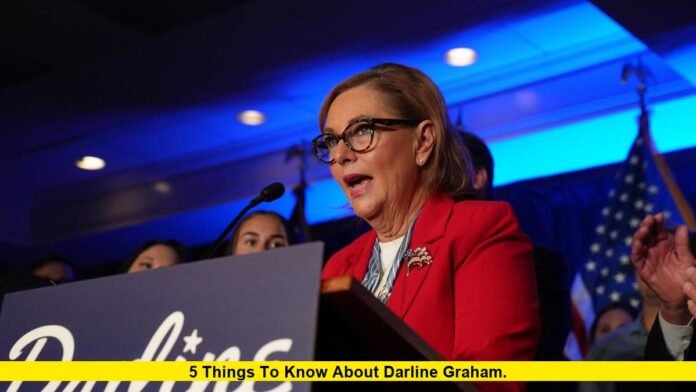

5 Things to Know About Darline Graham are especially relevant after the South Carolina Republican Senate runoff, where Graham defeated U.S. Rep. Ralph Norman and secured the GOP nomination for the November general election. The victory came just weeks after she entered the Senate following the death of her brother, longtime Sen. Lindsey Graham, and now puts her on track to seek a full six-year term.
Graham’s rapid rise has made her one of the most closely watched Republican Senate candidates of the 2026 election cycle. She entered the race without previous elected-office experience but already had a long record of public service in South Carolina.
Her runoff victory also reflected the importance of President Donald Trump’s endorsement. Trump backed Graham during the campaign and actively campaigned for her ahead of the Republican runoff.
Here are five important facts to know about the Republican nominee and current South Carolina senator.
1. Darline Graham won the Republican Senate runoff
The most immediate development is Graham’s victory over Norman in the Republican special primary runoff held August 25.
The Associated Press called the race for Graham at about 9:01 p.m. With roughly 93% of the vote counted, Graham had received 52.4% compared with Norman’s 47.6%. The margin was about 16,600 votes at that stage of the count.
The result settled a short but highly consequential Republican contest. Graham and Norman had emerged from a 10-candidate Republican field earlier in August.
In that first special primary, Graham finished first with about 33% of the vote. Norman followed with approximately 24%. Rep. Russell Fry and former Gov. Mark Sanford also competed in the crowded field.
Because neither Graham nor Norman secured a majority in that first contest, South Carolina Republicans held the August 25 runoff.
Graham’s victory means she will represent the Republican Party in the November general election for the Senate seat. She will face Democratic nominee Annie Andrews.
The Republican nomination is particularly significant because the seat had been held by her brother, Lindsey Graham, for more than two decades.
2. She became a U.S. senator only weeks before winning the nomination
Graham’s path to the Senate was unusually fast.
South Carolina Gov. Henry McMaster appointed her to the U.S. Senate on July 13 to fill the vacancy created by Lindsey Graham’s death. She took the oath of office on July 14.
Her appointment made her the first woman to represent South Carolina in the U.S. Senate. She also became the state’s first female senator at a time when the Republican Party was preparing for a special election to determine who would appear on the November ballot.
Graham had not previously served in elected public office.
That distinction became an important part of the Republican primary campaign. Supporters highlighted her years of public service, while Norman emphasized his own experience in Congress and questioned whether Graham had enough background for the Senate.
Despite the short time between her appointment and the Republican runoff, Graham built enough support to win both the initial primary and the subsequent runoff.
Her current Senate role is therefore separate from the full six-year term she is seeking. The appointment allows her to serve the remainder of her brother’s existing term, while the November election will determine who receives the next full term.
3. Her professional background is rooted in public service
Although Graham is new to elected politics, she is not new to government or public service.
According to official congressional records, Graham was born in Central, South Carolina, on June 12, 1964. She earned a bachelor’s degree in sociology from the College of Charleston in 1989 and a master’s degree in rehabilitation counseling from South Carolina State University in 2009.
Her professional career included work as a vocational rehabilitation counselor. She also worked as an optician and held positions involving South Carolina state agencies.
Graham joined the South Carolina Vocational Rehabilitation Department in 2007 and later became commissioner of the South Carolina Commission for the Blind.
She served as commissioner beginning in 2019, according to Gov. McMaster’s office. In that position, she worked on programs focused on employment, independent living and services for South Carolinians who are blind or have low vision.
Her campaign has emphasized that record as evidence of experience outside traditional electoral politics.
The campaign also says she led an agency with about 130 employees across 10 offices and oversaw a budget of approximately $90 million.
Before entering the state-government workforce, Graham’s background included work at an optometrist’s office, Clemson University and the U.S. Postal Service.
That combination of public administration and vocational rehabilitation work is central to how Graham has presented herself to voters.
Rather than portraying herself as a longtime politician, she has argued that her career demonstrates a history of serving South Carolinians.
4. She is the younger sister of the late Sen. Lindsey Graham
Family ties are impossible to separate from Darline Graham’s political story.
Her older brother, Lindsey Graham, represented South Carolina in the U.S. Senate for more than 20 years. His death on July 11 created the vacancy that led to Darline Graham’s appointment.
Their family history has also received considerable attention.
Lindsey Graham became Darline’s legal guardian after their parents died while she was still a teenager. She remained closely connected to him throughout his political career and appeared with him at political events over the years.
That relationship became especially important after his death.
When Graham was appointed to his Senate seat, she said she wanted to continue serving South Carolina and honor the legacy of her brother. Her family connection quickly became one of the defining characteristics of her candidacy.
At the same time, it became a source of criticism from opponents who argued that her appointment and campaign benefited from her relationship with Lindsey Graham.
Graham’s Republican runoff victory shows that those concerns did not prevent her from assembling enough support to defeat Norman.
Her campaign has instead presented her family history as part of a broader story of public service and loyalty to South Carolina.
5. Trump’s endorsement played a major role in the campaign
President Donald Trump’s backing was another defining feature of Graham’s Senate campaign.
Trump endorsed Graham and publicly encouraged her to seek the seat. He also campaigned with her in South Carolina before the runoff.
His support provided Graham with a major advantage in a race against Norman, an experienced member of Congress.
Trump’s endorsement also turned the contest into a broader test of his influence within the Republican Party. Outside spending reinforced that dynamic. MAGA Inc., a pro-Trump super PAC, spent more than $827,000 supporting Graham on the final day before the runoff, according to The Associated Press.
Graham’s campaign also aligned itself with Trump’s political priorities.
During the campaign, she promoted conservative positions on issues including immigration, abortion and gun rights. Her approach differed in emphasis from her brother’s long-established focus on national security and foreign policy.
The Trump connection was especially important during the final stretch of the runoff campaign.
Graham faced criticism after a Republican debate in which she acknowledged that national security was not an area in which she was highly informed. She also made an incorrect statement about South Carolina’s population. The episode gave Norman an opportunity to question her readiness for the Senate.
Trump nevertheless continued to defend Graham and campaign for her.
Her eventual victory gave the president another high-profile success in a Republican Senate primary and demonstrated the value of his endorsement in this particular contest.
What comes next for Darline Graham?
The runoff victory does not give Graham a full six-year Senate term yet.
Instead, it makes her the Republican nominee for the November general election. She will face Democratic nominee Annie Andrews, a physician who won the Democratic nomination earlier in the election cycle.
The general election will determine who serves the full term associated with the Senate seat.
For Graham, the next stage will require expanding her campaign beyond the Republican primary electorate. Her challenge will include introducing herself to voters who may know her primarily because of her connection to Lindsey Graham, her brief Senate tenure or Trump’s endorsement.
She will also need to defend her record and explain how her experience in state government would translate into a full Senate term.
Her first weeks in Washington have already placed her in an unusual position. She went from leading a state agency to serving in the Senate within a matter of weeks.
The runoff victory now gives that transition a much larger political consequence.
Why Darline Graham’s story is attracting national attention
Graham’s rise stands out because several major developments happened in rapid succession.
She entered the Senate through an appointment after her brother’s death. She became South Carolina’s first female senator. She then entered a 10-way Republican primary despite having never previously held elected office.
After finishing first in that primary, she defeated Norman in the runoff and secured the Republican nomination.
The sequence has made her campaign one of the more unusual Senate stories of the 2026 election cycle.
Her professional record also sets her apart from the traditional congressional candidate. Her background is rooted in vocational rehabilitation, disability services and state administration rather than years spent campaigning for federal office.
At the same time, her family name gave her immediate recognition in a state where her brother had built a powerful political profile.
Trump’s endorsement added another layer to the campaign, making the runoff a closely watched contest for both South Carolina Republicans and the national GOP.
Now Graham’s political future depends on the November general election.
For voters following her campaign, the most important developments will include how she defines her policy agenda, how she presents her record in state government and how she responds to questions about her experience.
The Republican runoff has answered one major question: Graham will be the GOP candidate.
The larger question about whether she will win a full Senate term will be decided by South Carolina voters in November.
The bottom line
The five most important points about Darline Graham are clear: she has won the Republican Senate runoff, currently serves as South Carolina’s senator, has a long background in state public service, is the sister of the late Lindsey Graham and benefited significantly from Trump’s endorsement.
Her victory over Ralph Norman has moved her from a temporary Senate appointment into the center of South Carolina’s 2026 Senate race.
What do you think about Darline Graham’s rapid rise to the Senate and her Republican runoff victory? Share your thoughts and stay updated as the November race develops.