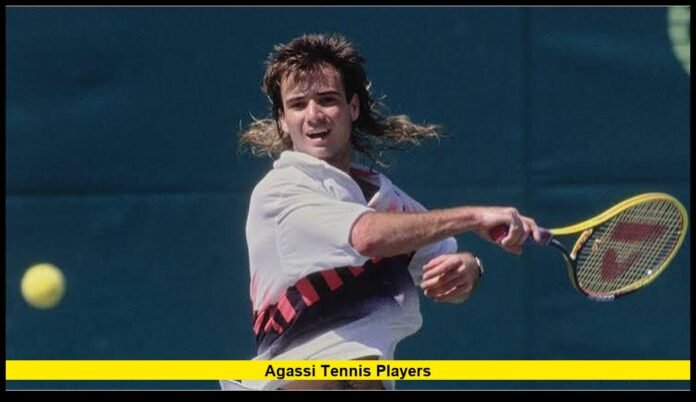

Andre Agassi remains one of the most recognizable names in American tennis, and anyone searching for agassi tennis player information will quickly discover a career defined by Grand Slam victories, an Olympic gold medal, a world No. 1 ranking and one of the most remarkable comebacks in professional sports.
Agassi was not simply a champion who collected major trophies. His career unfolded across several distinct chapters, from his teenage emergence in the 1980s to his rise to the top of men’s tennis, a dramatic fall in the rankings, and an extraordinary return that produced some of the most important victories of his career. More than a decade after his retirement, his influence remains visible in tennis and in the educational causes he has supported.
Who Is Andre Agassi?
Andre Kirk Agassi was born April 29, 1970, in Las Vegas, Nevada. He became a professional at 16 and quickly attracted attention as one of the most exciting young players in the sport.
His playing style was built around aggressive baseline tennis, exceptional timing and one of the strongest return games of his generation. Instead of relying primarily on a dominant serve-and-volley approach, Agassi often stood close to the baseline and attacked opponents with early ball striking.
That approach became especially effective against big servers. His ability to read serves and redirect the ball gave him a weapon that remained valuable throughout his career.
Agassi also became famous away from the court. His colorful clothing, long hair and unconventional personality made him stand out at a time when professional tennis was often associated with a more traditional image.
His personality helped turn him into a crossover sports celebrity, but his achievements eventually became strong enough to stand on their own.
From Teenage Prospect to Tennis Superstar
Agassi’s professional career began in 1986, when he was only 16 years old.
The expectations surrounding him were enormous. He had been trained intensely from childhood, and his father, Mike Agassi, believed he could become one of the best players in the world.
The young American eventually joined the Nick Bollettieri Tennis Academy in Florida, where he developed his game alongside other future stars.
Agassi’s early professional years were marked by rapid progress. He reached the top 10 and became a major presence on the ATP Tour before winning his first Grand Slam championship.
That breakthrough came at Wimbledon in 1992.
Winning Wimbledon in 1992
Agassi’s first Grand Slam title arrived at one of the most prestigious tournaments in tennis.
At Wimbledon in 1992, he defeated Goran Ivanisevic in a five-set final to claim the championship. The victory was particularly significant because Agassi had previously been viewed as a player whose game was better suited to hard courts.
Winning on grass demonstrated that his abilities extended far beyond one playing surface.
The Wimbledon championship also established Agassi as a legitimate major champion rather than simply a talented young star.
It was the first of eight Grand Slam singles titles he would eventually collect.
U.S. Open Glory
Two years after his Wimbledon triumph, Agassi captured his first U.S. Open championship.
In 1994, he defeated Michael Stich in the final to become the first unseeded men’s singles champion at the tournament in the Open Era.
The victory strengthened his position among the world’s elite and gave American tennis another major star during an era that featured several outstanding players.
Agassi would later win the U.S. Open again in 1999.
His relationship with the New York tournament became particularly important because the U.S. Open also hosted the final major match of his professional career in 2006.
Olympic Gold in Atlanta
Agassi added another historic accomplishment to his résumé at the 1996 Olympic Games in Atlanta.
Playing for the United States, he won the men’s singles gold medal by defeating Spain’s Sergi Bruguera in the final.
Olympic tennis had returned to the Games only a few years before Agassi’s triumph, and the Atlanta victory gave him another prestigious achievement beyond the Grand Slam tournaments.
The combination of his major titles and Olympic success ultimately placed Agassi among the rare players to achieve a career Golden Slam.
Completing the Career Grand Slam
The most important milestone of Agassi’s career came at the 1999 French Open.
Before arriving in Paris, he had already won the Australian Open, Wimbledon and U.S. Open. The French Open was the missing piece.
Agassi defeated Andrei Medvedev in the final after losing the opening two sets. His comeback produced one of the defining victories of his career and made him one of the few male players to win all four Grand Slam singles tournaments.
His Grand Slam titles were distributed across three different surfaces:
- Australian Open: 1995, 2000, 2001 and 2003
- French Open: 1999
- Wimbledon: 1992
- U.S. Open: 1994 and 1999
The achievement showed the remarkable versatility of Agassi’s game.
Clay presented a very different challenge from grass, while hard courts rewarded his powerful baseline game. Winning majors on each surface demonstrated that his success was not dependent on one specific style of tennis.
Reaching World No. 1
Agassi first reached the No. 1 ranking in 1995.
He ultimately spent 101 weeks at the top of the ATP rankings, including a year-end No. 1 finish in 1999.
That achievement placed him in an elite group of players who managed to reach the highest ranking in men’s tennis.
However, the story of his ranking is just as interesting because of what happened after his first period at the top.
The Dramatic Fall to No. 141
Agassi’s career took a major turn during the late 1990s.
In 1997, his ranking fell to No. 141. For a player who had already been No. 1, the decline was extraordinary.
Instead of walking away from tennis, Agassi began rebuilding his career.
He changed his approach to preparation, became more disciplined and worked to improve his fitness and overall consistency. His relationship with coach Brad Gilbert was an important part of the resurgence.
The comeback was not immediate, but it eventually transformed Agassi’s career.
He climbed back into the world’s top 10 and then returned to Grand Slam-winning form.
His 1999 season became the clearest evidence of the transformation. After years of uncertainty, he won the French Open and U.S. Open and finished the year as the world’s No. 1 player.
That turnaround remains one of the most memorable comeback stories in professional tennis.
The Australian Open Became Agassi’s Stronghold
Melbourne became one of Agassi’s most successful destinations.
He won the Australian Open four times, taking the championship in 1995, 2000, 2001 and 2003.
His ability to perform consistently on the tournament’s hard courts was a major reason he remained competitive well into his 30s.
The 2003 title was especially significant because it demonstrated that Agassi could still defeat younger players and contend for the biggest prizes late in his career.
His Australian Open record became one of the defining statistical elements of his résumé.
Rivalry With Pete Sampras
No discussion of Agassi’s career is complete without mentioning Pete Sampras.
The two Americans represented different approaches to tennis and became major rivals during the 1990s.
Sampras relied heavily on his serve, quick attacking play and ability to finish points at the net. Agassi was renowned for taking the ball early and controlling rallies from the baseline.
Their rivalry became one of the signature matchups of the era.
Sampras ultimately held the advantage in their overall head-to-head record, but their repeated meetings helped define men’s tennis during a period when American players dominated much of the sport’s attention.
The rivalry also created some of the most memorable Grand Slam and championship matches of the period.
Agassi and Roger Federer
Agassi’s career overlapped with the emergence of Roger Federer, another player who would become one of tennis’s all-time greats.
The two met several times, including in major tournaments.
Their most famous meeting came in the 2005 U.S. Open final, when Federer defeated Agassi.
That match was significant because Agassi was 35 and making another deep run at a Grand Slam. Reaching the final at that stage of his career was itself a remarkable achievement.
Federer’s victory also represented a generational transition in men’s tennis, with one legend beginning to approach the end of his career while another was entering a period of extraordinary dominance.
Retirement From Professional Tennis
Agassi played his final professional match at the 2006 U.S. Open.
He was 36 years old when he retired, bringing a 21-year professional career to an end.
His final appearance was emotionally significant. He had already won the U.S. Open twice and had reached the tournament final several other times.
By the time he walked away, his career included 60 ATP singles titles, eight Grand Slam championships, Olympic gold and more than 100 weeks at No. 1.
Few American men’s players have produced such a combination of longevity, versatility and major tournament success.
What the Agassi Tennis Player Legacy Means Today
The legacy of this legendary American champion extends beyond his statistics.
For many fans, Agassi represents the possibility of reinvention.
His career included success, failure, public pressure, ranking struggles and a return to the top. That makes his story different from that of a player who simply dominates from the beginning of a career to the end.
The agassi tennis player legacy is also connected to the way he changed the public perception of tennis. His youthful image, fashion choices and willingness to speak openly about his experiences helped make him one of the sport’s most recognizable personalities.
His autobiography, Open, further introduced fans to the personal side of his journey and described the pressures that accompanied his rise through professional tennis.
Life After Tennis
Retirement did not mean Agassi disappeared from public life.
Education became one of the most important areas of his work.
Through the Andre Agassi Foundation for Education and related initiatives, he focused on improving educational opportunities for children, particularly students who might otherwise have limited access to strong schools and resources.
His work in education became a significant part of his identity after tennis.
Agassi also remained involved in tennis-related events, charitable activities and business projects.
His marriage to fellow tennis great Steffi Graf has also made the couple one of the most famous partnerships in the sport’s history. Graf won 22 Grand Slam singles titles and completed her own career Grand Slam.
Andre Agassi in 2026
Agassi continues to appear at major tennis events, and his name has remained particularly prominent during the 2026 U.S. Open Fan Week.
On August 25, 2026, Agassi joined Roger Federer, Andy Roddick and John McEnroe at Arthur Ashe Stadium for a special exhibition celebrating Federer’s connection to the U.S. Open.
The event was not a competitive comeback for Agassi. Instead, it brought several generations of tennis history together on one of the sport’s most famous courts.
Federer played Roddick in singles before the program moved to doubles, with Federer and McEnroe facing Roddick and Agassi.
The appearance offered fans an opportunity to see four celebrated figures from different eras share the court.
It also highlighted Agassi’s continuing connection to the U.S. Open more than two decades after his second championship there.
Agassi’s Career Numbers
Agassi’s statistical résumé remains impressive:
- Professional debut: 1986
- Retirement: 2006
- Grand Slam singles titles: 8
- ATP singles titles: 60
- Career singles record: 870-274
- Highest ranking: No. 1
- Weeks ranked No. 1: 101
- Olympic singles gold: 1996
- Davis Cup titles: 3
- International Tennis Hall of Fame induction: 2011
- Career Grand Slam: Yes
- Career Golden Slam: Yes
Those numbers help explain why Agassi remains firmly established among the greatest players in tennis history.
Why Andre Agassi Still Matters
Tennis has changed dramatically since Agassi retired.
The modern game is faster, more physical and increasingly global. Yet Agassi’s influence remains easy to recognize.
His return game, aggressive baseline style and ability to take the ball early influenced later generations. His willingness to reinvent himself also offered an important lesson about athletic longevity.
Perhaps most importantly, his career demonstrated that a player’s legacy does not have to be defined by uninterrupted success.
Agassi reached the summit, experienced a dramatic decline and found a way back.
That combination of achievement and resilience is one reason his name continues to generate interest among tennis fans.
Final Thoughts
Andre Agassi’s career remains one of the most fascinating stories in American sports. He became a Grand Slam champion, won Olympic gold, reached the No. 1 ranking and completed the career Grand Slam. He then extended his relevance by reinventing himself after one of the steepest ranking declines experienced by a former world No. 1.
Today, his legacy encompasses far more than trophies. His educational work, public appearances and continuing relationship with tennis have given him a meaningful role long after his final professional match.
His appearance during the 2026 U.S. Open Fan Week is another reminder that tennis legends can remain part of the sport’s biggest moments even after leaving competitive play.
What is your favorite Andre Agassi memory, Grand Slam victory or rivalry? Share your thoughts below and keep following for more tennis updates and stories from the sport’s greatest champions.