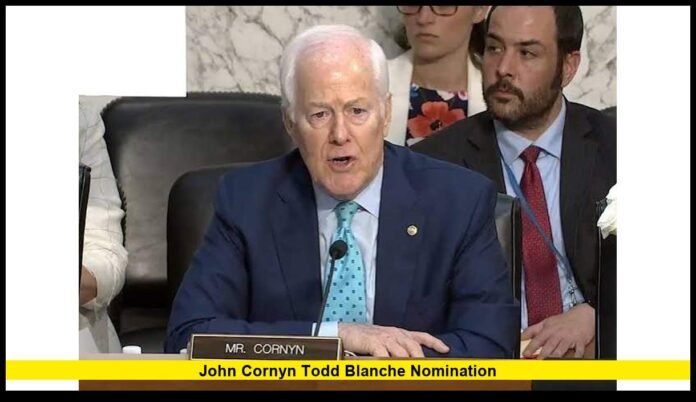

John Cornyn Todd Blanche nomination remains one of the biggest confirmation stories in Washington as the Senate considers whether Todd Blanche should become the next Attorney General of the United States. As of July 29, 2026, Republican Sen. John Cornyn has not announced support for Blanche’s confirmation, making his position one of the most important factors in determining the nomination’s path through the Senate Judiciary Committee.
Although Republicans hold the Senate majority, the nomination has not moved forward without questions. Cornyn and fellow Republican Sen. Thom Tillis have focused on a Justice Department settlement involving the Internal Revenue Service, saying they want formal changes before deciding whether to support Blanche. Their requests have placed the nomination under intense scrutiny and delayed what many expected to be a routine confirmation process.
Todd Blanche’s Nomination Became a Major Senate Test
President Donald Trump nominated Todd Blanche to serve as attorney general after Blanche had already taken on the responsibilities of acting attorney general. Before entering the department’s leadership, Blanche worked as a federal prosecutor and later became a well-known defense attorney in private practice.
His legal career attracted national attention after he represented Donald Trump in several criminal cases. Following his confirmation as deputy attorney general earlier in 2025, Blanche moved into the acting attorney general position after changes within the department’s leadership.
Because attorney general is one of the most influential positions in the federal government, every nomination receives close attention. The office oversees the Department of Justice, supervises federal prosecutors, directs major criminal investigations, and provides legal guidance for the executive branch.
Blanche’s experience has earned support from many Republicans, but several senators have insisted on addressing specific policy concerns before voting on his nomination.
Why John Cornyn’s Vote Has Become So Important
John Cornyn serves on the Senate Judiciary Committee, which reviews attorney general nominations before they can reach the full Senate.
That committee acts as the first major hurdle for any nominee. Members question candidates during public hearings, examine their qualifications, and decide whether to recommend confirmation.
Because Democratic members of the committee have opposed Blanche’s nomination, Republican votes are essential.
Cornyn has not rejected the nominee. Instead, he has repeatedly explained that he wants written assurances regarding a disputed Justice Department settlement before making a final decision.
His careful approach has made him one of the central figures in the confirmation process.
The IRS Settlement Is the Main Point of Disagreement
Unlike many confirmation battles that focus primarily on a nominee’s background, the biggest issue surrounding Blanche involves a legal settlement connected to the Internal Revenue Service.
The agreement included language establishing what became known publicly as an anti-weaponization compensation fund.
Some lawmakers questioned whether the proposal could allow payments to people claiming they had been unfairly targeted by federal agencies.
Todd Blanche told senators during his confirmation hearing that the compensation fund would not move forward. He stated that the proposal was effectively no longer active.
However, John Cornyn argued that verbal statements alone were not enough.
He has said the language should be formally removed or revised in writing before he supports advancing the nomination.
That distinction remains the central issue in the confirmation process.
Cornyn Continues Seeking Written Commitments
Throughout the confirmation process, Cornyn has maintained a consistent message.
He wants official documentation showing that the disputed settlement language has been changed.
His position does not focus on Blanche’s legal qualifications. Instead, it centers on ensuring the Justice Department formally addresses concerns surrounding the settlement.
Cornyn has indicated publicly that department officials understand the changes he expects.
As of July 29, 2026, those revisions had not yet been completed.
Until that happens, Cornyn has chosen not to announce support for the nomination.
Thom Tillis Shares Similar Concerns
North Carolina Sen. Thom Tillis has taken a position similar to Cornyn’s.
Tillis also questioned the settlement language and requested additional assurances from the Justice Department before deciding whether to support Blanche.
The two Republican senators have played a significant role because every committee vote matters.
With Democrats expected to oppose the nomination, Republican unity has become essential.
Even a small number of undecided Republicans can delay committee action.
Todd Blanche Defended His Position During the Hearing
During his confirmation hearing before the Senate Judiciary Committee, Todd Blanche answered questions from both Republican and Democratic senators.
He explained that the disputed compensation fund would not be implemented.
Blanche also defended his broader record within the Justice Department and emphasized his commitment to enforcing federal law fairly.
He rejected suggestions that his previous legal work representing Donald Trump would prevent him from serving independently as attorney general.
Instead, Blanche said he would carry out the responsibilities of the office according to the Constitution and federal law.
His testimony addressed numerous issues beyond the IRS settlement, but that dispute continued to receive the greatest attention from several Republican senators.
Questions Extended Beyond the Settlement
Although the IRS agreement dominated much of the Republican discussion, senators also explored several additional topics during the hearing.
Among the issues discussed were:
- Independence of the Department of Justice
- Federal law enforcement priorities
- Oversight responsibilities
- Ethics within the department
- Past legal representation of President Trump
- Department transparency
- High-profile criminal investigations
Democratic senators questioned Blanche extensively about maintaining independence from political influence.
Blanche responded that he understood the importance of protecting the integrity of the Justice Department while enforcing federal law equally.
Jeffrey Epstein Investigation Also Received Attention
Another subject raised during the confirmation process involved the Justice Department’s handling of records connected to Jeffrey Epstein.
Several advocacy organizations and survivors expressed concerns regarding the department’s decisions involving investigative materials.
Sen. Thom Tillis requested that Blanche meet directly with survivors before expecting his support.
That meeting later took place before the committee prepared for its next vote.
While this issue remained part of the broader confirmation discussion, it was separate from the settlement concerns that have guided John Cornyn’s decision-making.
Todd Blanche’s Legal Career
Todd Blanche has spent years working in both government service and private legal practice.
His career includes experience as:
- A federal prosecutor
- A senior Justice Department official
- Deputy attorney general
- Acting attorney general
- Defense attorney in high-profile criminal cases
Supporters point to this combination of public and private experience as evidence that Blanche possesses the qualifications needed to lead the Justice Department.
Critics, meanwhile, continue to question whether his previous legal representation of President Trump could affect public confidence in the department’s independence.
Those differing views have shaped much of the national debate surrounding his confirmation.
Timeline of the Confirmation Process
| Date | Development |
|---|---|
| June 2026 | President Donald Trump nominates Todd Blanche for attorney general |
| June 2026 | Blanche begins meeting with senators ahead of confirmation hearings |
| July 2026 | Senate Judiciary Committee conducts confirmation hearings |
| July 2026 | Cornyn and Tillis raise concerns over the IRS settlement |
| July 2026 | Blanche says the disputed compensation fund will not move forward |
| July 29, 2026 | Cornyn remains undecided while awaiting formal revisions |
How the Senate Confirmation Process Works
Every attorney general nominee must complete several important steps before assuming office permanently.
The process generally includes:
- Presidential nomination.
- Meetings with senators.
- Senate Judiciary Committee hearing.
- Committee vote.
- Full Senate confirmation vote.
The committee stage often receives less public attention than the final Senate vote, but it plays a critical role.
Committee members review qualifications, question nominees, and determine whether a nomination advances.
Because Blanche’s nomination currently faces questions within the committee itself, this stage has become especially important.
Republicans Continue Internal Discussions
The confirmation process has also highlighted different priorities within the Republican conference.
Some senators have emphasized Blanche’s prosecutorial experience and leadership within the Justice Department.
Others believe policy concerns surrounding the IRS settlement should be resolved before any confirmation vote.
Cornyn has consistently explained that his position relates to the written settlement rather than personal opposition to Blanche.
His public comments have left open the possibility of supporting the nominee once the requested revisions are completed.
That approach has allowed negotiations between senators and Justice Department officials to continue.
Why Written Changes Matter
Several senators have explained that official written revisions carry greater legal significance than statements made during a hearing.
While testimony becomes part of the public record, senators often seek formal changes to legal agreements when questions arise.
Cornyn’s position reflects that principle.
He wants the disputed settlement language removed through official action rather than relying solely on testimony that the proposal will not be implemented.
Whether the department agrees to make those revisions could determine the next step in the confirmation process.
Possible Next Steps
The nomination now depends largely on developments surrounding the settlement.
If the Justice Department formally revises the agreement, Cornyn may conclude that his concerns have been addressed.
If no revisions occur, the committee could face additional delays before deciding whether to advance the nomination.
At the moment, Blanche has completed the hearing portion of the process but continues waiting for the committee’s next action.
The Attorney General’s Role
The attorney general leads the Department of Justice and serves as the nation’s chief law enforcement officer.
Responsibilities include overseeing federal prosecutors, supervising criminal investigations, defending the federal government in court, and providing legal advice to the president and executive agencies.
Because the office carries enormous authority, Senate confirmation hearings often involve extensive questioning about legal philosophy, ethics, leadership, and departmental independence.
Blanche’s hearing followed that tradition while also focusing heavily on the IRS settlement controversy.
Current Status of the Nomination
As of July 29, 2026, Todd Blanche remains the president’s nominee for attorney general.
The Senate Judiciary Committee has not completed the confirmation process.
John Cornyn continues requesting formal written changes to the disputed settlement before announcing his vote.
Thom Tillis has also sought additional assurances.
Blanche has maintained that the compensation fund discussed during the hearings will not move forward, but committee members continue reviewing whether further written action is necessary.
The outcome of those discussions will likely determine when the nomination proceeds to the next stage.
Why the Confirmation Continues to Draw National Attention
Attorney general confirmations always receive close public attention because the position oversees federal law enforcement and major Justice Department decisions.
The current nomination has become especially notable because of the combination of Blanche’s previous legal work, his current leadership role inside the department, and the policy questions raised during committee review.
While many nominations advance with limited controversy, this confirmation has demonstrated how specific legal agreements can become central issues during Senate consideration.
John Cornyn’s decision remains one of the most closely watched developments because it could influence whether the nomination advances beyond committee.
What are your thoughts on the John Cornyn Todd Blanche nomination? Share your opinion in the comments and stay tuned for the latest confirmed developments from Washington.