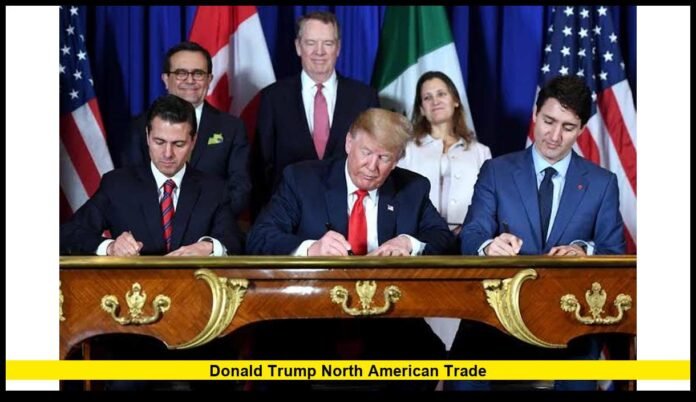

Donald Trump North American trade policy continues to shape the economic relationship between the United States, Canada, and Mexico as the administration moves forward with a new round of trade negotiations and policy reviews. The United States is keeping the United States-Mexico-Canada Agreement (USMCA) in force while seeking changes through its scheduled review process. At the same time, tariff policies and separate negotiations with Canada and Mexico have become central parts of the administration’s strategy to strengthen American manufacturing, protect domestic industries, and address trade concerns.
North America remains one of the world’s most important trading regions. Every day, billions of dollars in goods move across the borders connecting the United States, Canada, and Mexico. Businesses rely on integrated supply chains, while consumers depend on steady imports of vehicles, food, energy products, electronics, machinery, and countless other goods. Because of this close economic relationship, even modest policy changes can have widespread effects on manufacturers, farmers, retailers, and households throughout the region.
Why North American Trade Is So Important
Trade among the three North American countries supports millions of jobs and thousands of businesses. Over the past several decades, manufacturers have developed production networks that stretch across international borders.
Instead of producing an entire product in one country, companies often manufacture components in multiple locations. Auto parts may be produced in Michigan, assembled in Ontario, shipped to Mexico for additional work, and then returned to the United States for final sale.
This system allows businesses to improve efficiency while keeping production costs competitive. As a result, stable trade policies remain important for industries across North America.
Major sectors connected through cross-border trade include:
- Automotive manufacturing
- Agriculture
- Energy
- Medical equipment
- Technology
- Consumer electronics
- Aerospace
- Industrial machinery
These industries rely on predictable trade rules to maintain production schedules and investment plans.
The Administration’s Current Trade Approach
President Donald Trump has continued promoting an America First trade strategy during his second term in office.
Rather than allowing the USMCA to receive an automatic long-term extension during its scheduled review, the administration has chosen to continue evaluating the agreement through annual reviews.
This decision keeps the agreement active while giving U.S. negotiators additional opportunities to seek changes they believe will better protect American economic interests.
Administration officials have consistently stated that the goal is not to eliminate North American trade but to improve the existing framework by addressing areas they believe require stronger enforcement or updated rules.
USMCA Continues to Govern Trade
Although discussions about the future of North American trade have received significant attention, businesses continue operating under the existing USMCA framework.
The agreement remains the legal foundation for trade among the United States, Canada, and Mexico.
Companies continue receiving the benefits established under the agreement, including tariff preferences and updated trade rules that replaced the earlier North American Free Trade Agreement (NAFTA).
The current review process focuses on determining whether additional changes should be negotiated rather than ending the agreement altogether.
Separate Negotiations with Canada and Mexico
One of the most notable features of the current trade strategy is the decision to hold separate discussions with Canada and Mexico.
Instead of conducting every negotiation through a single trilateral process, the United States has chosen to address many issues individually with each neighboring country.
Supporters believe this approach allows negotiators to focus on country-specific concerns without slowing progress on unrelated issues.
Each trading relationship includes unique economic priorities, regulatory systems, and commercial disputes. Separate negotiations allow those matters to receive individual attention.
Trade experts have noted that talks with Mexico have generally moved more smoothly than discussions involving Canada, although negotiations remain active with both countries.
Read More – Trump Cabinet Members: Who Serves in Donald Trump’s Administration in 2026?
Tariffs Continue to Influence Negotiations
Tariffs remain one of the administration’s primary negotiating tools.
Officials argue that targeted tariffs encourage trading partners to resolve long-standing disputes and create fairer trading conditions for American businesses.
Recent tariff actions affecting Canadian imports have become one of the most closely watched developments in North American trade.
While some products remain exempt, additional duties now apply to selected Canadian imports.
Administration officials have stated that these measures are designed to encourage progress during ongoing negotiations while protecting U.S. economic interests.
Canadian leaders continue engaging with American officials as discussions proceed.
Mexico Remains a Key Trade Partner
Mexico continues to play an essential role in North American manufacturing and commerce.
The country’s extensive industrial base supports industries ranging from automobile production to electronics manufacturing.
Cross-border supply chains connect factories throughout both countries, allowing manufacturers to produce goods efficiently for North American consumers.
Current discussions between the United States and Mexico cover multiple trade issues, including implementation of existing USMCA provisions and possible future updates.
Officials from both governments have continued meeting regularly as negotiations move forward.
Manufacturing Stays at the Center of Trade Policy
American manufacturing remains one of the administration’s highest priorities.
Officials have repeatedly stated that trade agreements should encourage companies to expand production inside the United States while maintaining competitive access to North American markets.
Manufacturers across multiple industries continue monitoring negotiations because trade policies influence production costs, sourcing decisions, and long-term investment strategies.
Businesses often make investment decisions years in advance, making policy certainty especially valuable.
Automakers Are Watching Every Development
Few industries depend on North American trade more than automobile manufacturing.
Modern vehicles contain thousands of components that frequently cross international borders before final assembly.
An engine may be manufactured in one country while transmissions, electronics, steel, glass, and interior components originate elsewhere within North America.
Even relatively small changes to tariffs or trade rules can affect production planning throughout the automotive industry.
Automakers continue evaluating potential policy changes while operating under existing USMCA rules.
Agriculture Remains Closely Connected
American farmers maintain strong trading relationships with both Canada and Mexico.
Agricultural exports support rural economies throughout the United States.
Products commonly traded across North America include:
- Corn
- Soybeans
- Wheat
- Dairy products
- Beef
- Pork
- Poultry
- Fruits
- Vegetables
Reliable market access remains important because agricultural production depends on stable export opportunities throughout the year.
Energy Trade Supports Regional Growth
Energy cooperation represents another major component of North American commerce.
The United States, Canada, and Mexico exchange significant quantities of oil, natural gas, refined petroleum products, and electricity.
These energy connections strengthen supply reliability while supporting industrial production throughout the continent.
Energy companies continue following trade negotiations because regulatory changes can influence future investments and cross-border infrastructure projects.
Supply Chains Continue Operating
One of the defining characteristics of North American trade is the highly integrated nature of supply chains.
Instead of operating independently, manufacturers frequently coordinate production across all three countries.
A single finished product may include raw materials from Canada, specialized components from Mexico, and final assembly in the United States.
This interconnected system has developed over several decades and supports efficient production across numerous industries.
Maintaining stable trade rules helps businesses manage inventories, shipping schedules, and production timelines.
Business Leaders Seek Long-Term Stability
Companies generally favor predictable trade policies that allow them to make long-term investment decisions with confidence.
Major manufacturers invest millions or even billions of dollars when building factories, purchasing equipment, or expanding production facilities.
Because those investments often last decades, businesses closely monitor government trade policies before committing additional capital.
Annual USMCA reviews have increased attention on future policy developments, prompting companies to follow negotiations carefully.
Consumer Impact
Many Americans may not notice immediate effects from ongoing negotiations because current USMCA rules remain in place.
However, trade policies can eventually influence prices for imported goods if production costs change significantly.
Products that could experience future pricing changes include:
- New vehicles
- Vehicle parts
- Household appliances
- Building materials
- Electronics
- Grocery items
The extent of any future impact depends on final policy decisions and market conditions.
How USMCA Changed North American Trade
USMCA replaced NAFTA after negotiations during President Trump’s first term.
The updated agreement introduced several modern trade provisions covering areas that had changed significantly since NAFTA first took effect.
Key improvements included updated digital trade rules, revised automotive requirements, stronger labor standards, environmental commitments, and modern intellectual property protections.
Those provisions continue governing trade today while policymakers evaluate additional updates.
Trade Enforcement Remains a Priority
Administration officials have emphasized stronger enforcement of trade rules as an important objective.
They argue that agreements deliver greater value when participating countries consistently follow their commitments.
Enforcement efforts cover multiple areas, including labor standards, customs compliance, market access, and import regulations.
Officials believe stronger enforcement helps create a more level competitive environment for American workers and businesses.
North American Economic Cooperation Continues
Despite ongoing negotiations and policy disagreements, economic cooperation among the United States, Canada, and Mexico remains extensive.
Businesses continue investing throughout the region, supply chains remain active, and cross-border commerce continues every day.
The three economies remain deeply connected through decades of commercial partnerships, manufacturing investment, transportation infrastructure, and shared consumer markets.
Future negotiations are expected to focus on refining this relationship rather than replacing it entirely.
What Businesses Will Watch Next
Several important issues will remain in focus during the coming months.
Business leaders will continue monitoring:
- Progress in U.S.-Canada negotiations
- Additional discussions with Mexico
- Future USMCA review outcomes
- Tariff implementation
- Manufacturing investment decisions
- Agricultural market access
- Supply chain performance
- Cross-border transportation
Each development has the potential to influence trade throughout North America.
The Bottom Line
Donald Trump North American trade policy continues to evolve as the United States reviews the USMCA, negotiates separately with Canada and Mexico, and maintains tariffs designed to support its broader trade objectives. While the agreement remains fully operational, policymakers are working to reshape aspects of the trading relationship to reflect current economic priorities. Businesses, manufacturers, farmers, and consumers across North America will continue watching these developments because the decisions made during the review process could influence regional commerce for years to come.
How do you think future North American trade policies will affect U.S. businesses and consumers? Share your thoughts in the comments and check back for the latest verified updates.