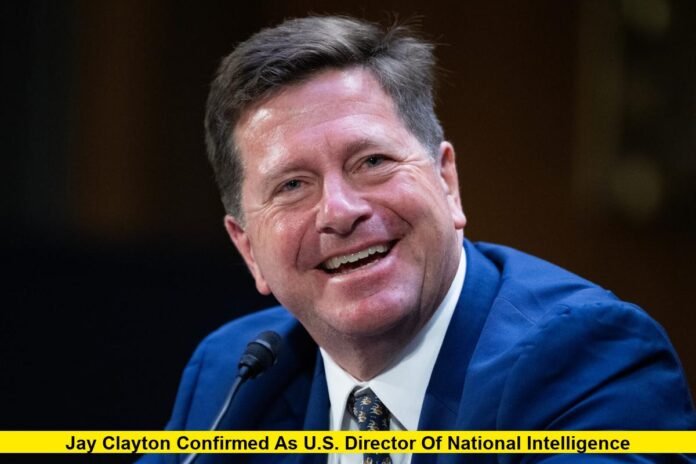

Jay Clayton has been confirmed by the United States Senate as the nation’s top intelligence official, taking over the role of Director of National Intelligence (DNI) after a tense and closely watched confirmation process. The Senate voted 51-47 along party lines on July 28, 2026, to install Jay Clayton as the permanent head of the Office of the Director of National Intelligence, ending weeks of uncertainty over who would lead the agency that oversees the country’s 18 intelligence agencies.
The confirmation caps a nomination process that stretched over several months and drew scrutiny from both Republicans and Democrats, particularly over Clayton’s remarks during his confirmation hearing regarding the 2020 presidential election. Despite the controversy, Clayton secured enough Republican support to clear the Senate and now steps into one of the most sensitive national security roles in the federal government.
Who Is Jay Clayton
Walter Joseph “Jay” Clayton III was born on July 11, 1966, and has built a career that spans Wall Street law, financial regulation, and federal prosecution rather than traditional intelligence or military service. He is currently the United States Attorney for the Southern District of New York, a position he has held since August 2025 after first serving as interim U.S. Attorney beginning in April 2025.
Before returning to government service in that role, Clayton spent years in the private sector. He worked as an associate and later a partner at the law firm Sullivan & Cromwell, where he co-headed the firm’s corporate practice and sat on its management committee. He also served as chairman of Apollo Global Management and held a board position with American Express, giving him a background steeped in financial markets and corporate governance rather than espionage or defense policy.
Clayton’s most prominent prior government role was as the 32nd Chairman of the U.S. Securities and Exchange Commission, a post he held from May 2017 to December 2020 during President Trump’s first term. During his tenure at the SEC, the agency pursued a heavy enforcement agenda, adopted dozens of new rules, and returned billions of dollars to harmed investors. That record positioned him as a familiar and trusted figure within Trump’s orbit, which ultimately led to his nomination as SDNY’s top federal prosecutor and, now, as director of national intelligence.
The Path to Confirmation
President Trump nominated Jay Clayton for the DNI position in June 2026, following the resignation of former Director of National Intelligence Tulsi Gabbard earlier in the year. Rather than moving quickly, Trump delayed Clayton’s confirmation hearing, which allowed Bill Pulte, a former housing regulator serving as acting DNI, to remain in the role for an extended period. Pulte, who had no prior intelligence experience, drew criticism from lawmakers in both parties for a series of staff reductions that he said cut the office’s workforce by roughly 30 percent in just a few weeks.
Clayton’s rescheduled confirmation hearing took place on July 15, 2026, before the Senate Intelligence Committee. During the hearing, he pledged to strengthen coordination and communication across the intelligence community and emphasized that the DNI’s core mission is to deliver timely, objective intelligence to the president, military leaders, and Congress. However, the hearing also became a flashpoint when Clayton declined to directly affirm that President Trump lost the 2020 election to Joe Biden, telling senators only that he was not an “election denier.” That answer frustrated Senate Intelligence Committee Vice Chairman Mark Warner and other Democrats who had previously signaled openness to supporting his nomination.
The Senate Intelligence Committee advanced Clayton’s nomination on July 21 by a party-line vote of 9-8. The full Senate then voted 51-43 on July 27 to clear a procedural hurdle, setting up the final confirmation vote the following day. On July 28, 2026, the Senate confirmed Jay Clayton as director of national intelligence by a vote of 51-47, with every Republican senator voting in favor and no Democrats supporting the nomination.
Public Interest and Reaction
The confirmation of Jay Clayton has drawn significant public and political attention, in part because of the unusual circumstances surrounding his nomination and the broader debate over the direction of the U.S. intelligence community. Senate Majority Leader John Thune and other Republicans framed Clayton’s confirmation as a needed return to stability after Pulte’s brief and turbulent tenure, arguing that a permanent, Senate-confirmed director would help restore functionality to the office.
Democrats, meanwhile, have expressed concern about what Clayton’s leadership could mean given the political climate surrounding the intelligence community. Some lawmakers have pointed to Trump’s continued public claims disputing the outcome of the 2020 election, along with his push to declassify additional materials related to that race, as reasons for unease about how Clayton might handle politically sensitive intelligence matters. Warner and other Democratic senators on the Intelligence Committee have said they remain watchful of how Clayton manages the office’s independence from political pressure.
Clayton’s confirmation also carries implications for an unresolved legislative fight over Section 702 of the Foreign Intelligence Surveillance Act, the law that permits U.S. surveillance of foreign nationals located overseas. That authority lapsed after expiring on June 12, 2026, and some Republican leaders have suggested that having a permanent DNI in place may help revive negotiations over reauthorizing the program, though no timeline for that has been confirmed.
Latest Updates
As of the confirmation on July 28, 2026, Jay Clayton is set to formally take over leadership of the Office of the Director of National Intelligence from Bill Pulte, who had served in an acting capacity for roughly a month. In his new role, Clayton will be responsible for overseeing coordination among the nation’s 18 intelligence agencies and preparing the president’s daily intelligence briefing.
There is no official confirmation yet regarding the exact date Clayton will be formally sworn in or begin his day-to-day duties at ODNI, nor has there been an official announcement about whether he will step down immediately from his post as U.S. Attorney for the Southern District of New York or how that transition will be managed. Any further personnel decisions within the intelligence community under Clayton’s leadership have also not been officially detailed and should not be assumed until confirmed through official channels.
Career Significance
Clayton’s rise to director of national intelligence is notable because it marks his second major Senate-confirmed role under President Trump and his third significant federal position overall, following his time at the SEC and his current post as a U.S. attorney. Unlike many past DNI appointees who came from military, congressional, or intelligence backgrounds, Clayton brings a legal and financial regulatory résumé to the job, which some senators highlighted as both a strength in organizational leadership and a gap in direct national security experience.
Supporters have pointed to his experience managing a large federal agency during his time at the SEC, where he led a substantial enforcement program and guided the agency through the early stages of the COVID-19 market disruption, as evidence that he can bring similar discipline to ODNI. Critics have countered that the DNI role requires a depth of intelligence community knowledge that a financial regulator and prosecutor may not readily possess, though Clayton has emphasized his intent to rely on the expertise of career intelligence professionals within the agency.
Final Thoughts
Jay Clayton’s confirmation as director of national intelligence marks a significant moment for the U.S. intelligence community, arriving after a stretch of leadership turnover and internal restructuring under acting Director Bill Pulte. With a career built primarily in financial regulation and federal law enforcement, Clayton now steps into a role focused on national security coordination, a shift that will be closely watched by lawmakers, intelligence officials, and the public alike.
The coming weeks are expected to bring more clarity on Clayton’s specific priorities as DNI, including how he approaches the unresolved FISA Section 702 debate and the broader relationship between the intelligence community and the White House. Readers should treat any details not yet officially confirmed, including his exact start date and specific policy plans, as unverified until further updates are released through official government channels.
Stay tuned for more updates on Jay Clayton’s tenure as Director of National Intelligence, and share your thoughts in the comments below.