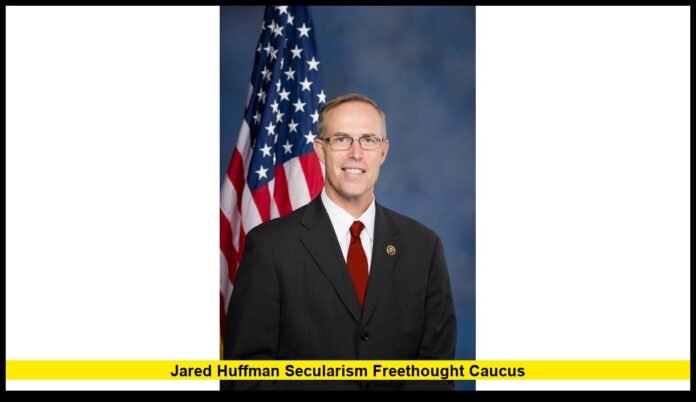

Jared Huffman secularism freethought caucus has gained renewed attention as the California congressman continues promoting a stronger separation between religion and government while addressing debates surrounding humanism, religious freedom, and democracy. Huffman’s recent book, “No Prophets: The Fight to Save Democracy from Christian Nationalism,” has brought additional national focus to his views on secular governance and the role of the Congressional Freethought Caucus in Washington.
Huffman, a Democratic representative from California’s 2nd Congressional District, has become one of the most visible advocates for secular government in Congress. He identifies as a Humanist and has openly discussed his personal journey from a religious upbringing to embracing a humanist worldview. His work through the Congressional Freethought Caucus focuses on protecting church-state separation, supporting evidence-based policymaking, and defending freedom of conscience for Americans of all beliefs and nonbeliefs.
Jared Huffman’s Role in the Congressional Freethought Caucus
The Congressional Freethought Caucus was created to provide a voice in Congress for Americans who support secular government and rational public policy. Huffman co-founded and co-chairs the caucus with Rep. Jamie Raskin of Maryland. The group promotes the idea that government decisions should rely on constitutional principles, scientific evidence, and public reasoning rather than religious doctrine.
The caucus has become increasingly visible as discussions about religion’s role in American politics continue. Members of the group argue that protecting secular institutions does not mean opposing religion. Instead, they describe secular government as a framework that allows people of different faiths and people without religious beliefs to participate equally in civic life.
Huffman has repeatedly emphasized that his position is not an attack on Christianity or other religions. He has pointed to the importance of protecting religious freedom by ensuring that no single religious viewpoint controls government decisions.
Huffman’s Humanist Identity and Political Journey
Huffman’s public identity as a Humanist has made him a unique figure in Congress. He has described his transition away from traditional religious belief as a long personal journey shaped by education, reflection, and his study of religion and politics.
Before entering politics, Huffman studied religion and politics at the University of California, Santa Barbara. His background influenced his understanding of how religious ideas interact with government systems and public policy.
Rather than defining his views only through the absence of religious belief, Huffman has explained that humanism represents a positive commitment to values such as compassion, ethics, reason, and responsibility toward society.
His position has also highlighted broader changes in American culture, where a growing number of people identify as religiously unaffiliated or describe themselves as spiritual without belonging to a traditional faith community.
“No Prophets” Brings National Attention to Huffman’s Views
Huffman’s book “No Prophets: The Fight to Save Democracy from Christian Nationalism” became a major focus of discussion in August 2026. The book examines his concerns about Christian nationalism and argues that democracy requires a clear boundary between religious authority and government power.
In the book, Huffman discusses his experiences in Congress and his perspective on how religious identity has been used in political debates. He argues that Americans should distinguish between individual religious beliefs and political movements that seek to establish government policies based on a specific religious ideology.
The release of the book increased attention around Huffman’s role as a leading congressional voice on secularism. It also renewed conversations about how elected officials address religion, constitutional protections, and political identity.
Church-State Separation as a Central Issue
A major focus of Huffman’s political message is the constitutional principle of separating church and state. He argues that this principle protects both religious people and nonreligious Americans.
Supporters of Huffman’s approach say a secular government creates space for diverse communities by preventing government institutions from favoring one belief system over another.
The debate around church-state separation remains one of the most discussed constitutional issues in the United States. Questions involving education, public policy, religious exemptions, and government funding continue to generate national attention.
Huffman’s argument is that maintaining a neutral government structure is essential for preserving individual freedom of belief.
The Growing Visibility of Secular Voices in Congress
The discussion surrounding the Jared Huffman secularism freethought caucus reflects a larger shift in American political representation. While Congress has historically included many lawmakers who openly identify with religious traditions, more officials have begun discussing secular identities and religious diversity.
The Congressional Freethought Caucus has grown as lawmakers and advocacy groups focus on issues involving secular representation, scientific reasoning, and constitutional protections.
Supporters believe increased visibility for secular lawmakers reflects changes among American voters. They argue that people without religious affiliation deserve representation equal to religious communities.
At the same time, debates continue over how secular values should interact with the nation’s long history of religious participation in public life.
Huffman’s Views on Religion and Democracy
Huffman has stated that protecting democracy requires cooperation between religious and nonreligious Americans. He has argued that many religious communities support democratic values, compassion, and equality, while warning against political movements that use religion as a tool for exclusion or control.
His approach focuses on building partnerships among people with different worldviews. He has emphasized that the goal of secular government is not removing religion from society but ensuring equal treatment under the law.
This distinction has been central to Huffman’s public message. He presents secularism as a constitutional principle rather than an anti-religious position.
The Congressional Freethought Caucus and Public Policy
The caucus continues to advocate for policies based on scientific research, constitutional protections, and government neutrality toward religion.
Key themes associated with the group include:
- Protecting separation between religious institutions and government authority
- Supporting freedom of conscience for all Americans
- Encouraging science-based decision-making
- Promoting representation for nonreligious citizens
- Defending constitutional protections involving religion
Huffman’s leadership has helped bring these issues into broader political conversations.
Why Huffman’s Message Has Drawn Attention
Huffman’s position places him at the center of some of America’s most important cultural debates. Discussions about secularism, religion, and government have become increasingly connected to questions about democracy, individual rights, and national identity.
Supporters view Huffman as an important advocate for Americans who do not belong to traditional religious groups. Critics argue that debates involving religion and politics require careful consideration of the country’s diverse religious traditions.
The continued attention surrounding his work shows how questions about faith, government, and personal freedom remain significant issues in American public life.
The Future of Secularism Debate in American Politics
The conversation around secularism is likely to continue as the United States becomes increasingly diverse in religious identity and belief systems.
Huffman and the Congressional Freethought Caucus represent one side of a broader national discussion about how government should operate in a country with many competing values and traditions.
For Huffman, the central argument is that democracy works best when citizens of different beliefs have equal rights and when government decisions remain independent from religious control.
His recent work, including his book and congressional advocacy, has placed secularism at the center of national political discussions.
As debates over religion, democracy, and government continue across the United States, readers can share their thoughts on Jared Huffman’s role and follow future developments in this important conversation.