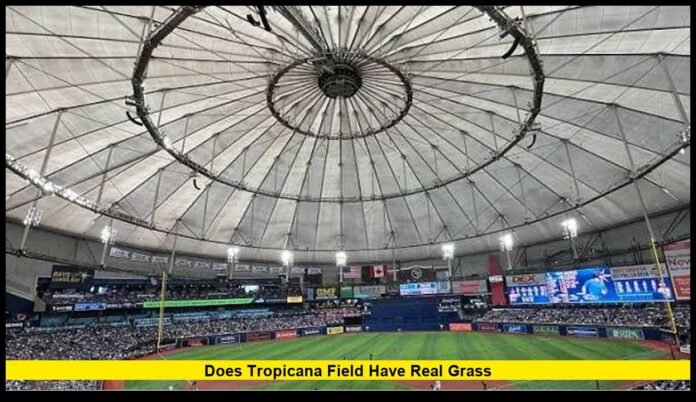

Tropicana Field in St. Petersburg, Florida, uses artificial turf rather than natural grass, and its 2026 playing surface features a new installation designed for Major League Baseball. The Tampa Bay Rays returned to their longtime home on April 6, 2026, after extensive repairs following Hurricane Milton, bringing a newly installed field back into the spotlight.
The surface is more than a cosmetic feature. It affects how the ball moves, how players navigate the field, and how stadium crews maintain the diamond. Although the green surface resembles a traditional baseball lawn, its construction and upkeep differ significantly from those of a natural-grass field.
The Direct Answer: Tropicana Field Does Not Have Natural Grass
The green playing surface at Tropicana Field consists of manufactured turf fibers. These fibers create the appearance of grass without requiring living plants, soil-based growth, or direct sunlight to remain green.
The distinction is especially relevant because Tropicana Field has a fixed roof. Unlike an outdoor ballpark, it cannot expose its entire playing surface to direct sunlight by opening the roof. Growing and maintaining natural grass under these conditions would present additional challenges.
Artificial turf provides a practical alternative for the enclosed stadium. It allows the Rays to maintain a consistent-looking field without relying on sunlight, seasonal growth, or the routine mowing required for a natural lawn.
However, synthetic turf still needs professional maintenance. Stadium personnel must inspect the material, manage the infill, address worn sections, and preserve the condition of the surface throughout the baseball season.
Fans may see green stripes, brown infield areas, and an orange-brown warning track when watching a game. Those different colors represent separate playing zones and materials rather than a field covered entirely in natural grass.
What Is the New Turf at Tropicana Field Made Of?
The Rays’ restored field uses Shaw Sports Turf, a synthetic playing-surface system installed as part of the stadium’s return to baseball in 2026.
The installation covers more than 137,000 square feet. Its dark and light green stripes create the familiar appearance of a professionally maintained baseball field.
The construction includes several layers and specialized materials. A three-quarter-inch padding mat sits over the concrete floor, providing a base for the turf installation.
The panels also vary in width depending on their location. Outfield sections measure 15 feet wide, while infield turf panels measure 7.5 feet wide.
The restored playing area incorporates the following features:
| Field component | Material or specification |
|---|---|
| Green playing surface | Shaw Sports Turf synthetic fibers |
| Total turf area | More than 137,000 square feet |
| Base padding | Three-quarter-inch mat over concrete |
| Outfield panels | 15 feet wide |
| Infield panels | 7.5 feet wide |
| Infield material | DuraEdge baseball infield clay |
| Green turf infill | Coconut material and sand |
| Warning track | Crushed walnut shells and sand |
These specifications show that the field is a purpose-built baseball surface rather than ordinary artificial grass used in landscaping.
The different materials also serve different roles. The synthetic fibers provide the green playing surface, the infield mixture creates a suitable dirt area, and the warning track offers a distinct zone near the outfield wall.
Why Does Tropicana Field Use Artificial Turf Instead of Real Grass?
Tropicana Field’s enclosed design is one of the principal reasons synthetic turf is suitable for the stadium.
Natural grass needs sunlight to support photosynthesis and maintain healthy growth. It also requires water, nutrients, and suitable growing conditions. A fixed-roof stadium limits the sunlight available to the playing surface, making natural grass more difficult to maintain.
Artificial turf removes the need to grow living grass beneath the roof. The synthetic fibers do not depend on sunlight, and the field does not need to recover through new grass growth after routine use.
This arrangement can simplify certain maintenance tasks. Grounds crews do not need to mow the synthetic green areas or manage grass-growth cycles. They can concentrate on the condition of the installed surface and the materials used in different sections of the diamond.
There are other practical considerations, too. Professional baseball involves repeated running, sliding, pivoting, and sudden changes of direction. The playing surface must withstand those movements throughout a long season.
A manufactured field can provide a durable playing area, but its performance depends on the specific product, installation, and upkeep. Artificial turf is not automatically maintenance-free or identical across every stadium.
For Tropicana Field, the combination of a fixed roof and the demands of professional baseball helps explain why a synthetic surface remains a practical choice.
How Hurricane Milton Led to a New Playing Surface
Tropicana Field’s current turf is closely connected to the stadium’s major restoration project.
In October 2024, Hurricane Milton tore away substantial sections of the stadium’s roof. Rain entered the building, causing damage to interior areas and stadium systems. The destruction left the Rays without their regular home venue for the 2025 season.
The team played its home games at Steinbrenner Field in Tampa while repairs continued in St. Petersburg.
Restoration work extended beyond the roof. Crews addressed water damage, repaired interior spaces, restored stadium systems, and prepared the building for baseball operations. The project also included a new artificial playing surface.
The replacement roof was completed in late 2025, allowing work inside the stadium to advance. The field was then prepared for the Rays’ return.
The team resumed playing at Tropicana Field on April 6, 2026, against the Chicago Cubs. The return ended an extended absence from the stadium that had served as the franchise’s home since 1998.
The new turf was therefore part of a broader effort to make the building ready for professional baseball again. It was not simply a change in the field’s color or appearance.
Did the Rays Have Artificial Turf Before 2026?
Yes. Artificial turf has been a longstanding feature of Tropicana Field, although the materials and installations have changed over time.
The stadium opened in 1990 and became the Rays’ home when the franchise began competing in Major League Baseball in 1998. Over the years, the playing surface underwent multiple replacements and modifications.
A notable installation arrived before the 2024 season. That surface featured a striped design and a coconut-based infill system intended to influence how baseballs moved across the field.
The hurricane subsequently exposed the stadium to rainwater and prolonged weather conditions that damaged parts of the playing environment. The existing field had to be replaced during the restoration.
The 2026 installation introduced a new surface, again using synthetic turf. Its coconut-and-sand infill mixture differs in composition from the rubber-pellet systems used at some other artificial fields.
These changes illustrate an important point: artificial turf is not one universal product. Manufacturers can vary fiber construction, infill materials, padding, and other features to produce different playing characteristics.
The Rays’ field has evolved through successive installations, but it has not become a conventional natural-grass playing field.
Does the Artificial Surface Change How Baseballs Bounce?
Yes. A baseball’s movement can differ depending on whether it travels across natural grass, artificial turf, or the dirt portions of a field.
On a natural-grass surface, factors such as grass height, soil firmness, moisture, and field maintenance can influence a ground ball. Synthetic turf has its own characteristics, including fiber design, infill composition, and surface firmness.
These variables can affect how quickly a ground ball travels and how consistently it bounces. The exact outcome depends on the field’s construction and condition rather than the simple presence of artificial grass.
Tropicana Field’s turf has received attention because the Rays have adjusted its infill materials over time. Coconut-based material has been used as an alternative to rubber pellets in efforts to achieve more predictable ball movement.
The 2026 surface uses a coconut-and-sand mixture in the green areas. Its specific performance depends on the installed system and how the field settles and responds to repeated play.
What This Means for Infielders
Infielders must judge the speed, direction, and bounce of ground balls. A firm or fast-playing surface can reduce the time available to react, while unpredictable hops can make routine plays more difficult.
The field’s construction therefore matters to defensive players. A consistent surface can help players anticipate the ball’s movement, although no surface can eliminate every irregular bounce.
What Outfielders Need to Consider
Outfielders must account for footing as they accelerate, turn, and approach the warning track. The transition between the green turf and the separate track material is particularly important when a player nears the wall.
The condition of the surface also affects how confidently players can move while tracking fly balls.
How the Surface Affects Base Runners
Base runners accelerate out of the batter’s box, round bases, and make abrupt stops. Their interaction with the turf depends partly on footwear, traction, and the characteristics of the playing surface.
These factors help explain why grounds crews must pay attention to more than the field’s appearance. The surface needs to support the physical demands of professional baseball.
Does Tropicana Field Have Real Grass in the Infield?
The stadium’s green areas use artificial turf, but the infield includes a separate dirt surface.
The restored field incorporates DuraEdge infield material, which is designed for baseball. The installation uses a substantial quantity of this material to create the areas around the bases and pitcher’s mound.
The warning track also differs from the green turf. It uses crushed walnut shells and sand to create a separate surface near the outfield wall.
This combination is common in the design of baseball diamonds, where different areas perform different functions. The infield dirt provides the playing conditions required for fielding and running, while the warning track helps distinguish the area near the boundary.
Consequently, the presence of brown dirt around the bases does not mean the stadium has natural grass. The green playing areas remain synthetic.
Is Tropicana Field the Only MLB Stadium With Artificial Turf?
No. Several Major League Baseball stadiums use synthetic playing surfaces.
Chase Field in Phoenix, Rogers Centre in Toronto, loanDepot park in Miami, and Globe Life Field in Arlington, Texas, are among the major-league venues associated with artificial turf.
Other stadiums use natural grass. The decision depends on a range of factors, including stadium design, climate, field construction, maintenance requirements, and operational priorities.
A roof alone does not determine the type of playing surface. Some stadiums have retractable roofs and natural grass, while others use synthetic material.
Tropicana Field’s fixed roof limits direct sunlight, which makes artificial turf a logical option for its playing environment.
The choice also demonstrates how baseball stadiums can use different technologies while preserving the traditional layout of the sport. A synthetic surface can still provide green playing areas, dirt infields, and warning tracks in the familiar arrangement expected by players and fans.
How Is Artificial Turf Maintained at Tropicana Field?
Synthetic turf requires a different maintenance routine from natural grass. Grounds crews do not need to mow or encourage plant growth, but they must monitor the condition of the manufactured surface.
Regular inspections help identify worn areas, loose seams, and other problems that could affect play. Crews also need to maintain the turf’s infill and check transitions between the synthetic field, infield dirt, and warning track.
The condition of the infield material is equally important. Dirt areas must remain suitable for fielding, pitching, and sliding, while the warning track must retain its intended characteristics.
Artificial turf can eventually wear out even when maintained carefully. Replacing it allows stadium operators to install updated materials and address the demands of professional baseball.
The 2026 restoration demonstrates this process. The Rays returned to a newly installed surface after the stadium underwent extensive repairs, giving the grounds crew a fresh field to maintain.
The system reduces the need for conventional grass-growing tasks, but it does not remove the need for specialist field management.
Frequently Asked Questions
Does Tropicana Field have real grass?
No. The green playing areas use artificial turf rather than living grass. The field also includes separate infield dirt and warning-track materials.
What artificial turf does Tropicana Field use?
The restored field uses Shaw Sports Turf. The installation covers more than 137,000 square feet and features a coconut-and-sand infill mixture in the green areas.
When did Tropicana Field receive its new turf?
The new surface was installed during the stadium’s restoration ahead of the 2026 baseball season. The Rays returned to the venue on April 6, 2026.
Why doesn’t Tropicana Field grow natural grass?
Its fixed roof limits direct sunlight, making natural grass more difficult to grow and maintain. Synthetic turf avoids that growing requirement.
Does the stadium use real dirt?
The infield uses specialized baseball dirt material, while the warning track has a separate mixture of crushed walnut shells and sand.
Can artificial turf affect baseball games?
Yes. Turf construction, infill, firmness, and maintenance can influence ground-ball movement and player footing. The exact effects vary by installation.
Does artificial turf need replacing?
Yes. Synthetic surfaces experience wear over time and may need repairs or complete replacement. A new installation can also introduce different materials or playing characteristics.
Final Takeaway
Tropicana Field’s playing field is artificial, not natural grass. Its latest installation uses Shaw Sports Turf and specialized materials for the green field, infield, and warning track. The surface was installed during the restoration following Hurricane Milton and was ready for the Rays’ return in April 2026.
The stadium’s fixed roof makes synthetic turf a practical choice because the field does not depend on direct sunlight to maintain its green appearance. At the same time, the playing surface remains an important part of field maintenance and baseball performance.
Have you watched a game at Tropicana Field or played on artificial turf yourself? Share your experience in the comments and keep following the latest updates on MLB stadiums and playing surfaces.