
Tax increment financing has become an important tool for local governments seeking to encourage economic growth, improve public infrastructure, and revitalize underdeveloped neighborhoods. Understanding what is tax increment financing can help homeowners, business owners, real estate investors, and taxpayers see how municipalities fund major development projects and how those decisions may affect public budgets. Known as TIF, this financing method uses designated increases in property tax revenue to help pay for eligible redevelopment expenses.
Cities across the United States use tax increment financing to address development challenges, support infrastructure improvements, and attract private investment. Depending on state law, the funding may support commercial construction, residential projects, environmental cleanup, roads, utilities, and other improvements.
Although TIF can create opportunities for economic development, it also raises concerns about public spending, school funding, financial risk, and the long-term distribution of tax revenue. Understanding its structure, advantages, limitations, and real-world applications is essential for evaluating whether a TIF district delivers meaningful benefits to a community.
Key Points Summary
╔════════════════════════════════════════════════════════════════════╗
║ – Tax increment financing uses designated future property tax revenue growth to help fund eligible redevelopment projects. ║
║ – Local governments establish TIF districts with defined boundaries and an initial property tax base. ║
║ – Common applications include infrastructure improvements, commercial redevelopment, housing projects, and environmental cleanup. ║
║ – TIF does not automatically create a new property tax rate, but it can affect how future tax revenue is distributed. ║
║ – Financial uncertainty, school funding concerns, and limited transparency are among the major criticisms of TIF. ║
║ – The rules governing TIF districts, eligible expenses, and financing periods vary by state and local jurisdiction. ║
╚════════════════════════════════════════════════════════════════════╝
What Is Tax Increment Financing and Why Do Cities Use It?
Tax increment financing is a public financing mechanism that allows an authorized government entity to direct certain increases in property tax revenue toward designated development or redevelopment expenses.
The process begins when a municipality identifies an area where investment is needed. The location might contain vacant commercial buildings, aging infrastructure, abandoned industrial sites, or properties that are difficult to redevelop because of high construction costs.
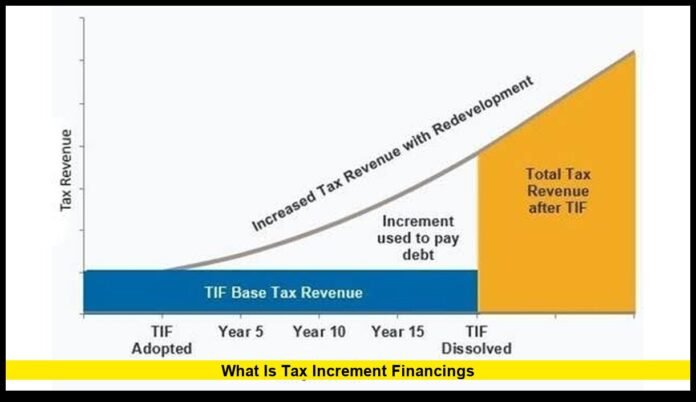
The government establishes a baseline property value for the designated area. As new construction, rehabilitation, and other economic activity increase taxable property values, additional property tax revenue may become available.
Under the applicable TIF arrangement, some or all of that incremental revenue can be placed into a dedicated fund to pay for eligible project expenses.
The main objective is to use anticipated economic growth to finance improvements that may encourage further development.
For example, a city might need to replace outdated water lines and improve roads before a developer can construct a commercial complex. TIF financing could help cover qualifying infrastructure costs, making the project more financially feasible.
However, the arrangement does not guarantee that development will occur or that the expected tax revenue will materialize.
How Does Tax Increment Financing Work?
TIF generally follows several stages, although legal procedures and financial arrangements differ among states.
1. Identifying an Area for Redevelopment
Local officials identify a geographic area that may benefit from additional investment. Depending on state law, the area might need to meet specific requirements involving blight, economic distress, obsolete infrastructure, or redevelopment potential.
Municipalities may commission feasibility studies to determine whether the proposed project is financially practical and whether TIF is an appropriate financing option.
2. Creating a TIF District
The government defines the district’s boundaries and prepares a redevelopment or financing plan. The approval process may include public hearings, notices to affected taxing authorities, financial projections, and legislative approval.
The plan generally outlines the development objectives, estimated costs, proposed funding arrangements, and anticipated duration.
3. Establishing the Original Tax Base
Officials determine the taxable property value within the district at the legally specified starting point.
This value establishes the baseline against which future growth is measured. Property tax revenue associated with the baseline generally continues to be distributed according to the applicable tax allocation arrangements.
4. Encouraging New Investment
The municipality may support qualifying infrastructure improvements, environmental remediation, site preparation, or other authorized expenses.
Private developers may then construct buildings, renovate properties, or introduce new commercial and residential uses.
The goal is to increase economic activity and strengthen the district’s taxable property value.
5. Collecting Incremental Revenue
As taxable property values increase above the baseline, the district may generate additional property tax revenue.
The eligible portion of this increase is allocated according to the TIF program’s rules. Actual collections depend on assessments, tax rates, exemptions, collection rates, and participating taxing jurisdictions.
6. Paying Eligible Expenses
Revenue collected through the district can help reimburse qualifying development expenses or pay obligations associated with financing improvements.
When the district reaches its legal expiration date or satisfies its financing obligations, revenue allocation generally returns to the applicable ordinary tax distribution arrangements.
A Practical Example of Tax Increment Financing
Consider a hypothetical city that establishes a TIF district with an initial taxable property value of $25 million.
Following several years of redevelopment, the district’s taxable value increases to $40 million.
The increase is $15 million.
If the applicable property tax rate is 2%, the theoretical annual tax revenue associated with that additional taxable value would be $300,000.
The calculation is:
$15 million × 2% = $300,000 in potential annual incremental property tax revenue.
Under the district’s financing rules, some or all of this amount could support eligible infrastructure expenses, reimburse a developer for approved improvements, or contribute to debt repayment.
This example is simplified. Actual TIF revenue may be lower because of exemptions, changes in tax rates, collection shortfalls, excluded levies, and other statutory restrictions.
The example also illustrates why TIF performance depends on economic conditions. If property values remain flat or development is delayed, the district may generate less revenue than officials originally projected.
What Projects Can TIF Financing Support?
The types of projects eligible for TIF funding depend on state statutes and local redevelopment plans. Common applications include the following.
Infrastructure and Public Improvements
Municipalities may use eligible TIF revenue to finance road repairs, sidewalks, drainage systems, utility upgrades, street lighting, and public parking improvements.
These projects can address infrastructure problems that prevent private development or limit access to existing businesses.
Commercial and Mixed-Use Development
TIF may help finance qualifying costs associated with downtown redevelopment, retail centers, office buildings, and mixed-use properties.
Such projects can introduce new businesses, improve vacant sites, and increase activity in commercial districts.
Affordable Housing
Some jurisdictions permit TIF revenue to support affordable housing construction, rehabilitation, or related infrastructure.
Housing-related provisions vary considerably. Certain programs establish specific affordability requirements or dedicate portions of revenue to housing initiatives.
Environmental Remediation
Former industrial properties may require expensive environmental cleanup before they can be reused.
Where authorized, TIF can support remediation, demolition, site preparation, and related expenses that make redevelopment possible.
Industrial Development and Employment Centers
Some TIF programs support industrial sites, manufacturing facilities, and business parks. Eligible improvements may include roads, utilities, and other infrastructure required to accommodate business investment.
Although these projects may create employment opportunities, job creation depends on the actual performance of the businesses involved.
What Are the Main Benefits of Tax Increment Financing?
Encourages Private Investment
Development can be difficult when infrastructure deficiencies or site preparation costs make a project financially unattractive.
TIF can help address certain expenses, allowing developers to pursue projects that might otherwise be delayed or abandoned.
Improves Neighborhood Infrastructure
Better roads, utilities, drainage, and pedestrian facilities can benefit existing residents and businesses as well as new developments.
These improvements may also make an area more attractive for future investment.
Supports Long-Term Tax Base Growth
Successful redevelopment can increase taxable property values and economic activity. When a TIF district expires, the additional tax revenue may become available for ordinary distribution among participating taxing jurisdictions.
The timing and extent of these benefits depend on the district’s performance and governing rules.
Revitalizes Underused Properties
Vacant buildings and contaminated industrial sites can remain unused for years because redevelopment costs are too high.
TIF can help close financing gaps and support the reuse of properties that might otherwise continue to deteriorate.
What Are the Risks and Disadvantages of TIF?
Despite its potential, TIF can create significant financial and policy challenges.
Concerns About School Funding
Property taxes are an important source of revenue for many school districts.
When certain tax increments are committed to redevelopment, participating school systems may not immediately receive the full benefit of future property tax growth. The impact depends on state funding formulas, participating tax levies, and district agreements.
Uncertain Financial Returns
TIF projections rely on assumptions about property values, construction schedules, and economic activity.
A recession, delayed development, or weak demand can reduce anticipated revenue. If the district has outstanding debt, lower collections may complicate repayment.
Projects That May Have Happened Anyway
Critics question whether some publicly supported developments would have proceeded without TIF assistance.
If a private project would have been completed regardless, public financing may provide less additional economic value than expected.
Officials should therefore evaluate whether public support is necessary and whether the projected benefits justify the cost.
Unequal Community Benefits
Redevelopment can increase rents, raise housing costs, and place pressure on existing small businesses.
Without appropriate planning, some residents may experience higher living costs without receiving a proportional share of the benefits.
Limited Budget Flexibility
Once future tax revenue is committed to an approved project or debt obligation, local governments may have less flexibility to use that revenue for schools, public safety, parks, or other services.
Transparent financial reporting is essential to understanding these trade-offs.
Does Tax Increment Financing Increase Property Taxes?
A traditional TIF district does not automatically establish a new property tax rate. Instead, it generally changes the allocation of designated future tax revenue growth.
However, property owners may still experience increases in their tax bills because of rising assessed values, changes in tax rates, voter-approved levies, or other local tax policies.
TIF may also influence local government finances when certain revenue growth is committed to redevelopment instead of being immediately available for general public services.
The effect on individual taxpayers depends on local assessment practices, the district’s financial structure, and the rules governing participating taxing jurisdictions.
TIF vs. Tax Abatement: Understanding the Difference
Tax increment financing and tax abatement are both used to encourage economic development, but their mechanisms differ.
TIF generally directs designated future tax revenue growth toward eligible project expenses. Tax abatement reduces or eliminates qualifying tax obligations for a specified period or under certain conditions.
TIF is often used to finance infrastructure and redevelopment costs, while tax abatement is frequently intended to reduce the tax burden on qualifying businesses or property owners.
Both approaches involve public policy trade-offs. Governments must consider potential economic benefits alongside revenue that may be unavailable for other purposes.
How Long Can a TIF District Remain Active?
The permitted duration of a TIF district depends on state law, the district’s establishment date, its purpose, and any authorized extensions.
Some districts operate for a limited period, while others may remain active for several decades.
For example, traditional Illinois TIF districts generally have a 23-year duration, although certain districts may qualify for legally authorized extensions.
Other states use different timelines and financing rules.
Before approving a district, residents should examine its expected expiration date, projected debt obligations, and the conditions under which captured tax revenue will return to ordinary allocation.
How to Evaluate a Proposed TIF District
Residents, business owners, and local officials can evaluate a proposed district by examining its financial assumptions and expected community benefits.
Important questions include:
- Would the project proceed without public financial assistance?
- What specific infrastructure or redevelopment improvements will be delivered?
- How much tax increment revenue is expected to be collected?
- What happens if property values increase more slowly than projected?
- How will participating school districts and other taxing authorities be affected?
- Are the developer’s obligations and public benefits clearly documented?
- Will annual financial statements and project results be available to residents?
- Could redevelopment increase housing costs or displace existing businesses?
A credible TIF plan should contain realistic projections, clearly defined eligible expenses, appropriate financial safeguards, and measurable performance objectives.
Frequently Asked Questions
1. What is tax increment financing in simple terms?
Tax increment financing is a public funding method that uses designated increases in property tax revenue to help pay for eligible development projects within a specific area.
2. Who benefits from tax increment financing?
Potential beneficiaries include municipalities, developers, property owners, local businesses, and residents who benefit from improved infrastructure. The distribution of benefits depends on project design and implementation.
3. Where does TIF money come from?
TIF money generally comes from the eligible portion of property tax revenue generated above a district’s established baseline. Some projects also use bonds, developer financing, or other authorized funding arrangements.
4. Can TIF be used for housing?
Yes. Certain jurisdictions allow TIF to support housing construction, rehabilitation, affordable housing initiatives, and related infrastructure, subject to applicable laws.
5. What happens when a TIF district fails to generate enough revenue?
Insufficient revenue can delay reimbursements, reduce available project funding, or create challenges meeting debt obligations. The consequences depend on financing agreements and any guarantees.
6. Is TIF available throughout the United States?
Many states authorize some form of tax increment financing, but eligibility requirements, district duration, permitted uses, and approval procedures differ by state.
7. Is tax increment financing good for taxpayers?
TIF can benefit taxpayers when it supports necessary improvements and creates additional economic activity. However, the public value may be limited if a project would have occurred without assistance or if financial risks are poorly managed.
8. What happens after a TIF district expires?
Once the district expires and outstanding obligations are addressed, captured tax revenue generally returns to ordinary allocation under applicable state and local rules.
Conclusion
Tax increment financing offers local governments a way to connect future property tax revenue growth with present-day redevelopment needs. It can support infrastructure, encourage private investment, improve underused properties, and help communities pursue long-term development goals.
However, TIF requires careful planning because the revenue it captures could otherwise support other public services. Uncertain property values, financing risks, and unequal community benefits can limit its effectiveness.
For residents and policymakers, the most important consideration is whether a proposed TIF district delivers measurable public benefits that justify committing future tax revenue. Transparent agreements, realistic projections, and ongoing oversight can help communities make better-informed decisions about this widely used development financing tool.