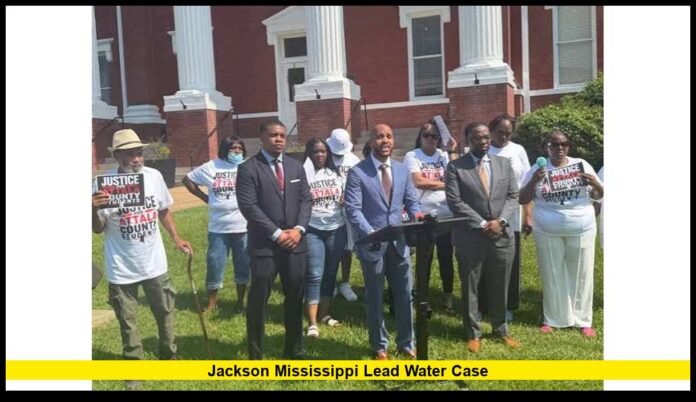

The Jackson Mississippi lead water case has reached a major legal turning point after the U.S. Court of Appeals for the Fifth Circuit upheld the dismissal of a lawsuit brought by Jackson residents who alleged that city officials allowed lead contamination in the municipal water system and failed to provide accurate information about the safety of the water.
The decision, issued September 4, 2026, ends the residents’ federal constitutional claims at the appellate level unless further legal action changes the outcome. The case had been closely watched because the allegations involved drinking-water safety, government responsibility and the constitutional protections available to residents affected by alleged public-system failures.
The ruling does not declare lead exposure harmless. It also does not erase the history of water problems in Jackson. Instead, the court focused on a narrower legal question: whether the Constitution provides the specific rights the plaintiffs claimed were violated.
Why the Jackson Water Lawsuit Matters
The lawsuit began with concerns about the quality and safety of water supplied through Jackson’s municipal system.
Residents Priscilla Sterling, Raine Becker, Shawn Miller and John Bennett filed the lawsuit in 2022. They brought claims individually and sought to represent other residents who received water through the city’s system.
Their allegations centered on lead contamination and the actions of city officials.
The residents claimed that decisions involving the city’s water system contributed to lead entering the drinking-water supply. They also alleged that officials knew about the risks but still told residents that the water was safe.
The plaintiffs argued that these circumstances violated their constitutional rights.
Their case therefore went beyond a conventional dispute about infrastructure or government negligence. They attempted to establish that the alleged conduct amounted to a violation of substantive due-process protections under the Fourteenth Amendment.
That constitutional argument ultimately became the central issue before the Fifth Circuit.
What the Fifth Circuit Decided
The full Fifth Circuit rejected the residents’ constitutional claims.
The court’s majority concluded that the plaintiffs were asking it to recognize constitutional rights that are not deeply rooted in the nation’s history and traditions.
Two proposed rights received particular attention.
The first involved a claimed right to be free from exposure to contaminated municipal drinking water.
The second involved a claimed right to receive accurate information from public officials about contaminants in the water supply.
The majority said neither right had the historical foundation required for protection under substantive due process.
That conclusion led the court to affirm the dismissal of the residents’ federal claims.
The ruling was issued by the court sitting en banc, meaning the case was considered by the full group of eligible Fifth Circuit judges rather than the smaller three-judge panel that ordinarily hears an appeal.
The Case Took a Different Direction in 2025
The latest decision is particularly important because it replaced an earlier appellate ruling.
In 2025, a three-judge Fifth Circuit panel had revived part of the residents’ lawsuit. That panel concluded that the allegations could support a constitutional claim involving bodily integrity and recognized the state-created-danger theory as potentially viable.
The full Fifth Circuit later agreed to reconsider the matter.
Once the en banc court accepted the case, the earlier panel decision was vacated.
The full court then reached a different conclusion.
That change explains why the September 2026 decision represents such an important development. The residents had previously received an opportunity to continue their constitutional claims after the panel ruling. The full court’s decision removed that path.
What Residents Alleged About Lead Contamination
The allegations described in the case were serious.
The plaintiffs pointed to water testing conducted by the Mississippi State Department of Health between 2010 and 2013. They argued that the testing showed increasing levels of lead in Jackson’s water.
They also alleged that city officials were aware of problems involving the city’s ability to control corrosion in its water system.
According to the lawsuit, changes to the city’s water source contributed to conditions that allowed lead to leach from pipes into drinking water.
The residents argued that officials failed to take adequate steps to prevent the problem from worsening.
They further alleged that public statements about the safety of the water gave residents reassurance that was not supported by the conditions inside the water system.
Those allegations formed the factual foundation of their constitutional claims.
Importantly, the appellate court’s decision did not conduct a new scientific investigation into each allegation. At this stage of the case, the question was whether those allegations created a constitutional cause of action.
The Bodily Integrity Argument
One of the plaintiffs’ most important arguments involved bodily integrity.
The residents argued that people have a constitutional interest in controlling what enters their bodies. They attempted to connect that principle to alleged exposure to contaminated drinking water.
The Fifth Circuit majority rejected that connection.
The court recognized that constitutional law has protected bodily integrity in certain circumstances. Those cases can involve forced medical procedures, unwanted medication and other direct physical intrusions.
But the majority said municipal water-system failures are fundamentally different.
According to the court, the alleged exposure resulted from the operation and management of a public utility rather than a government official physically forcing a substance into a person’s body.
That distinction was central to the ruling.
The majority concluded that expanding bodily-integrity protections to cover the alleged circumstances would create a new constitutional right without sufficient historical support.
The Court Also Rejected the Information Claim
The plaintiffs also argued that officials misrepresented the safety of Jackson’s drinking water.
Their position was that residents had a constitutional right to accurate information about potentially dangerous contaminants in the public water supply.
The majority rejected that argument as well.
The judges recognized that government officials are expected to communicate responsibly, especially during public-health situations. However, the court concluded that the Fourteenth Amendment does not establish a broad constitutional right to truthful statements from government officials in these circumstances.
That distinction is important.
The court was not saying that officials should be permitted to mislead residents without consequences under every possible legal theory.
Instead, the court said the specific constitutional theory presented by the plaintiffs could not provide the remedy they sought.
Why the Constitution Was Not Enough for This Lawsuit
The majority emphasized the limits of substantive due process.
Courts have repeatedly warned against creating new constitutional rights without strong historical or legal foundations. The Fifth Circuit applied that approach to the Jackson case.
The judges concluded that the alleged injuries, even if serious, did not automatically become constitutional injuries.
That reasoning shaped the entire decision.
The court essentially separated two questions:
- Whether the allegations described serious problems involving the city’s water system.
- Whether those problems violated a constitutional right enforceable through federal civil-rights law.
The majority concluded that the first question did not establish the second.
That meant the plaintiffs’ federal claims could not continue.
A Dissent Argued the Case Should Continue
The decision was not unanimous.
Judge Catharina Haynes wrote a partial dissent, joined by several other judges.
The dissent took a substantially different view of the allegations.
Rather than ending the case at the pleading stage, the dissent argued that the residents should have been allowed to develop their claims through discovery.
The dissent highlighted allegations concerning changes to Jackson’s water supply, corrosion problems, alleged misleading statements and the city’s handling of information about water-system violations.
The dissent also emphasized the state-created-danger theory.
Under that theory, government responsibility can be different when officials allegedly create or increase a danger rather than merely fail to protect people from an existing danger.
The dissent argued that the residents had presented enough factual allegations to justify allowing the case to move forward.
That disagreement shows how sharply the judges differed over the constitutional questions.
The State-Created-Danger Theory
The state-created-danger issue became another major dividing line in the case.
The plaintiffs argued that Jackson officials did more than simply fail to provide safe water.
They alleged that government decisions contributed to circumstances that increased the danger of lead contamination.
The earlier Fifth Circuit panel had been willing to recognize this theory as potentially viable.
The en banc majority took a different approach and concluded that the plaintiffs’ substantive-due-process theories were not constitutionally cognizable.
The dissent criticized that approach and argued that the allegations deserved further factual examination.
For the residents, this difference was significant because discovery could have allowed them to obtain additional records and testimony concerning decisions made by city officials.
The en banc ruling prevented that federal constitutional path from continuing.
The Lawsuit Named Multiple Defendants
The case was not directed only at the City of Jackson.
The plaintiffs also named former mayors Chokwe A. Lumumba and Tony Yarber, along with former public works officials Kishia Powell, Robert Miller and Jerriot Smash.
Trilogy Engineering Services was also named as a defendant.
The allegations varied depending on the individual defendant and their alleged role in the city’s water system.
The court separately noted that the plaintiffs failed to make sufficient factual allegations connecting Jerriot Smash to the management of the water system.
The broader constitutional claims, however, failed because the court determined that the asserted rights themselves were not protected under the theory advanced by the residents.
Qualified Immunity Was Another Barrier
The court also discussed qualified immunity.
Qualified immunity can protect government officials from money-damages claims when the law did not clearly establish that their specific conduct violated a constitutional right.
The Fifth Circuit found that the plaintiffs could not identify controlling authority or a sufficiently strong body of legal precedent establishing a constitutional right to lead-free municipal drinking water or truthful information from officials under the circumstances alleged.
That provided an additional problem for the plaintiffs.
Even if the court had viewed their constitutional theory differently, the question of whether the individual officials could be held personally liable would still have required analysis under qualified-immunity rules.
The majority therefore found another legal obstacle to the claims against individual officials.
The Court Did Not Rule That Lead Is Safe
One point deserves particular attention.
The ruling should not be interpreted as a statement that lead-contaminated water is safe.
The court’s decision concerns constitutional law.
It did not conclude that lead exposure has no health consequences. It did not establish that Jackson’s water infrastructure has no problems. It did not declare that residents should ignore water-quality information from health authorities.
The lawsuit involved specific allegations and specific legal claims.
The court’s decision simply determined that those allegations did not establish the particular constitutional rights needed to maintain the federal claims.
That distinction is especially important when discussing the case publicly.
What the Decision Means for Jackson Residents
For Jackson residents, the most immediate consequence is legal rather than a change in the water system itself.
The Fifth Circuit’s ruling means the federal constitutional claims brought in this case have been dismissed.
However, the court pointed toward other possible avenues for addressing alleged injuries.
Those avenues can include state-law claims, regulatory enforcement, legislative action and political accountability.
The decision also acknowledged that Mississippi and federal authorities have been working to address Jackson’s water-quality problems through regulations, investigations and compliance measures.
Therefore, the court’s ruling does not end government oversight of Jackson’s water system.
Water Infrastructure Remains at the Center of the Issue
Jackson’s water problems have developed over many years.
Aging infrastructure, treatment challenges, corrosion control and service-line identification have all played roles in discussions about the city’s water supply.
Lead contamination can be particularly difficult because lead may enter water through plumbing and service-line materials rather than originating in the source water itself.
That makes corrosion control and infrastructure management important.
It also means that identifying the materials used throughout a water-distribution network can be a major part of addressing potential exposure.
The court’s decision does not change the importance of those infrastructure responsibilities.
Why the 2026 Decision Could Have Broader Consequences
The ruling may influence future lawsuits involving municipal services.
The Fifth Circuit has drawn a clear line between serious government failures and violations of constitutionally protected rights.
Residents who experience harm because of problems involving water, sanitation, infrastructure or other public services may not automatically be able to use substantive due process as a federal remedy.
That does not necessarily mean other legal claims are unavailable.
Instead, the decision reinforces the importance of selecting the correct legal theory when challenging government conduct.
The ruling may also become relevant in future cases involving alleged government-created dangers and efforts to expand substantive due-process protections.
What Happens After the Court’s Decision
The September 2026 ruling closes an important chapter in this particular lawsuit.
The residents’ constitutional claims cannot continue under the theory rejected by the en banc Fifth Circuit.
The broader water-quality questions, however, remain separate.
Jackson’s water system continues to face regulatory oversight and infrastructure challenges. Government agencies remain involved in efforts to improve compliance and water quality.
For residents, future developments could therefore focus on infrastructure improvements, water testing, regulatory compliance and any additional legal or governmental action.
The court’s decision changes the legal landscape, but it does not remove the underlying importance of maintaining a safe and reliable public water system.
Key Takeaways
- The Fifth Circuit upheld dismissal of the residents’ federal constitutional claims.
- The decision was issued September 4, 2026.
- The lawsuit was filed in 2022.
- The plaintiffs alleged that city actions contributed to lead entering Jackson’s drinking water.
- They also alleged that officials misrepresented the safety of the water.
- The court rejected the claimed constitutional right to be free from exposure to contaminated municipal water.
- The court also rejected the claimed constitutional right to accurate information from officials about water contamination.
- A dissent argued that the allegations should have been allowed to proceed to discovery.
- The ruling does not establish that lead exposure is safe.
- Regulatory and infrastructure efforts involving Jackson’s water system remain separate from the court’s constitutional ruling.
Frequently Asked Questions
1. What is the latest development in this lawsuit?
The Fifth Circuit’s full court upheld the dismissal of the residents’ federal constitutional claims on September 4, 2026.
2. Did the court say Jackson’s water is safe?
No. The decision addressed the constitutional claims in the lawsuit. It did not issue a general finding that Jackson’s water system is free from contamination concerns.
3. Can residents still pursue other remedies?
The court indicated that other avenues may exist, including state-law claims, legislative action and regulatory mechanisms. The availability of a particular remedy depends on the facts and applicable law.
The latest ruling has reshaped the legal fight over Jackson’s water, and the story is still worth watching—share your thoughts below and stay informed as new developments emerge.
Disclaimer: This article is intended for general informational and news purposes only. It is not legal, medical, environmental or regulatory advice. Court decisions and government actions can change, and readers should consult qualified professionals or appropriate government agencies for advice concerning individual circumstances.