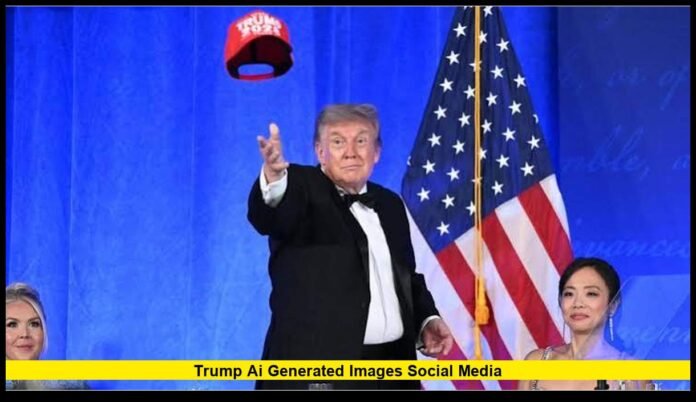

Trump AI generated images social media activity is drawing fresh attention after President Donald Trump shared a large collection of AI-generated pictures, videos, and memes on Truth Social on September 6, 2026. The posts included fictional scenes with George Washington, futuristic robots, Iran, the Moon, Hulk Hogan-style imagery, and a simulated stock-trading scene. The unusually heavy posting activity quickly became a major online discussion in the United States.
The latest activity continues a pattern that has made AI imagery a regular part of Trump’s online communication. His Truth Social account has increasingly mixed political statements with digitally created visuals, memes, satire, fictional scenes, and exaggerated depictions of himself.
The September 6 posts were particularly notable because they covered a wide range of subjects within several hours. Some were clearly impossible or fantastical. Others used real political figures, locations, companies, or international events as part of digitally created scenes.
That distinction matters. An AI-generated image can be intentionally humorous or symbolic, but viewers may still mistake a realistic-looking picture for an authentic photograph if the original context is removed.
Trump’s Latest Truth Social Posting Surge
Trump’s September 6 activity featured a rapid succession of posts. An archive of his Truth Social account records dozens of posts from that afternoon and evening.
Among the images were scenes showing Trump surrounded by giant robots, sitting in futuristic control rooms, appearing alongside historical figures, and appearing in other fictional settings.
One image showed a dramatic robotic scene with American symbols and the message, “THEY WILL DREAM OF US FOREVER.” Another portrayed Trump in a futuristic Space Force setting.
The posting sequence also included imagery focused on Iran. One picture showed a person striking a map of Iran with a large American-themed hammer. Other posts used imagery associated with military power and the Middle East.
The volume of material made the September 6 activity different from a single isolated AI meme.
Instead, AI-generated imagery appeared throughout a much broader stream of political and personal posts.
The George Washington Image Gets Attention
One of the most recognizable images from the latest activity showed Trump alongside George Washington inside the Oval Office.
The scene was fictional. Washington died more than two centuries ago, so no such meeting could have occurred.
The image used artificial imagery to place the current president and America’s first president together in a modern White House setting.
The post illustrates how AI tools can combine historical figures with contemporary political figures. Such images can be created quickly and distributed to large audiences without the need for traditional photography or physical staging.
For viewers, the historical impossibility also makes this type of image relatively easy to identify as fictional.
The challenge becomes greater when AI imagery depicts events that could realistically happen.
Trump’s AI Stock-Market Image
Another major image showed Trump seated at the Resolute Desk surrounded by computer screens displaying stock information.
The screens referenced Intel stock, showing a purchase price of $20 and a later figure of $95. Trump accompanied the image with a statement claiming he had made hundreds of billions of dollars on stocks and other holdings for the United States rather than himself.
The image itself represented a simulated scene. It was not a documentary photograph of Trump sitting at the Resolute Desk conducting stock trades.
The numbers, however, were connected to real Intel market performance. Intel shares had recently climbed sharply, making the image particularly notable because the fictional visual incorporated real market figures.
This combination demonstrates why AI-generated political imagery can require additional context.
A viewer who sees only the picture may not immediately understand which elements represent real information and which elements were created digitally.
Iran and AI-Generated Military Imagery
Iran has also featured prominently in Trump’s recent AI-related posts.
The latest wave included several images using Iran as a subject. Some portrayed Trump in exaggerated military scenes, while another depicted a figure striking a map of Iran.
The imagery followed an earlier controversy involving Kharg Island.
Trump previously shared an AI-generated video showing what appeared to be an attack on Iran’s Kharg Island. The video was not evidence that such an attack had actually taken place.
Vice President JD Vance later said Trump’s post was intended as a message to Iran. A U.S. official also clarified that Kharg Island had not been targeted in the manner suggested by the AI-generated material.
Kharg Island is a real and strategically important Iranian location. That made the distinction between fictional imagery and real military activity especially important.
The episode demonstrated how AI-generated content can become more complicated when it involves an actual location connected to an ongoing conflict.
Why AI Images Are Different From Traditional Political Photos
Traditional political photography normally documents something that happened in a specific place and time.
AI-generated imagery works differently.
It can place a real person in a location they never visited. It can create conversations that never happened. It can combine historical figures who lived centuries apart. It can also construct military scenes that resemble genuine battlefield footage.
That does not automatically make the image deceptive.
Political figures can use obviously fictional artwork as a meme or visual joke. The important issue is whether viewers understand what they are seeing.
Trump’s recent posts demonstrate several different categories of AI content:
- Clearly fictional historical scenes
- Fantasy and superhero-style imagery
- Political memes
- Digitally created military scenes
- AI-generated videos
- Financial-themed visuals
- Exaggerated portraits of Trump
- Images connected to real international events
Each category carries a different level of potential confusion.
The Green Lantern and Pop Culture Imagery
The recent AI wave also extended into popular culture.
One AI-generated video circulated through official presidential social-media channels depicted Trump in a Green Lantern-inspired setting. The imagery placed him in a fictional superhero universe and connected the character’s powers with political themes.
This type of content is easy to distinguish from genuine presidential photography because the visual setting is clearly fantastical.
It also reflects how AI tools allow political communication to borrow instantly from entertainment, comic-book imagery, fantasy, and internet culture.
The result is a style of political communication that can look very different from conventional campaign advertisements or official government photography.
Trump and AI Imagery Have a Longer History
Trump’s use of AI-generated images did not begin with the September 2026 posts.
AI imagery became particularly prominent around Trump’s 2024 presidential campaign.
One of the most widely discussed episodes involved Taylor Swift. Trump shared AI-generated images that falsely suggested Swift and her fans supported his campaign.
The images included a digitally created picture of Swift wearing an Uncle Sam-style outfit and other fictional representations involving supposed Trump supporters.
The incident became an early example of the political power of AI-generated imagery.
Since then, AI image technology has improved rapidly. Creating realistic people, backgrounds, political rallies, military scenes, and public figures has become easier.
Trump’s later social-media activity has shown how these tools can become part of an ongoing political communication strategy.
Not Every Viral Trump Image Comes From Trump
An important part of the current discussion involves false attribution.
The internet contains many AI-generated images featuring Trump. Some are created by supporters. Others come from critics, meme accounts, influencers, entertainment pages, or anonymous users.
A picture showing Trump does not automatically mean Trump created it or posted it.
That distinction has become increasingly important as AI-generated content spreads across X, Facebook, Instagram, TikTok, YouTube, and other platforms.
A screenshot may also remove the original account name or timestamp. Once that happens, identifying the original source becomes harder.
The safest approach is to distinguish between an image that features Trump and an image that Trump himself shared.
The September 6 activity is different because numerous images can be traced to posts from Trump’s Truth Social account.
Truth Social Remains Central to Trump’s Online Communication
Truth Social continues to be the main platform associated with Trump’s direct social-media messaging.
His account is used for political statements, personal commentary, reactions to current events, attacks on critics, economic messages, reposts, memes, and visual material.
The platform therefore provides a direct channel through which Trump can communicate without waiting for a traditional press conference or television interview.
AI-generated imagery fits naturally into this environment because posts can combine text and visual material.
A single post can contain a political message and an image created specifically to reinforce that message.
That combination gives visual content a greater role in presidential communication.
The September 6 Images Covered Multiple Themes
The latest posting spree was not limited to one political subject.
It included:
| Theme | Type of content |
|---|---|
| Historical figures | Trump shown with George Washington |
| Military power | Robots, aircraft and futuristic scenes |
| Iran | Digitally created political and military imagery |
| Space | Fictional Space Force imagery |
| Finance | Trump depicted around stock-market screens |
| Entertainment | Hulk Hogan and superhero-style imagery |
| Geography | AI-assisted visual jokes about U.S. locations |
| Personal promotion | Heroic and exaggerated depictions of Trump |
The variety shows how AI has become a flexible visual medium.
Instead of using one image for one political statement, multiple AI concepts can be produced within a single afternoon.
The New Mexico and Moon Images
The September 6 posting sequence also included unusual geographic themes.
Trump suggested that New Mexico should be renamed “New America.” The proposal appeared during the same broader burst of social-media activity.
Another image declared that the Moon belonged to the United States.
These posts combined political messaging with deliberately exaggerated visual concepts.
The proposed name for New Mexico should not be confused with an actual change to the state’s name. The president does not have unilateral authority to rename a state.
That distinction is important because AI-generated or meme-based political imagery can sometimes make a statement look more official than it actually is.
A visual can be powerful while still having no legal or governmental effect.
Why the Original Post Matters
When an AI-generated image becomes viral, the original post provides essential context.
Readers should examine:
- Who posted the image?
- When was it posted?
- Was the account verified?
- Did the post identify the image as AI-generated?
- Does the image show a real event?
- Are the people and locations depicted accurately?
- Has another credible source confirmed the event?
These questions become especially important for images involving wars, military operations, elections, disasters, public safety, and government actions.
A fictional image should not be treated as evidence that an event occurred.
AI Imagery Can Mix Real and Fictional Information
One of the most important features of Trump’s latest posts is the way real information can appear alongside fictional visuals.
The Intel image is a clear example.
Intel is a real company. Its stock price is real. Trump’s social-media post is real. But the image showing Trump sitting at a trading desk is an AI-created scene.
Similarly, Kharg Island is a real location. The conflict involving Iran is real. Trump’s social-media message was real. But the AI-generated video did not document a real destruction of the island.
This mixture makes context essential.
A viewer can accept the factual portion of a post while incorrectly assuming that the accompanying image is documentary evidence.
The Role of AI in Presidential Social Media
Trump’s latest posts show how artificial intelligence has changed the visual language of political communication.
Presidential communication once relied heavily on photographs, television appearances, campaign graphics, and professionally produced videos.
AI tools now allow political figures to create elaborate visuals without arranging a photo shoot or producing a traditional film.
A fictional scene can be created and posted within a short period.
That capability has made AI imagery an increasingly visible part of online politics.
Trump’s account has become one of the most prominent examples of this trend because of the volume and variety of AI-related material appearing alongside his political posts.
What U.S. Social-Media Users Should Keep in Mind
The biggest lesson from the latest activity is simple: a political image should not automatically be treated as a photograph.
AI-generated images can be visually convincing. They can also use accurate faces, recognizable buildings, real uniforms, real companies, and genuine locations.
That combination can make fictional scenes look plausible.
Users should therefore separate three things:
- The person who posted the content.
- The authenticity of the image.
- The reality of the event depicted.
Those are separate questions.
Trump may genuinely post an AI-generated image. That does not make the scene in the image real.
Likewise, an AI-generated image featuring Trump may circulate online without ever appearing on his official account.
Latest Update on Trump’s AI Social-Media Activity
As of September 7, 2026, Trump’s Truth Social activity continues to include AI-generated images and videos as part of his broader online communication.
The September 6 posting burst included fictional scenes involving George Washington, robots, Iran, Space Force themes, financial markets, entertainment figures, and exaggerated portrayals of Trump.
The activity also followed earlier AI-generated material involving Kharg Island and other political subjects.
The latest developments confirm that AI imagery is no longer an occasional feature of Trump’s social-media presence. It has become a recurring visual format used alongside political statements, memes, jokes, personal promotion, and commentary on current events.
For U.S. readers, the most important distinction remains between an authentic post and an authentic event. A verified account can publish a fictional picture, while an unrelated account can circulate a fabricated picture and falsely claim that Trump posted it.
That makes the original post, timing, context, and independent verification essential when evaluating any viral political image.
As AI becomes an even bigger part of political social media, keep checking the original post and the facts behind every viral image—and share your thoughts in the comments as the story develops.