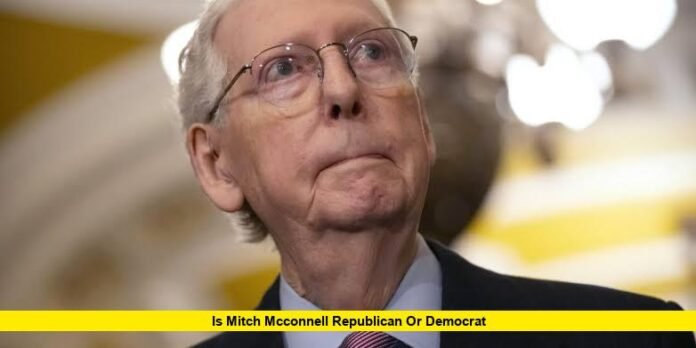

For anyone searching is Mitch McConnell Republican or Democrat, the answer is straightforward: he is a Republican. McConnell has represented Kentucky in the U.S. Senate since 1985 and has remained a member of the Republican Party throughout his entire political career. While his influence in Washington has evolved in recent years, he continues to serve in the Senate as one of the chamber’s longest-serving lawmakers and remains an important voice on national policy.
A Defining Figure in Modern Republican Politics
Few politicians have left a larger mark on the modern Republican Party than Mitch McConnell. During more than four decades in Congress, he helped shape legislative priorities, directed Senate strategy, and influenced the confirmation of hundreds of federal judges.
His reputation has long rested on his deep knowledge of Senate procedure and his ability to navigate complex political negotiations. Whether Republicans controlled the Senate or served in the minority, McConnell was widely viewed as one of the party’s chief strategists.
Although he has often attracted strong opinions from both supporters and critics, his political affiliation has never been in doubt. He has consistently served as a Republican and has built his career around advancing conservative policy goals.
From Kentucky to Capitol Hill
Born in Sheffield, Alabama, in 1942, McConnell later moved with his family to Kentucky, the state he has represented for decades. After earning degrees from the University of Louisville and the University of Kentucky College of Law, he entered public service and eventually became Jefferson County Judge/Executive.
His national political career began with a narrow victory in the 1984 Senate election. Since taking office in January 1985, he has won reelection multiple times, becoming one of Kentucky’s longest-serving elected officials.
Throughout his Senate career, he developed a reputation for focusing on legislative strategy rather than public appearances, gradually rising through the Republican leadership ranks.
Leadership That Shaped the Senate
McConnell’s influence reached its peak during his years leading Senate Republicans. He served as Majority Leader when Republicans controlled the chamber and later continued as the party’s top Senate leader while in the minority.
During that period, he played central roles in:
- Advancing Republican legislative priorities.
- Negotiating federal spending measures.
- Steering judicial confirmation votes.
- Managing major tax legislation.
- Guiding Senate responses during periods of divided government.
One of the defining aspects of his leadership was his emphasis on reshaping the federal judiciary. Under his leadership, the Senate confirmed a large number of federal judges, including multiple Supreme Court justices, creating a lasting impact on the American legal system.
Conservative Policy Priorities
McConnell’s voting record has generally reflected traditional Republican positions on major issues.
Over the years, he has consistently supported:
- Lower federal taxes.
- A strong national defense.
- Conservative judicial philosophy.
- Business-friendly economic policies.
- Reduced government regulation.
- Protection of Second Amendment rights.
Although individual legislative negotiations occasionally required bipartisan cooperation, his overall political philosophy has remained closely aligned with the Republican Party.
Why Some People Still Ask About His Party
Despite decades in public office, internet searches asking whether McConnell is Republican or Democrat continue to appear regularly.
Much of that confusion comes from his prominent role in bipartisan negotiations. As Senate leader, he frequently negotiated legislation with Democratic leaders on issues such as government funding, infrastructure, and national emergencies.
He has also disagreed publicly with Republican presidents and lawmakers at various points in his career. Those disagreements, however, reflected political strategy rather than any change in party affiliation.
McConnell has never switched parties and has remained a Republican throughout his time in elected office.
Recent Developments in 2026
McConnell’s role in Washington has entered a new phase.
After leading Senate Republicans for many years, he stepped aside from the party’s top leadership position, allowing a new generation of Republican senators to assume leadership responsibilities.
He has also announced that he will not seek reelection when his current Senate term expires in 2027, bringing an end to a congressional career that spans more than four decades.
In recent weeks, McConnell has drawn national attention following a medical emergency that resulted in hospitalization. His office has provided limited public information while confirming that he remains under medical care and continues recovering. Senate colleagues from both parties have expressed support and wished him a speedy recovery.
Despite recent health concerns, McConnell continues serving as Kentucky’s Republican senator, and there has been no announcement indicating any change to his official duties beyond his temporary absence during recovery.
Growing Public Interest Following Major Political News
Interest in McConnell has also increased following recent headlines involving senior Republican lawmakers.
The death of Senator Lindsey Graham prompted many readers to revisit the careers of longtime Republican leaders who have shaped the Senate over the past several decades. McConnell and Graham worked together extensively on judicial nominations, national security legislation, and other Republican priorities during their years in Congress.
However, the two developments are separate. There has been no official indication that McConnell’s recent hospitalization is connected in any way to Graham’s death.
What Comes Next
As McConnell prepares to conclude his Senate career, attention is increasingly turning toward Kentucky’s next Senate election and the future direction of Republican leadership in Congress.
Even after leaving party leadership, his experience continues to influence discussions involving Senate rules, foreign policy, defense funding, and institutional reforms.
Political analysts also expect his retirement to create one of the most closely watched Senate races in the country, given his longstanding influence and seniority.
A Lasting Political Legacy
Whether viewed as one of the Republican Party’s most effective strategists or one of its most polarizing figures, McConnell’s impact on American politics is difficult to overstate.
His leadership changed how the Senate approached judicial confirmations, legislative negotiations, and long-term political planning. Many of the policies and institutional decisions associated with his tenure will continue shaping Congress well after his retirement.
His career also reflects the changing landscape of American politics over the last four decades, spanning multiple presidential administrations and major shifts in party control.
For voters, students, and political observers, understanding his role provides important context for many of the Senate’s most significant decisions in recent history.
As public attention shifts toward the next generation of Republican leaders, Mitch McConnell remains one of the defining political figures of his era.