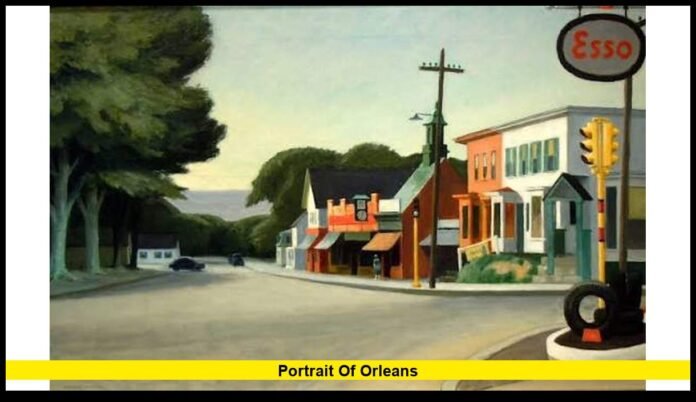

Portrait of Orleans is a 1950 oil painting by American artist Edward Hopper that captures an ordinary Cape Cod setting with remarkable precision and restraint. The painting shows a roadway and commercial intersection in Orleans, Massachusetts, bringing together storefronts, automobiles, a gas station, a pedestrian and open stretches of pavement. Today, the work remains part of the Fine Arts Museums of San Francisco collection and continues to attract attention because of its distinctive view of American life during the postwar era.
Hopper completed the painting after visiting Orleans in September 1950. By that point in his career, he had developed a distinctive reputation for transforming familiar American places into atmospheric works of art. Rather than focusing on spectacular landmarks or dramatic events, he often painted houses, roads, businesses, theaters and quiet landscapes.
The Orleans painting follows that approach closely. Its subject looks simple, yet its arrangement creates a powerful impression of place. The road, buildings and vehicles suggest movement, while the limited human activity produces an almost suspended moment.
Edward Hopper and His Connection to Cape Cod
Cape Cod held a special place in Hopper’s artistic life. He and his wife, Josephine Hopper, regularly spent time in the region, and the artist maintained a home in Truro beginning in the 1930s.
The Cape offered Hopper an environment filled with subjects that suited his artistic interests. Its houses, roads, businesses, beaches and changing light provided opportunities to study architecture and landscape without relying on crowded urban scenes.
Orleans became one of those subjects in 1950.
The town offered a mixture of established buildings and modern transportation infrastructure. That combination was especially relevant during a period when automobile travel was becoming increasingly important to everyday American life.
Hopper approached the location as an artist rather than simply as a recorder of architecture. He selected a particular viewpoint and arranged the visible elements to create a carefully balanced composition.
The finished painting therefore reflects both a real place and Hopper’s interpretation of that place.
What Viewers See in the Painting
The composition presents an intersection from a road-level perspective. The viewer appears to occupy a position close to the roadway, creating the impression of looking toward the town while approaching the intersection.
Main Street extends through the composition, while Route 6A provides another direction.
A gas station occupies a significant position in the foreground. The station immediately identifies the setting as a place connected to automobile travel.
Across the street, commercial buildings create a compact townscape. A woman stands near the storefronts, providing one of the few visible signs of human activity.
Cars can also be seen in the scene.
Despite those elements, the painting does not feel crowded. Hopper leaves considerable space around the buildings and roadway. That open space becomes an important part of the composition.
The result is a scene that feels quiet without appearing abandoned.
The Gas Station as a Major Visual Element
The gas station is among the most recognizable features of the painting.
Its presence carries particular importance because the work dates from 1950. The United States was entering a period of substantial postwar economic and social change, and automobiles were becoming increasingly central to transportation and daily life.
Hopper places this modern commercial feature beside more traditional small-town buildings.
That contrast gives the composition much of its character.
The gas station represents movement, fuel and automobile travel. The storefronts represent an established community center. The roadway connects the two.
None of these elements appears exaggerated. Hopper simply places them together.
This restrained approach allows viewers to consider the changing American landscape without the artist needing to depict a dramatic transformation.
A Quiet Picture of a Changing America
The painting can be understood as a record of American change at a local level.
Postwar America experienced rapid development in roads, automobiles, commercial businesses and suburban communities. Those changes did not occur only in major cities. Smaller towns also encountered new forms of transportation and commerce.
Orleans provided Hopper with a setting where those changes could be seen within a relatively compact space.
The older buildings remain visible.
The roadway remains open.
The gas station introduces modern commercial infrastructure.
Automobiles appear as part of the everyday environment.
Together, these details create a snapshot of a country adapting to a new period.
Hopper does not present the change as either dramatic or chaotic. Instead, it appears almost quietly, embedded within the ordinary landscape.
The Importance of the Empty Road
The open roadway plays a major role in the painting.
Rather than filling the foreground with traffic, Hopper allows large areas of pavement to remain visible. The road leads the viewer into the composition and establishes the perspective from which the town is observed.
That empty space also contributes to the painting’s calm atmosphere.
The road suggests travel, but the scene itself appears temporarily still. Cars are present, yet there is no obvious rush.
This combination is characteristic of Hopper’s ability to make ordinary places feel psychologically charged without providing an explicit story.
There is no major event for viewers to follow. Instead, attention shifts toward the environment.
The road becomes a visual pathway through the town.
Architecture Takes Center Stage
Hopper had a longstanding interest in architecture, particularly buildings that could communicate something about their surroundings.
In the Orleans painting, the storefronts form an important visual backdrop. Their shapes and placement provide structure to the scene.
The buildings are not presented as grand architectural achievements. They are everyday commercial structures.
That choice is significant.
Hopper often found artistic potential in ordinary American architecture. A simple building could become the central focus of a painting when placed within the right light, perspective and surroundings.
Here, the storefronts help establish Orleans as a lived-in community.
Their presence also contrasts with the gas station, making the intersection a meeting point between established town life and automobile-oriented commerce.
The Lone Pedestrian
A woman near the storefronts provides a small but important human detail.
She is not surrounded by a crowd. Instead, she appears almost isolated within the wider setting.
That limited human presence contributes to the painting’s atmosphere.
Hopper frequently depicted individuals separated from one another or placed within spacious environments. His figures often appear to belong naturally to their surroundings rather than dominating them.
The woman in this composition functions in much the same way.
Her presence confirms that the town is active, but the lack of additional people keeps the scene quiet.
The viewer is encouraged to notice the buildings and roadway as much as the person herself.
Cars and the American Road
Automobiles are another essential component.
Their inclusion places the painting firmly within a transportation landscape. The road is not simply a street between buildings. It is a route used by people traveling through and around the community.
That detail connects the work with a larger development in American culture.
By the middle of the 20th century, car travel had become an increasingly visible part of American life. Roads linked towns, businesses and residential communities, while gas stations became familiar features along travel routes.
Hopper captures that environment without turning the painting into an advertisement for modern transportation.
The automobiles simply belong to the setting.
Their quiet presence helps make the painting feel like a genuine observation of everyday life.
Light and Stillness Define the Atmosphere
Light is one of the most recognizable characteristics of Hopper’s paintings, and it plays an important role here as well.
The illumination across the buildings, pavement and surrounding structures creates distinct areas of light and shadow.
These divisions give the relatively simple scene a strong visual rhythm.
The light also reinforces the feeling that the viewer has arrived at a particular moment in the day.
Nothing appears to be moving quickly.
The scene feels temporarily paused.
That sense of stillness does not mean the town lacks life. Instead, Hopper shows how an ordinary moment can contain visual interest.
A road, building, automobile and person can become compelling when their relationships are carefully arranged.
A Clock Adds Another Sense of Time
A clock visible within the scene contributes another layer to the composition.
Time is already suggested by the roadway and the implied movement of automobiles. The clock makes that idea more explicit.
Yet the painting itself appears to resist urgency.
The clock indicates that time continues to pass, while the composition creates the impression of a moment held still.
That contrast is one reason Hopper’s work continues to invite close observation.
Viewers can spend considerable time examining details that might otherwise seem insignificant.
The clock, cars, pedestrian and road all become part of a carefully controlled visual environment.
The Preparatory Drawing
Hopper’s finished oil was connected to preparatory work.
A related pencil drawing, identified as a study for the Cape Cod painting, demonstrates that he worked through the composition before completing the final canvas.
This connection provides insight into his artistic process.
The finished work may appear spontaneous because the scene represents an everyday location. However, the arrangement of its elements reflects deliberate decisions.
The position of the road, buildings, gas station, telephone pole and figures creates a carefully constructed visual balance.
The preparatory drawing helps show how Hopper translated observation into a finished composition.
His process involved looking closely at the physical environment and deciding which features would become important within the final image.
The Telephone Pole
A telephone pole in the foreground is another detail that helps establish the composition.
The pole rises prominently against the scene, creating a strong vertical element beside the horizontal roadway and buildings.
This contrast between vertical and horizontal forms gives the painting additional structure.
The pole also belongs naturally to the town environment.
Hopper did not need to remove ordinary infrastructure to create a beautiful painting. Instead, he incorporated it into the composition.
That decision reflects his broader interest in depicting America as it actually looked rather than presenting an idealized version of the country.
The Painting’s Place in the Museum Collection
The original work is held by the Fine Arts Museums of San Francisco.
The museum acquired it as a gift from Jerrold and June Kingsley in 1991.
The painting measures 26 by 40 inches and is executed in oil on canvas.
Its presence in the San Francisco collection gives the work a permanent institutional setting outside the Cape Cod community where Hopper created it.
The painting has also remained represented through the museum’s digital collection and authorized reproduction program.
That continued institutional presence helps keep the work accessible to audiences interested in Hopper and American art.
Why Orleans Became an Important Hopper Subject
Hopper did not need a famous monument to create a memorable American painting.
Orleans offered something different.
It provided an ordinary intersection where several aspects of American life came together.
There was an established town center.
There was a modern gas station.
There were automobiles.
There was a roadway leading beyond the immediate community.
There was also the characteristic Cape Cod environment that Hopper knew well.
Those ingredients gave him a subject capable of representing both a specific location and a broader moment in American history.
The painting does not attempt to tell viewers everything about Orleans.
Instead, it isolates one view and allows that view to speak through architecture, light and space.
How the Work Reflects Hopper’s Artistic Approach
Hopper’s reputation rests partly on his ability to find significance in familiar places.
His paintings often leave viewers with questions rather than clear narratives.
Who has just driven through the intersection?
Where is the woman going?
What lies beyond the road?
Why is the street so quiet?
The painting does not answer those questions.
That is part of its appeal.
The viewer can observe the setting without being given a fixed storyline.
The composition remains grounded in a real location, while the atmosphere creates room for personal interpretation.
At the same time, the documented details of the painting keep it firmly connected to its historical setting.
It is a 1950 view of Orleans, Massachusetts, created by an artist with a longstanding relationship to Cape Cod.
The Historical Value of the Scene
The value of the work extends beyond its artistic qualities.
It also preserves a visual record of a particular American community during the middle of the 20th century.
Buildings change.
Businesses disappear.
Road layouts evolve.
Transportation patterns shift.
Paintings can preserve details that photographs and written records may not emphasize in the same way.
Hopper’s scene shows how a small community looked at a moment when modern automobile culture was becoming increasingly visible.
The gas station is especially useful in that context.
It demonstrates how transportation infrastructure had become part of the visual identity of American towns.
Portrait of Orleans Today
Portrait of Orleans continues to stand as a documented Edward Hopper work from 1950 and remains part of the Fine Arts Museums of San Francisco collection.
Its enduring appeal comes from the combination of simplicity and detail.
At first glance, the painting shows only a quiet intersection.
A closer look reveals a carefully organized study of American architecture, transportation and daily life.
The roadway establishes movement.
The gas station signals modernity.
The storefronts establish the town.
The pedestrian provides a human presence.
The automobiles connect the location to the growing culture of road travel.
Light unifies the entire scene.
Together, these elements create a painting that remains recognizable as both a portrait of one Massachusetts community and a reflection of mid-century America.
Why the Painting Continues to Matter
More than seven decades after Hopper painted the scene, the work continues to offer viewers a way to examine the relationship between place and change.
The painting does not rely on dramatic action. Its subject remains quiet and familiar.
That quality makes its historical details easier to appreciate.
The viewer can see how commercial buildings, roads and automobiles existed together in an American town during the postwar period.
Hopper’s approach also demonstrates how an artist can transform a routine location into a lasting cultural record.
The scene may have represented one moment in Orleans in 1950, but its themes remain recognizable.
American towns continue to evolve around roads, businesses and transportation.
That connection gives the painting an enduring relevance without changing what Hopper originally depicted.
A Lasting View of American Life
The lasting importance of Hopper’s Cape Cod painting comes from its ability to make an ordinary place worth looking at closely. Its quiet roadway, modest storefronts, gas station, automobiles and solitary pedestrian capture a specific American environment while revealing the changes taking place around it.
The original remains preserved within the Fine Arts Museums of San Francisco collection, ensuring that Hopper’s carefully observed view of Orleans continues to be available for study and appreciation.
What details in Edward Hopper’s view of Orleans stand out to you most? Share your thoughts and stay connected with the latest developments in the world of American art.