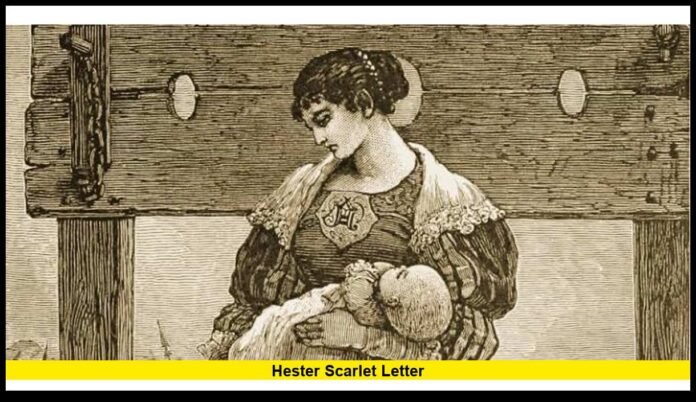

Hester Prynne stands at the center of Nathaniel Hawthorne’s The Scarlet Letter, a novel that has remained a major part of American literature since its publication in 1850. Her story begins with public punishment in Puritan Boston and develops into a powerful examination of identity, motherhood, social judgment, guilt, independence, and personal strength.
Hester’s most recognizable feature is the scarlet letter “A” that she must wear on her clothing. The community intends the symbol to identify her as an adulteress. Over time, however, the meaning attached to Hester changes as her actions challenge the judgment imposed upon her.
More than 175 years after Hawthorne introduced her, Hester remains a familiar literary character for American readers. Her story continues to appear in classrooms, modern editions, theatrical adaptations, and discussions of classic American fiction.
Who Is Hester Prynne?
Hester Prynne is the protagonist of The Scarlet Letter. She lives in seventeenth-century Boston, a community governed by strict Puritan religious and social standards.
At the beginning of the novel, Hester has given birth to Pearl while her husband is absent. The circumstances surrounding Pearl’s birth become public, and Hester is punished for adultery.
Her punishment is highly visible.
She must stand before the community while wearing a scarlet letter “A” on her clothing. The letter serves as a permanent public reminder of the offense that authorities believe she committed.
Hester refuses to identify Pearl’s father.
That decision becomes an important part of her character. She accepts the consequences imposed upon her rather than exposing another person to public punishment.
Her silence also creates a central mystery within the novel.
The Scarlet Letter as Hester’s Symbol
The letter “A” initially represents adultery. It is meant to shame Hester and separate her from the rest of the community.
Yet the symbol does not remain simple.
As Hester continues living in Boston, her behavior begins to influence how others perceive her. She works to support herself and Pearl. She also helps people who are struggling.
Her conduct creates a contrast between the meaning society originally gives the letter and the person Hester becomes.
The symbol follows her throughout the story, but Hester herself changes.
That distinction is important to understanding Hawthorne’s character. Hester cannot remove the public mark placed upon her, but she can influence how that mark is understood.
The letter therefore becomes connected not only with sin but also with endurance, isolation, independence, and the complicated nature of public judgment.
Hester’s Public Punishment
Hester’s first major appearance is connected directly to her punishment.
She emerges from prison carrying Pearl and walks before the community. The scene establishes the social environment surrounding her.
People stare at her. Authorities expect her to feel shame. The scarlet letter immediately identifies her to everyone watching.
Hester does not respond by denying what has happened.
Instead, she accepts her punishment while refusing to reveal Pearl’s father.
Her composure during this public humiliation establishes one of her defining qualities. She experiences intense social pressure, yet she does not allow the community to force her into revealing another person’s identity.
The opening sequence also establishes the conflict between Hester and the society around her.
She has broken a social rule, but Hawthorne encourages readers to consider the broader consequences of how society responds to that violation.
Hester as a Mother
Hester’s relationship with Pearl gives her story much of its emotional depth.
Pearl is the child whose birth exposes Hester’s adultery. The girl therefore becomes closely associated with the scarlet letter and the circumstances surrounding it.
Hester nevertheless loves Pearl and works to provide for her.
Motherhood gives Hester a responsibility that exists independently of the community’s opinion. She must earn enough to support her daughter and protect her from the consequences of social rejection.
Pearl also has an unusual personality within the novel.
She is energetic, observant, imaginative, and often difficult for adults to control. Her behavior reflects the unusual circumstances surrounding her birth and upbringing.
Hester frequently worries about Pearl’s future.
The child represents both a source of love and a constant reminder of the event that changed Hester’s life.
That combination makes their relationship particularly significant.
Hester’s Independence Through Work
Hester does not have the financial protection that marriage might normally provide.
Instead, she earns a living through needlework.
Her skill allows her to support Pearl without depending entirely on the community.
Her work also becomes a subtle expression of independence.
Hester creates clothing for other members of society even though society has marked her own clothing with a symbol of shame.
This contrast is significant.
Her needlework demonstrates that the person whom the community has publicly condemned remains talented, productive, and capable of contributing to the same society.
Over the years, Hester develops a reputation for helping people.
She gives assistance to those experiencing hardship and becomes increasingly associated with compassion.
Her transformation does not erase the original punishment. Instead, it changes the way people interpret her presence.
Hester and Arthur Dimmesdale
Arthur Dimmesdale is the minister who shares Hester’s secret.
Hester knows his identity as Pearl’s father, but she refuses to reveal him publicly.
This creates a striking difference between the two characters.
Hester wears the scarlet letter where everyone can see it. Dimmesdale retains his respected public position while privately struggling with guilt.
Their relationship becomes increasingly complicated as the novel progresses.
Hester eventually recognizes the destructive effect that secrecy has on Dimmesdale. She also begins to understand that their situation cannot continue indefinitely.
Their connection illustrates one of Hawthorne’s central concerns: the difference between public reputation and private truth.
Hester receives public condemnation for an act that involved two people.
Dimmesdale, meanwhile, carries his guilt privately.
The imbalance between their experiences shapes much of the novel’s conflict.
Hester and Roger Chillingworth
Roger Chillingworth is Hester’s husband.
Before the events that begin the novel, he has been absent from Boston. When he returns, he discovers that Hester has had a child.
Rather than immediately revealing his identity as her husband, he becomes focused on discovering who Pearl’s father is.
Chillingworth eventually determines that Dimmesdale is responsible.
His response is driven by revenge.
He remains close to Dimmesdale while investigating and exploiting the minister’s private suffering.
Hester becomes increasingly concerned about Chillingworth’s actions.
Their relationship has changed dramatically from the marriage that existed before the novel begins. Hester recognizes the destructive nature of his obsession and eventually confronts him.
Chillingworth provides another important contrast with Hester.
While Hester gradually builds a life through work and compassion, Chillingworth becomes increasingly consumed by revenge.
How Hester Changes
Hester is not the same person at the end of the novel that readers meet at the beginning.
Initially, the community defines her almost entirely through her punishment.
She is a public example.
Over time, however, Hester becomes more independent and self-aware. She develops her own livelihood and raises Pearl.
Her experiences also lead her to question the social and religious structures surrounding her.
Hester does not simply accept every belief imposed by the community.
Her suffering gives her a different perspective on human weakness and social judgment.
The woman who once stood before the crowd as an object of condemnation eventually becomes someone whom people approach for comfort and assistance.
That change is one of the most important developments in her story.
Hester’s Relationship With Puritan Society
Hester’s relationship with the Boston community remains complicated.
She is never completely welcomed in the same way she was before her punishment. The scarlet letter continues to identify her.
Yet her actions gradually alter the community’s perception.
People who once viewed her only through the lens of her offense begin to recognize her generosity.
This change raises an important question within the novel.
Can a person be permanently defined by one mistake?
Hawthorne does not provide a simple answer.
Instead, he allows Hester’s life to demonstrate how identity can evolve over time.
The community creates one definition of Hester. Her actions create another.
That tension remains central to her character.
The Meaning of Hester’s Silence
Hester’s refusal to name Pearl’s father is one of her most important decisions.
She could reduce some of the mystery surrounding Pearl’s birth by identifying Dimmesdale. She chooses not to do so.
Her silence protects him, although it also contributes to his private suffering.
The decision shows that Hester has agency even within a society that has taken away much of her freedom.
Authorities control her punishment, but they cannot force her to surrender information she chooses to keep private.
Her silence also separates her from the community’s expectations.
Hester becomes responsible for her own choices rather than simply following the demands of those around her.
Hester and the Theme of Identity
Identity is one of the strongest themes connected to Hester.
The community gives her a visible label.
She spends years living with that label while developing an identity of her own.
Her clothing, occupation, motherhood, relationships, and actions all contribute to how readers understand her.
Hawthorne therefore creates a distinction between the identity society assigns to Hester and the identity she develops through her life.
The scarlet letter remains visible, but its meaning becomes increasingly complex.
Hester’s experience suggests that identity cannot always be reduced to a single event.
Hester and the Theme of Motherhood
Motherhood also shapes Hester’s decisions throughout the novel.
Pearl depends on her, which gives Hester a powerful reason to remain strong despite social rejection.
Hester’s choices are frequently connected to Pearl’s safety and future.
The child also forces Hester to confront the consequences of her relationship with Dimmesdale.
Pearl is a living reminder of the secret that Hester protects.
At the same time, Pearl gives Hester companionship in a community where she has been isolated.
Their relationship therefore combines love, responsibility, conflict, and symbolism.
Why Hester Remains Important to American Literature
Hester Prynne has become one of the most recognizable women in American literature.
Her importance comes from the complexity of her character rather than from a single trait.
She is not simply a victim of punishment. She is also a mother, worker, community member, and independent woman.
Her story explores how social judgment can shape a person’s life without necessarily determining that person’s entire identity.
That idea has helped keep The Scarlet Letter relevant in American education and literary discussion.
The novel also provides an example of how nineteenth-century American fiction could examine gender, religion, morality, and social authority through an individual character.
Hester carries those themes throughout the story.
Modern Interpretations of Hester Prynne
Hester’s story has continued to receive new interpretations long after Hawthorne’s original publication.
Stage adaptations have introduced the character to audiences who experience the story through performance rather than solely through the novel.
In 2026, Kate Hamill’s adaptation received a production at American Stage in St. Petersburg, Florida. The production ran from January 21 through February 15.
A musical adaptation also presented Hester’s story in 2026, with performances in Dallas and New York.
These modern interpretations demonstrate the flexibility of Hawthorne’s central character.
The basic events remain rooted in the nineteenth-century novel, but theater makers can emphasize different aspects of Hester’s experience.
Some productions place greater attention on gender and social authority. Others emphasize relationships, secrecy, motherhood, or personal freedom.
Hester remains at the center of each interpretation because her conflict with society drives the story.
Hester’s Lasting Legacy
The continued publication and adaptation of The Scarlet Letter have helped preserve Hester Prynne’s place in American culture.
Students encounter her story in literature courses. Readers continue to purchase new editions. Theater companies reinterpret the novel for contemporary audiences.
The circumstances surrounding Hester belong to Puritan New England, but the questions raised by her story remain recognizable.
People continue to debate how communities should respond to wrongdoing. They also continue to consider whether one mistake should define an individual permanently.
Hester’s story offers no simple solution.
Instead, it follows one woman as she lives with the consequences of public judgment and gradually builds a different identity.
Her transformation gives the character her lasting significance.
What Hester Prynne Represents
Hester can be understood through several interconnected ideas:
- Public judgment: Her punishment demonstrates the power of community opinion.
- Motherhood: Pearl becomes a central part of Hester’s identity and purpose.
- Independence: Her needlework allows her to support herself.
- Secrecy: Her decision to protect Pearl’s father drives much of the plot.
- Identity: Hester’s personal development challenges the community’s definition of her.
- Resilience: She continues building a life despite prolonged rejection.
- Moral complexity: Her circumstances reveal that wrongdoing and personal character are not always simple matters.
These elements make Hester more than a symbolic figure.
She remains a fully developed literary character whose choices affect the direction of the entire novel.
The Continuing Appeal of Hester Prynne
Hester’s story has survived because it combines a dramatic historical setting with questions that remain understandable to modern readers.
She faces public condemnation, raises her daughter, earns her own living, protects a secret, and gradually develops a reputation that differs from the one imposed upon her.
The scarlet letter never becomes irrelevant to her story.
Instead, its meaning changes alongside her.
That evolution gives the novel much of its lasting power.
For U.S. readers encountering The Scarlet Letter today, Hester remains a useful starting point for understanding Hawthorne’s examination of morality, social pressure, personal responsibility, and identity.
Her story also demonstrates why classic American literature continues to receive new interpretations more than a century after its original publication.
Final Thoughts
Hester Prynne remains at the heart of The Scarlet Letter because her life captures the conflict between public judgment and personal identity. Her experiences as a mother, worker, outcast, and independent woman give Hawthorne’s novel its enduring emotional and literary force.
The scarlet letter begins as a mark imposed upon Hester by society, but her actions gradually complicate what that mark means. That transformation continues to make her one of the most discussed characters in American literature.
What does Hester Prynne’s story mean to you? Share your thoughts and stay connected for more updates on this enduring American literary classic.