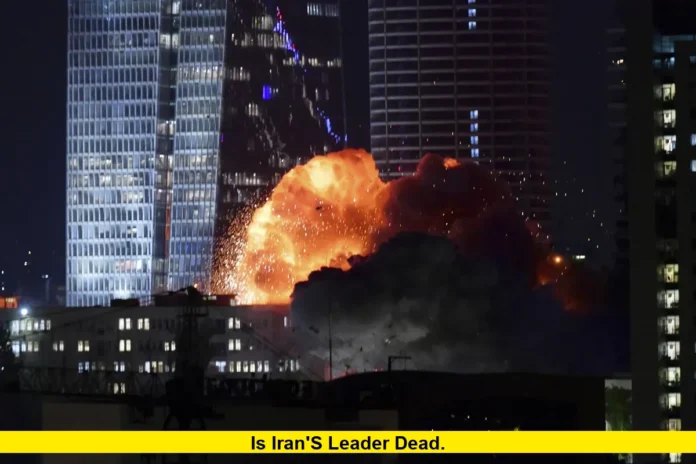

The question millions of Americans are asking right now — is Iran’s leader dead — has a stunning answer. Ayatollah Ali Khamenei, the 86-year-old supreme leader who ruled the Islamic Republic of Iran for more than three decades, was killed on Saturday, February 28, 2026, in a joint U.S.-Israel military strike on Tehran. The operation, which President Donald Trump called “Operation Epic Fury,” targeted the Iranian government’s leadership structure in one of the most consequential military actions in modern Middle East history.
The world woke up to a transformed geopolitical landscape. Whether this marks the beginning of the end of the Islamic Republic or the start of a dangerous new chapter remains the defining question of the moment.
Stay informed — bookmark this page and check back for the latest updates as this rapidly developing situation continues to evolve.
How the Strike Happened
In the early morning hours of Saturday, U.S. and Israeli forces launched coordinated strikes across Iran in what Israeli officials described as a campaign developed over thousands of hours of joint planning. The strikes targeted Khamenei’s residential and administrative compound in Tehran, along with dozens of senior military, intelligence, and government officials.
Satellite imagery captured after the attack showed multiple structures within the secure Tehran compound heavily damaged or destroyed. Israeli Prime Minister Benjamin Netanyahu stated at a press conference that the operation hit “the tyrant Khamenei,” saying his plans to destabilize the region “no longer exist.”
Trump announced the death of Iran’s supreme leader in a post on his Truth Social platform, writing that Khamenei was “one of the most evil people in History” and that his killing represented “justice” for Americans and people around the world harmed by his regime over the decades. Trump added that U.S. bombing would continue “uninterrupted throughout the week” until the operation achieved its stated objective.
Who Was Khamenei?
Ayatollah Ali Khamenei came to power in 1989 following the death of Ayatollah Ruhollah Khomeini, the founding leader of the Islamic Republic. At the time of his appointment, Khamenei was considered a midlevel cleric without the deep religious credentials typically expected of a supreme leader. Yet he spent the next 37 years consolidating near-total control over every branch of Iranian government — including the judiciary, state media, the military, and the powerful Islamic Revolutionary Guard Corps (IRGC).
Under his leadership, Iran developed an extensive ballistic missile program, built a network of regional proxy forces including Hezbollah in Lebanon and Hamas in Gaza, and advanced a nuclear program that brought the country into repeated confrontation with Western powers. He also oversaw the brutal suppression of multiple waves of pro-democracy protests. The Human Rights Activists News Agency estimates that more than 7,000 Iranian citizens were killed during mass protests that erupted in late 2025 alone.
Khamenei survived an assassination attempt in 1981 that left him without the use of his right arm. He outlasted eight U.S. presidents before Saturday’s strikes ended his rule.
The Confusion in the Hours Before His Death Was Acknowledged
In the hours immediately following the strikes, conflicting information created significant confusion about whether Iran’s leader was actually dead. Iran’s Foreign Minister Abbas Araghchi told NBC News that, as far as he knew, both Khamenei and Iranian President Masoud Pezeshkian were “safe and sound.” Iran’s Foreign Ministry spokesman made similar statements to international media.
Iranian state news agencies Tasnim and Mehr initially reported that Khamenei remained “steadfast and firm in commanding the field.” These statements are now understood to have been part of a deliberate effort to project stability in the chaos following the strikes.
By Saturday evening, Iran’s own state media acknowledged that Khamenei had been killed. Netanyahu’s earlier statement — “This tyrant no longer exists” — was widely read as the first clear public declaration from a world leader that the strike had achieved its primary objective.
What Is Iran’s Leader Dead Means for the Country’s Future
The killing of Iran’s supreme leader has immediately triggered a constitutional succession crisis. Under Iran’s governing structure, an interim council assumes executive authority while the Assembly of Experts — a body of 88 Islamic clerics — is responsible for selecting a new supreme leader. However, Israeli officials say the opening strikes also decimated Iran’s chain of command, killing seven senior defense and intelligence officials and targeting approximately 30 top military and civilian leaders.
With so much of the leadership eliminated, the most senior civilian official believed to have survived is Ali Larijani, the secretary of Iran’s Supreme National Security Council and a longtime confidant of Khamenei. Larijani vowed on social media that Iran would deliver an “unforgettable lesson” to Israel and the United States.
There is also open uncertainty about whether the IRGC will attempt to seize direct control of the government, or whether the strikes will create the political opening that Trump and Netanyahu have publicly called for — urging the Iranian people to rise up and replace the government entirely.
Iran’s exiled former Crown Prince Reza Pahlavi, a prominent opposition leader, has publicly called on the Iranian people to take advantage of the moment.
The Regional and Global Fallout
The strikes have not been limited to Iran. The IRGC announced retaliatory waves of missile strikes against U.S. and Israeli positions in the region. Tel Aviv experienced missile strikes, and emergency workers were filmed extinguishing fires across the city on Saturday.
The United Nations Security Council held an emergency session. UN Secretary-General António Guterres stated that a chance for diplomacy had been “squandered” and warned that military action risks “igniting a chain of events that no one can control in the most volatile region of the world.” He called for de-escalation and an immediate ceasefire.
Iran’s UN Ambassador Amir Saeid Iravani addressed the Security Council, calling the strikes “unprovoked and premeditated aggression” against civilian-populated cities.
In the United States, the New York Police Department announced enhanced patrols around sensitive locations, including diplomatic, cultural, and religious sites, as a precautionary measure. Federal law enforcement officials said there were no specific threats to the U.S. homeland as of Saturday, though the situation remained fluid.
What Comes Next
The killing of Khamenei leaves the Islamic Republic in a state of profound uncertainty. The succession process, even under normal circumstances, would be deeply contested. Under current conditions — with much of the senior leadership killed or in hiding, the IRGC under pressure, and retaliatory missile strikes ongoing — no clear path forward has emerged.
Trump has framed the operation as the “single greatest chance for the Iranian people to take back their country.” Whether that vision takes shape, or whether Iran responds with a protracted military escalation, will define the coming days and weeks.
What is not in question is the scale of what happened. A 37-year reign by one of the most powerful and controversial figures in the modern Middle East came to an end on a Saturday morning in February 2026.
Drop your thoughts in the comments below — this story is still unfolding and your perspective matters.