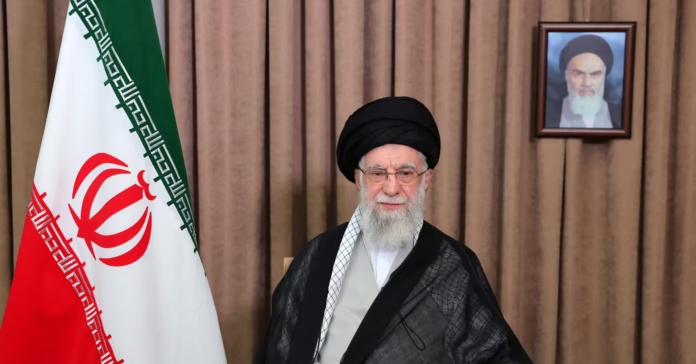

The question of who is Iran’s supreme leader has defined global headlines for decades — and today, that question has a new, staggering answer. Ayatollah Ali Khamenei, the man who held absolute power over the Islamic Republic of Iran for 36 years, was killed on February 28, 2026, in a massive joint military operation carried out by the United States and Israel. His death marks the most seismic shift in Middle Eastern geopolitics since the Iranian Revolution of 1979 — and for Americans, understanding who he was and what his death means has never been more urgent.
This is the full story of Iran’s supreme leader — his rise, his reign of repression, his defiance of the West, and the power vacuum his death has now created.
👉 Keep reading — this is one of the most consequential stories of our lifetime, and every paragraph matters.
From Mashhad to Supreme Power: Who Was Khamenei?
Ali Hosseini Khamenei was born on April 19, 1939, in Mashhad, a holy city in northeastern Iran. He was raised in a deeply religious household — his father was a respected Muslim cleric. From the age of four, Khamenei studied the Quran, and his path toward religious scholarship was set early. His mother, a devoted reader of religious texts, instilled in him a love of literature that would later manifest in a lifelong appreciation for poetry.
As a young man, Khamenei became politically radicalized against the Shah of Iran, Mohammad Reza Pahlavi, and the monarchy’s brutal secret police, known as SAVAK. He was arrested multiple times for his political activities and was sent into internal exile. Rather than quieting him, those experiences hardened his resolve.
When the 1979 Islamic Revolution swept the Shah from power and installed Ayatollah Ruhollah Khomeini as Iran’s founding supreme leader, Khamenei rose quickly through the new government’s ranks. He served as Iran’s president through the devastating Iran-Iraq War of the 1980s — a grinding conflict that killed hundreds of thousands and left Khamenei with a deep, permanent distrust of the United States, which had backed Iraqi leader Saddam Hussein during that war.
In 1981, he narrowly survived an assassination attempt that permanently cost him the use of his right arm. That experience only deepened his siege mentality — and his belief that Iran was surrounded by enemies.
When Ayatollah Khomeini died in 1989, Khamenei was elevated to supreme leader. It was a position he was not universally expected to hold, as he lacked the senior religious credentials typically required. But through political maneuvering and the backing of key regime factions, he secured the role — and never let go of it.
The Architecture of Absolute Power
Understanding the scope of Khamenei’s authority requires understanding what Iran’s supreme leader actually controls. The answer is: everything.
As supreme leader, Khamenei commanded the military, the judiciary, all branches of government, and the media. He had the power to override elections, nullify legislation, and set the ideological direction of the entire Iranian state. No president, no parliament, and no court could challenge him. Iran held elections, but Khamenei always held the final word.
Central to his power were two institutions he cultivated with extreme care: the Islamic Revolutionary Guard Corps (IRGC) and the Basij paramilitary forces. The IRGC was not just a military — it was an economic empire, a political machine, and an intelligence apparatus rolled into one. Khamenei used it as his personal enforcer, both at home and abroad.
Abroad, Khamenei built what Iran called the “Axis of Resistance” — a sprawling network of proxy militias and allied governments stretching from Lebanon to Iraq to Yemen. Hezbollah in Lebanon, the Houthi rebels in Yemen, and various Iraqi Shia militias all received training, weapons, and financing from Tehran under his direction. He used these forces to project Iranian power across the Middle East without committing Iranian troops directly — a strategy that kept Iran perpetually dangerous while avoiding direct confrontation.
A Record of Repression at Home
For all his international maneuvering, Khamenei’s most consistent legacy may be the repression of his own people.
Over three decades, his government imprisoned journalists, tortured political dissidents, executed thousands, and brutally suppressed wave after wave of popular protest. The 2009 Green Movement — sparked by disputed presidential election results — was met with beatings, arrests, and killings. The 2019 protests, triggered by fuel price hikes and economic collapse, saw the internet shut down and security forces fire directly into crowds.
In late 2025 and into 2026, another massive uprising erupted across Iran, driven by devastating inflation, a collapsing currency, and decades of accumulated fury at clerical rule. This time, the crackdown was even more severe. More than 6,800 people were killed as Khamenei approved a pre-planned military-style suppression strategy that gave the IRGC full command authority to use lethal force. Leaked documents later revealed that the National Security Council had prepared this blueprint years in advance, modeling it on lessons learned from earlier uprisings.
Throughout all of it, Khamenei maintained that protesters were enemies of the state — foreign-backed agitators seeking to destabilize the Islamic Republic. He drew a distinction between what he called legitimate economic grievance and what he labeled sedition. The distinction, to most Iranians, was meaningless. The bullet didn’t care which category you fell into.
The Nuclear Standoff That Defined His Final Years
No issue defined Khamenei’s relationship with the West more than Iran’s nuclear program. For decades, he insisted publicly that Islam forbids the development of nuclear weapons and that Iran’s enrichment activities were purely for civilian energy purposes. Privately, his government steadily advanced its nuclear capabilities to the point where intelligence assessments concluded Iran was positioning itself to build a bomb should it choose to do so.
The cycle of nuclear diplomacy and breakdown consumed multiple U.S. administrations. A landmark nuclear deal reached in 2015 under President Obama briefly restrained Iran’s program in exchange for sanctions relief — until President Trump withdrew the United States from the agreement during his first term. After that, Iran dramatically accelerated its uranium enrichment.
When Trump returned to office and again sought a new nuclear agreement in early 2025, talks began cautiously. But Israel, deeply skeptical that any deal would permanently prevent an Iranian bomb, struck first. In June 2025, Israeli forces launched devastating strikes on Iran’s nuclear facilities, killing key nuclear scientists and military commanders. The United States followed with its own strikes.
Iran retaliated. A twelve-day war followed, with missile exchanges between Iran and Israel causing casualties on both sides. Khamenei survived that round — battered and weakened, but still in power.
He would not survive the second.
February 28, 2026: The Day Everything Changed
In the early hours of February 28, 2026, the United States and Israel launched Operation Epic Fury — a coordinated, large-scale assault targeting Iran’s leadership structure, military infrastructure, and Khamenei himself.
American and Israeli intelligence had tracked Khamenei to a secure location where he was meeting with top aides, including senior security and military officials. The strikes hit their targets with precision. By that afternoon, President Trump had posted on social media that Khamenei was dead, calling him “one of the most evil people in History.”
Israeli officials also declared that multiple top Iranian commanders had been killed in the strikes. Khamenei’s daughter, grandchild, daughter-in-law, and son-in-law were reportedly among the casualties.
Within Iran, state media did not immediately confirm the supreme leader’s death. Iranian officials initially claimed Khamenei was “steadfast and firm.” But in the streets of Tehran, Iranians were photographed celebrating. For millions who had lived under his rule, the news — if true — represented something they had dreamed of for decades.
Trump, meanwhile, pledged that strikes would continue throughout the week and called on IRGC members to seek immunity and stand down.
What Comes Next: Iran’s Succession Crisis
With Khamenei gone — or potentially incapacitated — Iran faces a constitutional and political crisis unlike anything in its modern history.
Iran’s constitution tasks an 88-member body of clerics called the Assembly of Experts with selecting the next supreme leader. In practice, the IRGC holds enormous real-world power and will shape whoever emerges from that process. Ali Larijani, a longtime Khamenei loyalist and former parliament speaker who had been elevated to head of Iran’s Supreme National Security Council, has emerged as the most senior civilian official still standing after the strikes. He had reportedly already been designated to manage a crisis of exactly this kind.
Khamenei’s son, Mojtaba, had been widely discussed as a potential successor, though many within Iran’s religious establishment resisted the idea of hereditary succession — a concept more associated with the monarchy the revolution overthrew. Three senior clerics were also reportedly nominated as potential successors in the event of Khamenei’s death, though none have been publicly named.
The IRGC, which controls much of Iran’s economy and all of its hard power, may effectively run the country in the interim — or push its own preferred candidate to the top. The risk of factional infighting, or even an open power struggle, is significant.
What It Means for Americans
For the United States, the death of Iran’s supreme leader reshapes the Middle East equation in ways that will take years to fully understand.
Khamenei was the singular driving force behind Iran’s nuclear ambitions, its proxy network, and its decades-long campaign against American interests and allies. Whether his successor pursues the same confrontational path — or seizes the opportunity to chart a different course — is the question that will dominate American foreign policy in the months ahead.
Trump has signaled that the goal is broader than eliminating one man. He has called on the Iranian people to reclaim their country and suggested there are people capable of leading Iran in a new direction. Whether that vision matches what actually emerges from Tehran’s fractured, post-Khamenei power struggle remains deeply uncertain.
One thing is not uncertain: the world that existed yesterday — with Ayatollah Ali Khamenei as the unquestioned supreme leader of the Islamic Republic of Iran — no longer exists. What replaces it will define the next era of the Middle East, U.S. foreign policy, and global security.
What do you think happens next in Iran — and what should the United States do? Drop your thoughts in the comments below and stay close to this story as it develops.