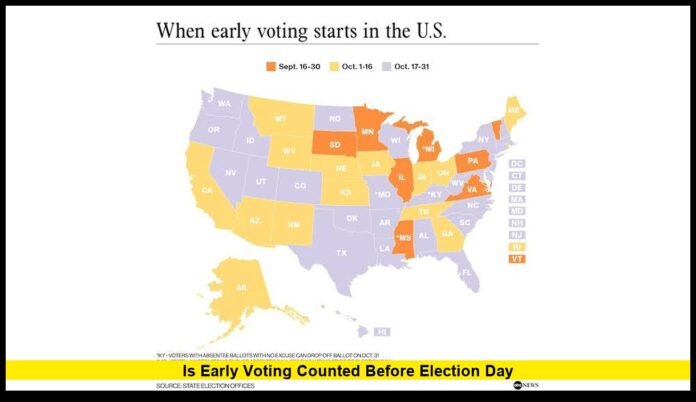

Is early voting counted before Election Day? Yes, in many U.S. states, election officials begin processing and counting early ballots before Election Day. However, the rules vary by state, and counting votes does not necessarily mean that election results can be released before polls close.
Early voting has become an important part of the American election process. Millions of voters cast their ballots in person or by mail before Election Day, giving election officials additional time to prepare ballots for counting and verify voter information.
Although some states allow election workers to begin tabulating early votes days or weeks before Election Day, others have restrictions that prevent officials from counting ballots until Election Day or later.
Understanding the difference between processing ballots, counting votes, and releasing election results can help voters understand why early voting totals are not always available immediately and why election results may take hours or days to become final.
This guide explains when early votes are counted, whether officials can see the results early, how mail-in ballots are handled, and when the public can expect election results.
Quick Answer: Is Early Voting Counted Before Election Day?
Yes. Many states allow election officials to process and tabulate early voting ballots before Election Day. However, the exact timing depends on state election laws.
In some states, officials can scan and count ballots before November’s general Election Day but cannot publicly release the results until voting ends. Other states require ballots to remain uncounted until Election Day or later.
The most important distinction is that early vote counting can begin before Election Day, but public election results generally cannot be announced until the polls close.
How Early Voting Works in the United States
Early voting allows eligible voters to cast their ballots before the scheduled Election Day. Depending on the state, this may include voting in person at designated locations, submitting an absentee ballot, or returning a mail-in ballot.
Once a voter submits a ballot, election officials follow procedures established by state law to verify eligibility, protect ballot secrecy, and prepare the ballot for counting.
The process generally involves several stages:
- Ballot receipt: Election workers receive ballots cast in person or returned by mail.
- Voter verification: Officials confirm registration details and review required signatures or other identifying information.
- Ballot processing: Workers prepare accepted ballots for tabulation, which may involve opening envelopes and separating ballots from identifying information.
- Vote tabulation: Approved ballots are scanned or counted using authorized equipment or other approved methods.
- Results reporting: Election officials release unofficial totals when legally permitted.
- Canvassing and certification: Officials reconcile voting records, review outstanding ballots, and certify the final results.
Not every state allows all these steps to occur before Election Day. Some jurisdictions permit officials to scan ballots in advance, while others allow only preliminary processing.
The important point is that casting an early vote does not automatically mean that the vote has already been counted.
Can Election Officials Count Early Votes Before Election Day?
Yes. In many states, election officials can begin counting some early or absentee ballots before Election Day. However, the permitted starting time and the exact activities allowed vary significantly.
Some states allow ballots to be processed and scanned days or weeks before the election. Other states prohibit officials from beginning tabulation until Election Day or until the polls close.
For example, Arizona permits counties to process and tabulate eligible early ballots before Election Day after required equipment testing and signature verification. California also allows officials to begin processing vote-by-mail ballots well before Election Day, while restricting access to the resulting vote totals until the polls close.
Massachusetts permits local election officials to conduct advance processing and tabulation under state rules, but they cannot access or release vote totals before the polls close.
These examples demonstrate why there is no single nationwide answer for every early ballot.
The National Conference of State Legislatures tracks state laws governing ballot processing and counting. Its election administration resources explain how different state rules affect the timing of election results.
For voters, the key takeaway is that early ballots may be counted in advance, but the timing depends on the law where the ballot is cast.
Why Aren’t Early Voting Results Released Before Election Day?
Even when officials have already counted early ballots, election laws generally restrict the release of those totals until the polls close on Election Day.
There are several reasons for this restriction.
1. Protecting the fairness of the election
If candidates, political parties, or voters learned the results of early voting before Election Day, that information could influence the decisions of people who have not yet voted. Keeping totals confidential helps ensure that voters make their choices without access to premature results.
2. Preventing unauthorized disclosures
Election workers are responsible for maintaining the security and confidentiality of election information. Rules restricting access to early vote totals help prevent leaks and unauthorized announcements.
3. Preserving public confidence
Releasing results only when legally permitted supports a consistent reporting process. It also reduces the risk of misleading claims based on partial totals.
4. Ensuring that all eligible voters have an opportunity to participate
Election Day voting remains open to eligible voters who have not yet cast a ballot. Withholding early voting results helps prevent incomplete information from affecting the final hours of voting.
For these reasons, a state may allow officials to scan and tabulate ballots before Election Day while prohibiting them from viewing or publishing the totals.
What Is the Difference Between Processing and Counting Early Votes?
The terms processing and counting are often used interchangeably in everyday discussions, but they can describe different stages of election administration.
| Activity | What it means |
|---|---|
| Receiving ballots | Election officials take custody of submitted ballots. |
| Verifying ballots | Officials check voter eligibility, signatures, and other required information. |
| Preparing ballots | Workers open permitted envelopes and prepare accepted ballots for tabulation. |
| Scanning ballots | Ballots are fed through approved equipment to record voter selections. |
| Tabulating votes | The voting system calculates the totals for candidates and ballot measures. |
| Releasing results | Officials publish totals when permitted by election law. |
| Certifying results | Election authorities complete required reviews and formally approve the final outcome. |
The exact definitions vary by jurisdiction, and some activities may occur together.
For example, a state might allow election workers to verify signatures and prepare mail ballots before Election Day but prohibit them from scanning or tabulating those ballots until a later time.
Another state might allow the complete tabulation process to occur in advance while keeping the totals inaccessible until Election Day.
This distinction explains why two states can receive similar numbers of early ballots but report results at very different times.
How Early Voting Is Counted in Different States
Election procedures differ across the country, so the answer to whether early voting is counted before Election Day depends on the state.
Here are several examples of how the process works.
Arizona
Arizona allows counties to begin processing and tabulating eligible early ballots before Election Day. Election officials verify signatures and follow required procedures before ballots are tabulated.
Results are generally released after polls close, beginning with early ballots that were processed and tabulated in advance. Ballots returned on Election Day may take longer to process and count.
California
California permits election officials to begin processing vote-by-mail ballots well before Election Day. Officials can prepare ballots for tabulation, but they cannot access or share the vote totals before the polls close.
The first results reported on election night commonly include ballots received before Election Day, including mail ballots and ballots cast at early voting locations.
Massachusetts
Massachusetts allows local election officials to conduct advance processing of early and absentee ballots under state law. Depending on local procedures, ballots may be prepared and tabulated before Election Day.
However, election officials cannot access or release vote totals before polls close. Some municipalities also count ballots on Election Day rather than using advance tabulation.
Pennsylvania
Pennsylvania generally does not allow election officials to begin opening and preparing mail ballots for counting until 7 a.m. on Election Day. This process is known as pre-canvassing.
As a result, Pennsylvania may take longer to report substantial mail-ballot totals than states that permit earlier tabulation.
Texas
Texas permits certain ballot-processing activities before Election Day, including verifying information on mail-ballot envelopes. The rules governing when ballots can actually be counted depend on the applicable state law and election jurisdiction.
These differences illustrate why early voting results can appear quickly in some states but take longer in others.
When Are Early Voting Results Released on Election Day?
In most states, early voting results become publicly available after the polls close, subject to state-specific reporting rules.
Election officials may release results in several batches rather than publishing one complete total.
The first batch often includes early in-person votes and mail ballots that were received, processed, and tabulated before Election Day. Additional updates may include ballots cast in person on Election Day, mail ballots processed later, and other eligible votes.
The timing depends on factors such as:
- The number of early ballots submitted.
- Whether officials were allowed to process ballots in advance.
- The time required to verify signatures and voter eligibility.
- The number of polling locations and ballot-counting facilities.
- The number of ballots received on Election Day.
- State rules governing when election results can be reported.
Some states report substantial early voting totals shortly after polls close. Others may take several hours or longer to provide a complete picture.
Early results are not necessarily a reliable indication of the final winner. The first reported ballots may favor one candidate or party, while later batches may reflect different voting patterns.
Can Early Voting Change the Election Results?
Yes. Early votes are part of the official vote count and can determine the outcome of an election.
A candidate who leads in early voting may lose after Election Day ballots are counted. Similarly, a candidate who trails in initial results may gain enough votes from later-counted ballots to win.
For example, imagine an election in which Candidate A receives 60,000 early votes and Candidate B receives 55,000. Candidate A initially leads by 5,000 votes.
If Election Day ballots and other eligible ballots later give Candidate B a sufficiently large advantage, Candidate B could overtake Candidate A.
This is why election-night totals can change as officials count additional ballots.
The same principle applies to close races, ballot measures, and elections involving several candidates.
Early voting results represent only the ballots included in those totals. They do not automatically represent every eligible vote cast in the election.
Why Do Election Results Take Days After Election Day?
Even when early voting ballots have been counted in advance, election officials may need additional time to complete the overall count.
Several factors can delay final results.
Mail ballots received near the deadline: Ballots arriving close to the applicable deadline may need to be verified and processed before they can be counted.
Signature verification: Election officials may need to review ballot-envelope signatures or resolve discrepancies under state procedures.
Provisional ballots: Some voters cast provisional ballots when their eligibility or registration cannot immediately be confirmed. Officials must determine whether those ballots qualify for counting.
Military and overseas ballots: Eligible military and overseas voters may have different ballot-return deadlines under applicable law.
Reconciliation and audits: Election officials compare voting records, ballot totals, and other election data to identify discrepancies and verify accuracy.
Certification requirements: Final results must go through the required canvassing and certification process before they become official.
The U.S. Election Assistance Commission explains that preliminary results can change as additional eligible ballots are counted and election officials complete the canvass.
Therefore, a projected winner on election night is not necessarily the same as a formally certified winner.
Can You Check Whether Your Early Vote Has Been Counted?
Many states and counties provide online tools that allow voters to check the status of a mail-in or absentee ballot.
Depending on the jurisdiction, the tracking system may show whether a ballot was mailed, received, accepted, or rejected. Some systems also provide additional information about ballot processing.
However, a ballot-status tracker usually does not tell you which candidate received your vote. Ballot secrecy is an essential part of the voting process.
If your ballot status has not changed, it does not automatically mean your vote will not count. Processing and status updates can take time, especially during busy elections.
If a ballot is marked as rejected or requires additional information, follow the instructions provided by your local election office. Any correction must be completed within the applicable legal deadline.
For the most accurate information, check your state’s official election website or contact your county election office.
Five Useful External Resources for Early Voting Rules
The following resources provide additional information about ballot counting, election procedures, and state-specific rules.
- U.S. Election Assistance Commission — Voter FAQs: Learn how preliminary results, ballot counting, canvassing, and certification work.
- National Conference of State Legislatures — Elections and Campaigns: Explore state election laws and differences in ballot-processing procedures.
- Arizona Secretary of State — Post-Election Procedures: Review ballot tabulation, election results reporting, and post-election safeguards.
- California Secretary of State — Official Canvass and Vote Counting Process: Understand how California processes ballots and reports election-night results.
- Massachusetts Secretary of the Commonwealth — Counting Ballots: Learn how Massachusetts handles early and absentee ballots.
Frequently Asked Questions
Is early voting counted before Election Day?
Yes, in many states. Election officials may process and tabulate early ballots before Election Day, but other states restrict when counting can begin. State law determines the applicable procedure.
Can officials know the early voting results before Election Day?
The answer depends on state procedures and access controls. Some states permit advance tabulation while preventing officials from accessing the totals. Others prohibit tabulation until Election Day or a later time. Public release of results is generally restricted until polls close.
Are early votes counted on Election Day?
Some early ballots are counted on Election Day, particularly in states that do not allow advance tabulation. Other states count eligible ballots before Election Day and release the results after polls close.
Do mail-in ballots count as early votes?
Mail-in and absentee ballots are generally submitted before or around Election Day and are included in the official count if they meet applicable eligibility and deadline requirements. The rules for processing and counting them vary by state.
Why are early voting results sometimes released first?
States that permit advance tabulation can prepare early ballots before Election Day. Once reporting is legally permitted, officials may release those totals before completing the count of ballots cast on Election Day.
Can election results change after early voting totals are released?
Yes. Additional Election Day ballots, mail ballots, provisional ballots, and other eligible ballots can change the totals. Election-night results are generally unofficial until the required counting, canvassing, and certification procedures are complete.
Does a candidate who leads in early voting usually win?
Not necessarily. Early voting totals reflect only the ballots counted in that batch. The final outcome depends on all eligible votes included in the official count.
How long does it take to count all early votes?
There is no single nationwide deadline. Some states tabulate many early ballots before Election Day, while others require more work after polls close. The time needed also depends on ballot volume, verification requirements, and local procedures.
Conclusion: Is Early Voting Counted Before Election Day?
Early voting is counted before Election Day in many states, but not everywhere. Some election officials can process and tabulate ballots in advance, while others must wait until Election Day or follow more restrictive schedules.
Even when early votes have already been counted, election officials generally cannot release the results until the polls close. Additional ballots must then be counted, election records reconciled, and the required certification process completed.
The most important point is that early voting ballots count toward the final election outcome regardless of when they are tabulated, provided they meet the applicable legal requirements.
Voters who want to understand exactly when their early ballots will be counted should consult their state’s election rules because the timing and procedures differ across the United States.