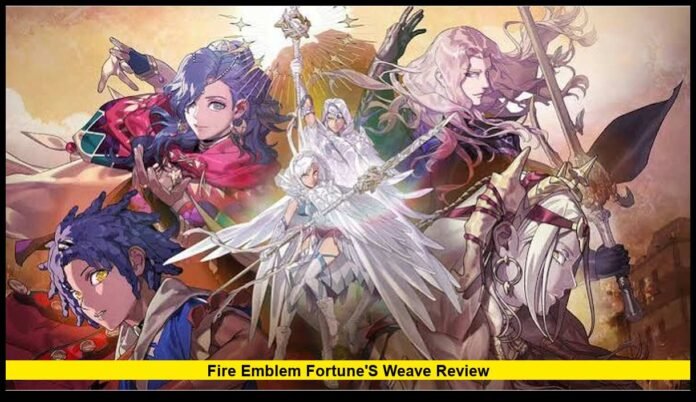

Fire Emblem fortune’s weave review coverage is now live ahead of the game’s September 17, 2026, launch, giving Nintendo Switch 2 players a detailed look at Intelligent Systems’ huge new tactical RPG. Early critical reception is strongly positive, with the game currently sitting around 89 on Metacritic and about 90 on OpenCritic as reviews continue to arrive. Several major outlets have praised its tactical battles, four interconnected hero stories, character development, customization, and enormous amount of content, while some reviewers have pointed to repetitive activities, pacing issues, and less compelling dungeon combat.
The new release is exclusive to Nintendo Switch 2. Nintendo lists Intelligent Systems as the developer and Nintendo as the publisher. The game supports TV, tabletop, and handheld play, features a single-player campaign, and has an estimated 29.5GB file size. Its U.S. release date is September 17, 2026.
With the review embargo now lifted, players finally have a much clearer picture of what the finished game offers. The biggest takeaway is its scale. This is not simply another traditional campaign built around one central route. Instead, the game combines four hero journeys, multiple campaign sections, extensive character management, exploration, tactical battles, side activities, and a concluding storyline that brings the different threads together.
Current Critical Reception
The latest review coverage places the game among the better-reviewed major releases of 2026 so far.
Metacritic currently lists a score of 89, while review aggregation coverage places OpenCritic at roughly 90. Those figures can change as additional reviews are published.
The individual reviews show a similarly broad but positive response. IGN awarded the game 10/10 and highlighted the way its tactical battles and time-management systems work together. Eurogamer gave it 5/5 and praised its combination of storytelling, combat, world exploration, and large-scale strategy. GameSpot gave it 9/10, while The Gamer also gave it 5/5 after a lengthy playthrough.
Not every review reached the same conclusion. Nintendo Life scored it 8/10 and praised the battles, protagonists, and side content while criticizing some later pacing and management elements. RPG Site also awarded 8/10. GamesRadar+ gave it 4/5 and highlighted the amount of busywork that remains throughout the campaign. Gfinity was more critical, giving it 7/10 and arguing that some exploration and dungeon elements distract from the stronger tactical combat.
That spread is important because it shows that the game’s size is both one of its most frequently praised features and one of its most common criticisms.
A Four-Hero Story Structure
One of the biggest changes is the way the campaign is organized.
Players can follow four major heroes: Cai, Dietrich, Theodora, and Leda. Each has a distinct motivation and personal story, but their journeys eventually become part of the larger conflict surrounding the world.
Cai is a young boy determined to save his imprisoned father. Dietrich is a swordsman who constantly seeks stronger opponents. Theodora is a queen pursuing a long-held dream for her homeland. Leda is a musician driven by revenge. Nintendo has built these individual motivations into separate story paths that eventually connect.
The structure gives players considerably more freedom than a conventional linear campaign.
Rather than committing to one character and seeing the entire game through that single perspective, players can move between the four stories. Progress on the different paths can be preserved, allowing the campaign to develop across multiple protagonists.
This approach also changes how the player thinks about character development.
A hero’s journey is not simply a standalone side story. The characters and allies developed through earlier sections can eventually become part of the game’s later stages. That creates an incentive to explore multiple routes instead of treating them as optional branches that have little effect on the wider experience.
Three Main Parts Shape the Campaign
The overall story is divided into three major sections.
The first focuses heavily on the four heroes and the Heroic Games. Players spend time in Dagsion, the capital city of the Dagdan Empire, while preparing for battles, developing characters, completing side activities, recruiting allies, and building relationships.
The second section moves toward a larger war. Management elements become less dominant, while tactical battles become the central focus.
The third section brings the major story threads together. Players take control of the central protagonist while drawing on characters and parties developed during the earlier routes.
This structure creates a distinctive rhythm.
The first section gives players room to prepare and experiment. The second puts greater emphasis on traditional Fire Emblem-style warfare. The final section combines several of the game’s systems while introducing additional strategic considerations.
Reviewers have generally appreciated the ambition behind this structure, although some have found the transitions uneven.
The Tactical Combat Remains the Core
Despite all the additional systems, the foundation remains turn-based tactical combat.
Battles take place on grid-based maps. Players move individual characters, attack opponents, use abilities, heal allies, and manage positioning across the battlefield.
One notable change is the treatment of weapon strengths and weaknesses. The familiar weapon triangle does not operate in the same way here. Instead, the game uses a broader set of strengths and weaknesses that gives battles a different strategic texture.
The result is a combat system that reviewers have repeatedly identified as one of the game’s strongest components.
IGN specifically praised the way the game asks players to develop both tactical skills and time-management skills. GameSpot similarly highlighted the flexibility and interconnected systems surrounding combat. Nintendo Life called the battles one of the game’s biggest strengths.
Difficulty can also increase substantially as the campaign progresses.
Some reviewers found the later sections demanding even on standard difficulty. The final portion introduces additional complications that can make battlefield planning considerably more important.
For longtime players, this provides a significant amount of strategic depth. Newcomers, however, may need time to understand how the many systems interact.
Dagsion Is More Than a Background Setting
Dagsion serves as one of the most important hubs in the game.
Between major battles, players can return to the city to prepare their forces. Activities include training, recruitment, relationship building, shopping, side quests, and other forms of character development.
The city effectively functions as a preparation center.
Instead of simply moving from one tactical battle to another, players repeatedly make decisions about how to spend their available time. Training one character may mean postponing another activity. Exploring an area may provide useful resources but consume time that could have been spent developing relationships.
That calendar-based structure gives the campaign a management component similar to the social and scheduling systems that have appeared in earlier Fire Emblem games.
The difference here is the scale.
There are four major hero paths to consider, along with a much larger amount of optional activity.
Several reviewers enjoyed this freedom. Others felt that the amount of management could sometimes become excessive, especially when the campaign slows down between major battles.
Character Development and Recruitment
Character customization is another major part of the experience.
Players can recruit additional allies, improve their abilities, develop relationships, and build teams around different strategic needs.
The class system also gives players significant freedom. Characters can develop into different classes rather than being locked permanently into one predetermined role.
That flexibility makes team construction more important.
A player can experiment with different combinations and adapt a character’s development to match a particular battle strategy. The ability to carry characters and parties into later sections also gives earlier decisions more significance.
Relationship-building remains part of the experience as well.
Players can spend time with characters, share meals, and complete activities that strengthen relationships. Support conversations add additional character context and provide another reason to invest time outside combat.
Reviewers have generally praised the cast and recruitment mechanics, although the sheer number of characters can make the overall experience feel enormous.
Exploration Adds Another Layer
The game expands beyond traditional Fire Emblem battle maps.
Players can travel around larger areas, take on side quests, collect resources, fight additional enemies, and improve their teams before returning to the main storyline.
This makes preparation an active part of the game.
Instead of simply selecting equipment before a mission, players can decide how much time they want to spend strengthening their forces.
The system also creates a sense of progression between major battles. Characters can gain experience, weapons can become stronger, and new allies can change the composition of a party.
The downside is repetition.
Several reviewers noted that some activities can begin to feel repetitive after extended play. GamesRadar+ specifically criticized the amount of busywork, while The Verge noted repeated quests, exploration, and some reused material during its lengthy playthrough.
For players who enjoy optimization, that repetition may feel useful. For those who prefer a faster route from one major battle to the next, it can slow the experience.
Dungeon Battles Are a Mixed Element
The game also includes dungeon sections that depart from the standard grid-based battles.
These encounters use a more traditional turn-based RPG structure. They provide variety and break up the tactical battles, but reviewers have been less enthusiastic about them.
WCCFtech described the dungeon combat as considerably simpler than the main tactical system. The reviewer also found the dungeons easy to navigate and less memorable than the game’s primary battles.
The Verge similarly found these encounters less interesting than the strategy battles and made use of the game’s autoplay option during some of them.
That creates a noticeable contrast.
The tactical battles are where the game’s strategic systems are most concentrated. Dungeon sections instead serve primarily as a change of pace.
For players who enjoy variety, that may be welcome. For others, the difference in quality between the two combat formats may stand out.
The Campaign Is Extremely Long
Length is one of the most frequently discussed elements of the game.
WCCFtech estimates that a player focused primarily on completing the major content could spend around 150 hours with the game. The estimate comes from roughly 20 to 25 hours for each major first-section hero campaign, additional time for the second section, and another 25 to 30 hours for the final act.
The Verge finished its playthrough at around 130 hours after completing all four hero routes while using fast travel, reducing battle animations, and skipping some previously seen material.
The Gamer reported completing its own playthrough after 121 hours.
These numbers should not be treated as a single official playtime figure. Individual completion times can vary dramatically depending on difficulty, side quests, recruitment, exploration, and how many routes a player completes.
Still, the available reviews make one point clear: this is an unusually large Fire Emblem campaign.
Visuals and Presentation
The game’s visual presentation has also received positive attention.
The setting draws on a Mediterranean-inspired aesthetic, while the character designs and cinematic presentation give the game a distinct identity.
Eurogamer praised the visual presentation and described the setting as inspired by medieval Spain. WCCFtech also highlighted the game’s visual style and soundtrack among its strengths.
The presentation is especially important because the campaign contains such a large cast.
Different characters need to remain visually recognizable across numerous story routes, battles, conversations, and cinematic scenes.
Nintendo has also confirmed HDR output on compatible displays. The game supports TV, tabletop, and handheld modes on Nintendo Switch 2.
Performance and Technical Notes
The review coverage also identifies some technical limitations.
WCCFtech lists a 30fps performance target among its criticisms. The reviewer otherwise praised the visual style, soundtrack, and overall presentation.
The game’s estimated digital file size is 29.5GB, making it one of the larger Nintendo Switch 2 releases. Nintendo lists American English among the supported languages, alongside Japanese, French, German, Italian, Spanish, Korean, Simplified Chinese, and Traditional Chinese for the digital version.
The physical edition information lists American English, Spanish, and French among its supported languages.
How Reviews Describe the Biggest Strengths
The strongest themes across the current reviews are fairly consistent.
Major strengths include:
- Deep tactical combat
- Four interconnected hero stories
- Extensive character development
- Large recruitment system
- Flexible class development
- Calendar and time-management mechanics
- Large-scale exploration
- Significant customization
- Strong character writing
- A very large amount of content
- Multiple ways to approach progression
IGN, GameSpot, Eurogamer, VGC, The Gamer, and several other outlets have emphasized different combinations of these features while arriving at broadly positive conclusions.
The central idea is that the game’s systems reinforce one another.
Training affects battles. Battles affect character growth. Character development influences later routes. Earlier routes can affect the final act. Exploration provides resources that can strengthen teams.
That interconnected design is one of the clearest reasons the game has received strong early reviews.
Where the Reviews Find Problems
The criticism is also fairly consistent.
The biggest concern is simply how much there is to do.
Some reviewers enjoyed the massive scope, while others felt the game could have benefited from tighter pacing.
Repetition appears in several reviews. Certain quests and activities can recur across routes. Some story sections can take a long time to reach their next major battle. The dungeon system is another commonly mentioned weakness.
The game’s structure can also create a learning curve.
Players are not dealing with one simple progression system. They are managing characters, classes, relationships, resources, maps, calendars, battles, side activities, and multiple story paths.
For players who enjoy detailed RPG management, that complexity is part of the appeal. For others, it can make the experience feel unnecessarily busy.
Final Verdict From the Current Reviews
The current review picture is remarkably clear even though individual outlets disagree on the game’s weaknesses.
The majority of published reviews are strongly positive. Metacritic’s current score is 89, while OpenCritic is around 90. Major publications have awarded scores ranging from 7/10 and 8/10 to 9/10, 10/10, and equivalent five-star ratings.
The praise centers on tactical combat, character development, story ambition, customization, and the sheer amount of content.
The criticism focuses mainly on repetition, pacing, management-heavy sections, dungeon combat, and the challenge of maintaining momentum through such a long campaign.
That makes the game’s reception more nuanced than a simple collection of high scores. Reviewers clearly see a very ambitious strategy RPG that sometimes struggles under the weight of its own size.
Still, the most recent reviews establish that the game has made a strong critical debut before launch.
For U.S. players, the wait is now almost over. Nintendo has confirmed that the game arrives exclusively for Nintendo Switch 2 on September 17, 2026. The official listing also confirms the game’s single-player format, 29.5GB estimated file size, supported play modes, and American English language support.
The latest reviews suggest that players looking for a large tactical RPG will find an unusually extensive adventure waiting for them, while those who prefer a shorter and more focused campaign should be prepared for its enormous scope.
What do you think about the latest Fire Emblem fortune’s weave review scores and early impressions? Share your thoughts and stay updated as the game launches.