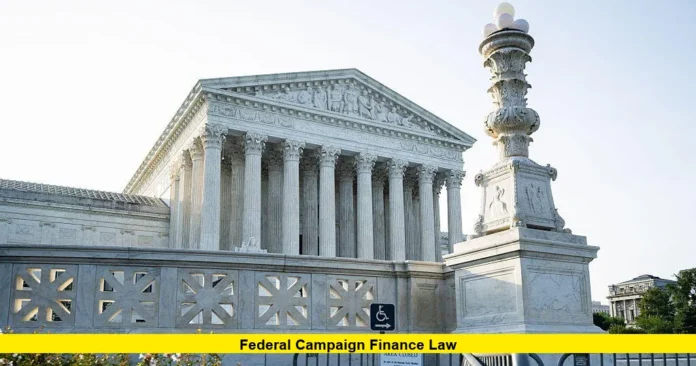

Federal campaign finance law entered a new chapter in late June 2026 after the Supreme Court issued a major ruling reshaping how political parties can spend money in coordination with candidates for federal office. The decision, handed down just days before this article was published, marks one of the most consequential shifts in campaign finance law in over two decades and is already reshaping strategy for the 2026 midterm elections. For anyone trying to understand how money moves through American politics, this ruling is essential reading.
Background: How Federal Campaign Finance Law Developed
Federal campaign finance law traces its roots to the Federal Election Campaign Act (FECA) of 1971, which established the basic framework for regulating money in federal elections. FECA created the Federal Election Commission (FEC), the independent agency responsible for enforcing contribution limits, overseeing disclosure requirements, and administering public financing for presidential campaigns.
In the years following the Watergate scandal, Congress tightened these rules considerably, adding limits on how much political parties could spend when coordinating directly with candidates. The idea was straightforward: without limits on coordinated spending, wealthy donors could funnel unlimited sums through party committees to benefit specific candidates, effectively sidestepping individual contribution caps.
For decades, this coordinated-spending limit was periodically challenged in court but generally upheld. The Supreme Court affirmed the restriction in a 2001 case involving the Colorado Republican Federal Campaign Committee, ruling 5-4 that the limits served a legitimate anti-corruption purpose. That precedent held for 25 years, even as other pillars of campaign finance regulation fell away, most notably following the Supreme Court’s 2010 Citizens United decision, which lifted restrictions on independent corporate and union spending.
The Supreme Court’s June 2026 Ruling
On June 30, 2026, the Supreme Court ruled 6-3 in National Republican Senatorial Committee v. Federal Election Commission that the coordinated-expenditure limits under federal campaign finance law violate the First Amendment. Writing for the majority, Justice Brett Kavanaugh concluded that restricting how much a political party can spend in direct coordination with its own candidates unfairly burdens political speech and association.
The case originated in 2022, when then-Senator J.D. Vance, former Representative Steve Chabot of Ohio, and two national Republican campaign committees sued the FEC, arguing the spending caps were unconstitutional and did little to actually prevent corruption. The lawsuit worked its way through the federal court system, with the full U.S. Court of Appeals for the 6th Circuit upholding the limits while acknowledging the challengers had made compelling arguments. By the time the case reached the Supreme Court, the Justice Department had already stopped defending the limits, leaving the Democratic National Committee and a court-appointed attorney to argue for keeping the restrictions in place.
In his opinion, Kavanaugh reasoned that the only constitutionally valid justification for restricting campaign spending is preventing “quid pro quo” corruption, meaning direct exchanges of money for official favors. He argued that existing safeguards, including base contribution limits, rules against “earmarking” donations for specific candidates, and federal disclosure requirements, already address that concern without the need for a separate cap on coordinated party spending. The ruling formally overturned the Court’s 2001 precedent, which Kavanaugh described as resting on legal reasoning that subsequent decisions had already undermined.
Justice Elena Kagan, writing for the dissent, warned that the decision reopens a pathway for exactly the kind of corruption the original law was designed to prevent. She noted that under the new rules, a donor could give a political party several hundred thousand dollars, far more than the roughly $7,000 an individual could contribute directly to a candidate under current limits, with the expectation that the party would funnel that support toward a specific campaign.
What the Limits Looked Like Before the Ruling
Understanding the scale of this change requires looking at what federal campaign finance law previously allowed. Under the 2026 election cycle limits, national party committees could spend between $65,300 and $130,600 in direct coordination with U.S. House candidates, depending on the state. For Senate races, the coordinated spending caps ranged much more widely, from roughly $130,600 in smaller states like Wyoming up to more than $4 million in a large state like California, reflecting the higher cost of statewide campaigns.
These limits applied specifically to coordinated expenditures, meaning spending done in direct consultation with a candidate’s campaign. They were separate from other party activities, such as general get-out-the-vote efforts or independent expenditures made without coordinating with a candidate, which were already largely unrestricted following earlier court rulings.
Other parts of federal campaign finance law remain intact for now. Individuals are still limited in how much they can donate annually to political party committees, currently capped at roughly $44,300 to national party committees and $10,000 to state and local party committees. Political parties also remain barred from accepting so-called “soft money,” meaning unrestricted contributions from corporations and labor unions for general party-building purposes. Candidates can still spend unlimited amounts of their own personal funds on their campaigns, provided they properly disclose those expenditures to the FEC.
Public Interest and Political Reaction
The ruling has generated sharp reactions across the political spectrum. Republican campaign committees, including the National Republican Senatorial Committee, which brought the lawsuit, celebrated the decision as a major win for political speech, arguing that the old rules unfairly restricted how parties could support their own nominees. Attorneys involved in the case described the outcome as a turning point that removes what they viewed as an irrational barrier between parties and the candidates they exist to elect.
Democratic officials and campaign finance watchdog groups, meanwhile, have expressed alarm. Organizations that track money in politics argue the decision opens the door to circumventing individual contribution limits by routing large donations through party committees. Legal advocacy groups focused on transparency in elections have signaled they will continue pushing for stronger disclosure requirements and enforcement of the rules that remain, even as coordinated spending limits disappear.
Election analysts note that the practical effects of the ruling could be significant heading into the 2026 midterms. According to FEC data, Senate candidates have already spent more than $490 million this cycle, while House candidates have spent nearly $1 billion. With coordinated spending limits now removed, party committees are expected to funnel substantially more money directly into competitive races, particularly benefiting candidates who have struggled to keep pace with better-funded opponents through traditional fundraising.
Latest Updates on Enforcement and Oversight
Beyond the Supreme Court ruling, federal campaign finance law continues to be shaped by ongoing enforcement actions at the FEC level. In recent weeks, watchdog organizations have filed complaints alleging that certain political committees violated federal reporting rules by using shell companies to obscure the true recipients of campaign spending. Separate complaints have also targeted so-called “pop-up PACs,” short-lived political action committees that emerge shortly before a primary election and then dissolve, often raising questions about whether they properly disclosed their donors and spending under federal law.
These enforcement matters illustrate that even as coordinated-spending limits fall away, other components of federal campaign finance law, particularly transparency and disclosure requirements, remain active areas of scrutiny. The FEC continues to require candidates and committees to report the sources of their contributions and the specific purposes of their disbursements, and violations of these reporting rules can still result in fines or other penalties.
It remains unclear how quickly political parties will adjust their spending strategies in response to the ruling, or whether Congress will attempt to pass new legislation addressing the gap left by the decision. There is no official confirmation at this time of any pending congressional action to respond to the ruling, and any such effort would likely face significant political hurdles given the current composition of Congress.
Final Thoughts
The Supreme Court’s decision to strike down coordinated-spending limits represents a defining moment in the ongoing evolution of federal campaign finance law. Building on a trajectory that began with Citizens United in 2010, the ruling continues to shift American elections toward a system with fewer restrictions on how money flows to candidates through party organizations. Supporters view the change as a necessary correction that restores parties’ ability to freely support their own nominees, while critics see it as another step toward a campaign finance system more vulnerable to the influence of large donors.
As the 2026 midterm elections approach, the practical consequences of this ruling will likely become clearer in the months ahead, particularly in competitive House and Senate races where party spending could make a meaningful difference. Voters, candidates, and watchdog organizations alike will be watching closely to see how political parties adapt their fundraising and spending strategies under this newly deregulated landscape.
Stay informed on how this landmark ruling continues to reshape American elections, and share your thoughts on what it means for the future of campaign finance in the comments below.