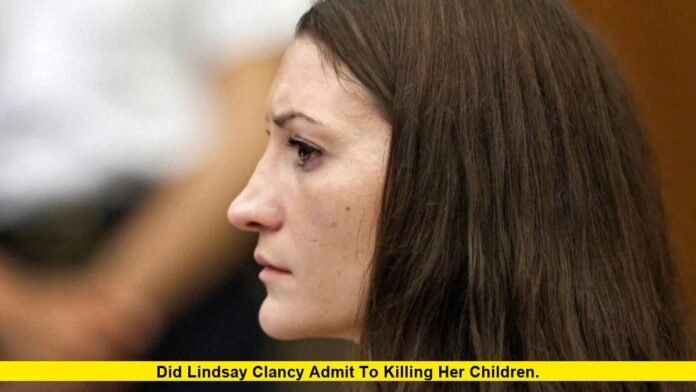

The answer to “did Lindsay Clancy admit to killing her children?” is yes, but the wording requires an important legal distinction.
Lindsay Clancy’s defense team formally indicated before her 2026 murder trial that she was willing to stipulate in writing to her involvement in the conduct that caused the deaths of her three children. The defense made that offer while asking the court to divide the trial into separate stages so that the jury could focus primarily on whether Clancy was criminally responsible for what happened.
That does not mean Clancy pleaded guilty to murder. She has maintained a defense based on lack of criminal responsibility, arguing that severe postpartum psychosis and other mental-health problems affected her ability to understand the wrongfulness of her actions.
The case remains unresolved after a judge declared a mistrial on September 4, 2026, when jurors could not reach a unanimous decision. Prosecutors have not yet announced whether they will seek a retrial.
What Did Lindsay Clancy Actually Admit?
In April 2026, Clancy’s attorney, Kevin Reddington, asked Plymouth Superior Court Judge William Sullivan to reconsider a request for a bifurcated trial.
According to the defense filing, Clancy was willing to “stipulate formally in writing” to her involvement in the underlying conduct that resulted in the deaths of her three children. The defense argued that the central issue should instead be Clancy’s mental state and whether she was criminally responsible.
That distinction is important.
A stipulation is not the same thing as a conventional guilty plea. Clancy did not enter a guilty plea to three murder charges. Instead, her defense sought to remove the factual question of whether she caused the deaths from the main dispute and concentrate the trial on criminal responsibility.
The prosecution opposed that approach and argued that jurors should hear the evidence surrounding the killings as part of the case.
The judge ultimately declined to split the proceedings.
Why Did Clancy’s Defense Want to Admit Her Involvement?
The defense strategy centered on a fundamental question: What was Lindsay Clancy’s mental state when her children died?
Clancy’s attorneys did not make the factual occurrence of the killings the primary issue they wanted the jury to resolve. Instead, they argued that she was experiencing a severe psychiatric crisis, including postpartum psychosis, and therefore should not be held criminally responsible.
The strategy was designed to prevent the trial from becoming primarily a dispute over whether Clancy physically caused the deaths.
The defense wanted jurors to concentrate on whether her mental illness prevented her from appreciating the wrongfulness of her conduct.
That argument remained central throughout the trial.
What Happened to Clancy’s Three Children?
Clancy was charged in connection with the January 2023 deaths of her children:
- Cora Clancy, age 5
- Dawson Clancy, age 3
- Callan Clancy, age 8 months
Prosecutors alleged that the children were strangled with exercise bands at the family’s home in Duxbury, Massachusetts.
Clancy later attempted suicide by jumping from a second-story window. The attempt left her with severe physical injuries and paralysis.
The prosecution and defense agreed on the basic fact that the children died, but they sharply disagreed over why Clancy acted and whether she was legally responsible for her conduct.
Did Lindsay Clancy Plead Guilty?
No.
This is one of the most important points for anyone searching for the latest answer to the question.
Clancy pleaded not guilty and pursued a defense based on lack of criminal responsibility. Her legal position was not that the deaths did not occur or that someone else caused them. Instead, the defense argued that a serious psychiatric condition made her legally incapable of being held responsible for the killings.
That is why headlines saying Clancy “admitted” or was “willing to admit” to killing her children can be misleading if they are interpreted as meaning she entered a guilty plea.
She did not receive a murder conviction, and she was not acquitted.
What Did Prosecutors Argue?
Prosecutors presented a substantially different explanation of the events.
The Commonwealth argued that Clancy intentionally killed her children and understood what she was doing. Prosecutors pointed to evidence they said demonstrated planning and deliberate conduct before the killings.
Among the evidence discussed at trial were Clancy’s movements and communications before the deaths, her husband’s absence from the home, digital evidence, medical evidence and expert testimony concerning her mental state.
Prosecutors also challenged the defense account of postpartum psychosis and questioned whether Clancy’s reported hallucinations and symptoms were consistent with genuine psychosis.
The prosecution’s position was that mental-health problems did not prevent Clancy from appreciating the wrongfulness of her actions.
What Did the Defense Argue About Postpartum Psychosis?
The defense presented extensive evidence about Clancy’s mental-health deterioration in the period before the killings.
Multiple medical professionals, family members and other witnesses testified about her psychiatric symptoms, treatment and medication history.
Defense experts argued that Clancy was suffering from postpartum psychosis at the time of the killings. The defense also argued that her treatment history and multiple psychiatric medications contributed to a worsening mental state.
A major part of the defense case involved alleged command hallucinations and the contention that Clancy believed she was acting under the influence of a psychotic episode.
The prosecution presented experts who disputed that interpretation.
The disagreement over her mental state ultimately became the central issue for the jury.
What Happened at the 2026 Trial?
Clancy’s murder trial lasted nearly six weeks in Plymouth, Massachusetts.
The trial included testimony from family members, medical professionals, mental-health experts, law enforcement witnesses and other people connected to the case.
The defense did not attempt to establish that the children had died through an unrelated event. Instead, its legal strategy focused heavily on criminal responsibility.
The prosecution sought to persuade jurors that Clancy’s actions were deliberate and that she understood the wrongfulness of what she was doing.
After the evidence and closing arguments, the jury began deliberations.
The jury deliberated for more than 38 hours over seven days but could not reach a unanimous verdict.
Why Was There a Mistrial?
On September 4, 2026, Judge William Sullivan declared a mistrial after the jury reported that it could not reach a unanimous decision.
Recent reports indicate that the jury was divided 11-1. The dispute centered on whether Clancy should be found not guilty by reason of lack of criminal responsibility.
Several jurors later spoke publicly about the deliberations and said the holdout juror acknowledged having reasonable doubt but still would not agree to an acquittal on the insanity-based defense.
Clancy’s defense team unsuccessfully sought intervention concerning the holdout juror before the mistrial was formally declared.
The Massachusetts Supreme Judicial Court denied an emergency request from the defense seeking relief that would have prevented the mistrial.
Because the jury did not reach a verdict, the case ended without either a murder conviction or an acquittal.
Is Lindsay Clancy Still Facing Murder Charges?
Yes.
The mistrial did not establish that Clancy was innocent, nor did it establish that she was guilty. The underlying criminal case remains unresolved.
The prosecution has said that it has not yet decided whether to seek a new trial.
A September 29, 2026, court hearing is scheduled to address the next stage of the case. That proceeding could provide a clearer indication of whether prosecutors intend to retry Clancy and how the defense will proceed.
Clancy remains in state custody at Tewksbury State Hospital.
Could Lindsay Clancy Be Retried?
A retrial remains possible because the 2026 proceedings ended in a mistrial caused by a deadlocked jury rather than an acquittal.
However, the prosecution has not publicly committed to a retrial as of the latest available updates.
The decision could depend on a number of legal and practical considerations, including the evidence presented during the first trial, the difficulty of securing a unanimous verdict, the impact of another trial on the victims’ family and the prospects for obtaining a different result with a new jury.
The September 29 hearing is therefore an important upcoming development.
What Is the Most Accurate Answer to “Did Lindsay Clancy Admit to Killing Her Children?”
The most accurate answer is:
Clancy’s defense formally offered to stipulate in writing to her involvement in the conduct that resulted in her children’s deaths, but she did not plead guilty to murder.
Her defense was built around the argument that she was not criminally responsible because of severe mental illness, particularly alleged postpartum psychosis.
That distinction matters because “admitted to killing” can sound like a guilty plea when the actual legal strategy was more specific.
The defense was effectively saying that the jury did not need to spend its primary effort deciding whether Clancy caused the deaths; instead, it wanted the central legal question to be whether her mental condition made her criminally responsible.
The judge did not adopt the requested two-stage trial format, and prosecutors continued presenting evidence about the circumstances surrounding the killings.
What Happens Next in the Lindsay Clancy Case?
The immediate next major date is September 29, 2026, when the case is scheduled to return to court.
The prosecution’s decision on a possible retrial remains one of the most important unanswered questions.
For now, there is no final verdict determining whether Clancy is criminally responsible for the deaths of her three children. The September 2026 mistrial left the murder charges unresolved.
The case also continues to draw attention because of its unusual intersection of criminal law, postpartum mental illness, psychiatric treatment and the legal standard for criminal responsibility.
Any future proceedings will likely again focus heavily on the competing explanations of Clancy’s mental state at the time of the killings.
Stay with the latest verified updates on the Lindsay Clancy case, and share your thoughts in the comments as the next court proceedings unfold.