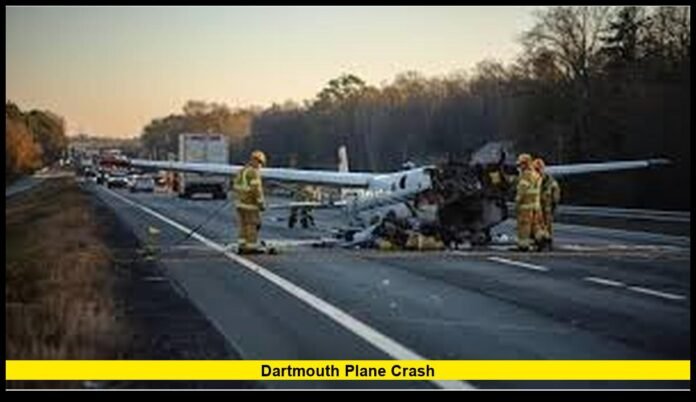

The Dartmouth plane crash has left two people dead and one injured after a small aircraft came down on Interstate 195 in Massachusetts. The crash, which took place on a stormy Monday morning, shocked commuters, disrupted major traffic routes, and prompted a detailed investigation into how a routine flight ended in tragedy.
Officials are now carefully reconstructing the final moments before the crash as residents of Dartmouth and the wider region grapple with the impact of the event.
A Routine Morning Shattered
Sudden Descent Over I-195
Shortly after 8:00 a.m., as heavy rain and winds swept across the area, a small, fixed-wing aircraft was on its approach to New Bedford Regional Airport. Instead of making a safe landing, the plane suddenly descended and crashed into the median of I-195, a busy commuter highway running through Dartmouth.
The impact was devastating. The plane burst into flames upon hitting the ground, sending thick smoke billowing across both eastbound and westbound lanes. Two people aboard the plane were killed instantly. A third person—who happened to be on the highway at the time—sustained injuries and was transported to a nearby hospital.
Emergency services arrived within minutes, battling both the flames and the stormy conditions to secure the crash site and assist the injured. Morning commuters were forced to a halt, many witnessing the fiery wreck just yards away from their vehicles.
Severe Weather Loomed Over the Region
Nor’easter Conditions at Time of Crash
The Dartmouth plane crash occurred during a powerful nor’easter that brought heavy rainfall, low visibility, and winds gusting up to 40 mph. These conditions made flying difficult, particularly for small aircraft.
Strong crosswinds and rapidly shifting cloud cover are known hazards for pilots approaching airports in storm systems. Investigators are examining how these weather patterns may have influenced the pilot’s ability to maintain control during the final approach.
Investigation Launched into Dartmouth Plane Crash
Authorities Examine Multiple Possible Causes
Following the crash, a comprehensive investigation began. Local and federal aviation investigators are working together to determine the cause. While the investigation is ongoing, several key areas are being analyzed:
- Flight Path and Altitude: Officials are examining radar data to understand the plane’s trajectory in the moments leading up to impact.
- Mechanical Factors: Investigators are checking whether any technical failures contributed to the crash.
- Pilot Decision-Making: Authorities are reviewing communications to determine whether the pilot attempted to divert, declare an emergency, or perform an emergency landing.
- Weather Influence: Wind speeds, precipitation rates, and visibility are being analyzed to assess how much the storm may have affected flight dynamics.
The aircraft wreckage has been recovered and moved for closer inspection, where engineers and aviation experts will carefully examine its components.
Scene Response and Emergency Operations
Quick Actions Minimized Further Harm
Local fire and rescue teams responded rapidly, despite the challenging weather. The combination of heavy rain and fire created hazardous conditions on the ground. Firefighters managed to contain the blaze and prevent it from spreading to nearby vehicles on the highway.
Police closed a large section of I-195 to keep motorists and first responders safe. Both directions of the highway remained shut down for several hours as crews cleared debris, managed traffic redirection, and began initial investigative work.
The swift response likely prevented additional casualties, as the busy morning highway could have led to a far greater disaster if other vehicles had been directly struck by debris.
Traffic Disruption Across the Region
The Dartmouth plane crash caused a major transportation shutdown, affecting thousands of commuters. I-195 is a critical route connecting Dartmouth and New Bedford to surrounding towns and highways.
Drivers were forced onto alternate routes, causing congestion on local roads and significant delays during the morning rush hour. Transportation officials worked to reroute traffic, but backups extended for miles, with some drivers delayed for hours before the highway reopened later in the day.
Local businesses and schools also experienced ripple effects, with late arrivals and temporary schedule changes due to the sudden traffic gridlock.
Community Reaction: Shock and Grief
Residents Rally Around Victims’ Families
The Dartmouth plane crash has left a visible mark on the local community. Residents have expressed deep sadness for the victims and their families, many noting how unusual it is for a plane crash to occur in such a populated, well-traveled area.
People living near the crash site described hearing a loud noise followed by smoke rising from the highway. Some witnesses reported seeing the plane descending unusually low before the crash, although official conclusions have not yet been released.
Community leaders have extended their condolences to those affected and praised first responders for their rapid and brave actions in dangerous conditions.
Questions Surrounding the Final Moments
As investigators work through evidence, several critical questions remain unanswered:
- Did the pilot attempt to use the highway for an emergency landing, or did the aircraft lose control in the storm?
- Were there any signs of mechanical trouble before the descent?
- Could more have been done to avoid flying in such severe weather conditions?
- Were air traffic controllers aware of the plane’s distress in the moments before the crash?
Answers to these questions will emerge as radar data, communication logs, and physical evidence are analyzed in the coming weeks.
Aviation Safety and Highway Proximity
The Dartmouth plane crash has renewed conversations about aviation safety in areas where airports are located near major highways. New Bedford Regional Airport sits close to I-195, meaning aircraft regularly fly over or near the highway during landing and takeoff.
While such arrangements are common, incidents like this highlight how vulnerable motorists can be in the rare event of an aviation emergency. Experts often emphasize that pilots are trained to consider highways as potential emergency landing sites if engine failure occurs. However, in stormy conditions, even this can become extremely dangerous.
Rare but Impactful Events
Plane crashes on major highways are rare in the United States, but when they happen, they attract national attention because of their potential for mass casualties. Unlike crashes in remote areas, incidents on busy roads place both passengers and civilians in immediate danger.
While the Dartmouth plane crash involved a small private aircraft, its location and timing underscore how aviation accidents can disrupt communities and transportation networks in unpredictable ways.
Looking Ahead: What Comes Next
As the investigation progresses, officials will:
- Reconstruct the flight path using radar and on-board equipment.
- Review weather reports and air traffic communications.
- Analyze mechanical components for signs of failure.
- Interview witnesses and local residents who saw or heard the crash.
Findings from this investigation may lead to safety recommendations for pilots, particularly regarding flying during severe weather systems like nor’easters. Local officials may also review whether any infrastructure changes could mitigate risks near major highways.
A Tragedy That Leaves Lasting Questions
The Dartmouth plane crash has left two families mourning loved ones and a community searching for answers. While aviation incidents are statistically rare, their suddenness and scale leave a lasting emotional impact.
As investigators work to piece together the full story, the event serves as a sobering reminder of how weather, human decision-making, and flight operations can converge in unpredictable and sometimes tragic ways.
The Dartmouth plane crash has shaken the community and raised critical questions about aviation safety during severe weather. As officials continue their work, the region waits for answers that may help prevent future tragedies.