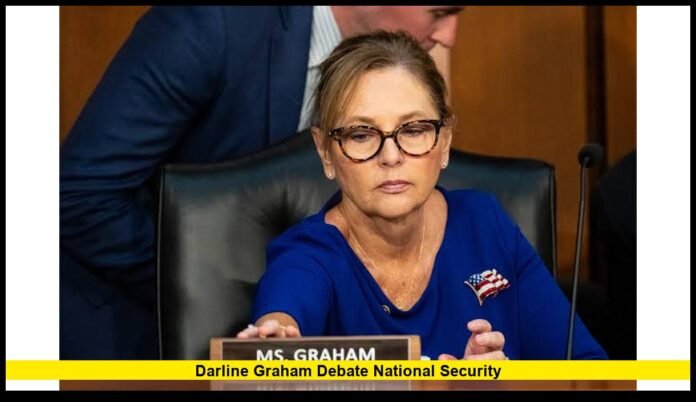

The Darline graham debate national security controversy is drawing attention across South Carolina after Sen. Darline Graham struggled to answer a foreign-policy question during her Republican runoff debate with Rep. Ralph Norman on August 18.
The exchange came during the candidates’ only scheduled one-on-one debate before the August 25 Republican runoff. The moderator asked Graham whether Taiwan and the South China Sea represent national security interests for the United States and why those areas matter to American security.
Graham paused and asked for the question to be repeated. She then acknowledged that national security was not an area in which she considered herself highly informed. She emphasized her support for the U.S. military and pointed to her family’s military background.
The response produced audible reactions from people attending the debate at the Newberry Opera House. The moment quickly became one of the most closely discussed parts of the contest.
What Darline Graham said about national security
Graham’s response centered on her personal connection to military service rather than a detailed explanation of U.S. policy toward Taiwan or the South China Sea.
She highlighted the military service of her late brother, former Sen. Lindsey Graham, and her father. Lindsey Graham served in the U.S. Air Force before entering politics, while their father also served in the military.
Darline Graham said she supports the military but acknowledged that national security has not been the main focus of her professional career.
That distinction is important because she is seeking a full Senate term. The Senate handles major national security responsibilities, including defense legislation, military funding and confirmation of senior national security officials.
Her answer therefore created a direct debate over whether her background has prepared her for the responsibilities of a U.S. senator.
Why the Taiwan question mattered
The moderator’s question focused on Taiwan and the South China Sea because both issues remain important to U.S. foreign policy.
Taiwan occupies a strategically important position in East Asia. Its relationship with mainland China has remained a major source of tension between Washington and Beijing.
The South China Sea also carries significant strategic importance. Several governments have competing territorial claims in the region, while China has asserted extensive claims of its own.
For the United States, developments in the area can affect military planning, regional alliances, trade routes and relations with China.
That made the question especially significant in a Senate race. A senator may vote on defense spending, military authorizations and foreign-policy legislation that directly affects America’s approach to those issues.
Graham did not offer a detailed policy position during the exchange. Instead, she stressed that she supports the military and comes from a family with military experience.
Ralph Norman’s response created a sharp contrast
Rep. Ralph Norman used the same discussion to present himself as the more experienced candidate on federal policy.
Norman has served in the U.S. House since 2017. His congressional background gives him a record of votes and public positions on national security and foreign affairs.
During the debate, Norman offered a more detailed response on Taiwan. He argued that the United States has important strategic interests in the region and discussed the threat posed by possible Chinese aggression.
The contrast between the two candidates was immediate.
Graham presented herself as someone whose professional experience has largely centered on South Carolina issues. Norman emphasized his years in Congress and his experience dealing with federal legislation.
That difference has become one of the defining issues of the Republican runoff.
The debate comes just days before voting
The timing of the exchange gives it additional importance.
South Carolina’s Republican runoff is scheduled for August 25. Early voting began August 19, one day after Graham and Norman met on the debate stage.
The runoff follows the August 11 special Republican primary, in which Graham and Norman finished as the top two candidates.
Graham entered the runoff with the advantage of finishing first in the primary. Norman remained close enough to force a second election and now has another opportunity to challenge her.
The two candidates are competing to become the Republican nominee for the Senate seat that became vacant after the death of Lindsey Graham.
The Republican nominee will then move toward the November general election.
Darline Graham’s Senate appointment
Graham’s current position in the Senate began only recently.
South Carolina Gov. Henry McMaster appointed her to fill the Senate vacancy created by her brother’s death. She subsequently took the Senate oath and became a temporary holder of the seat.
Her appointment made her the first woman to represent South Carolina in the U.S. Senate.
However, the appointment did not guarantee her a full Senate term.
South Carolina Republicans still needed to choose their nominee through a special primary process. Graham entered the Republican contest and finished first in the initial vote, but she did not receive enough support to avoid a runoff.
That means her future in the Senate remains dependent on the outcome of the election.
Lindsey Graham’s national security record adds another layer
The national security question carries unusual significance because of Graham’s family connection to the seat.
Lindsey Graham was well known nationally for his involvement in foreign policy and national security during his Senate career. He regularly addressed international conflicts, military policy and U.S. relations with other countries.
He also traveled internationally as part of congressional delegations and frequently spoke about threats involving China, Russia, Iran and other countries.
Darline Graham has not attempted to duplicate that career.
Instead, she has emphasized her own background and the domestic issues that she believes matter most to South Carolina residents.
That approach has allowed her to distinguish herself from her brother, but it also creates a difficult political question. Voters must decide whether they want a candidate with extensive state-level experience or a candidate with a longer federal record.
The debate brought that difference into sharp focus.
Graham’s political background is different from her opponent’s
Before entering the Senate, Graham built her career outside elected federal office.
She spent years working in South Carolina public service and eventually became associated with the state’s Commission for the Blind.
Her supporters point to that experience as evidence that she understands the needs of South Carolina residents.
Norman’s experience is different. He has spent years in Congress and has already dealt with federal legislation and national political issues.
The national security exchange gave Norman an opportunity to argue that Senate service requires more than familiarity with state-level concerns.
Graham’s answer also allowed her supporters to make a different case. She did not pretend to have expertise she does not possess. Instead, she openly acknowledged her limited background in national security.
For voters, the question is whether that honesty outweighs concerns about preparedness.
National security is a major Senate responsibility
The Senate’s role extends well beyond domestic legislation.
Senators vote on major defense bills and approve funding for the Department of Defense. They also participate in oversight of military and intelligence agencies.
The Senate has constitutional responsibilities involving treaties and plays an important role in confirming senior officials across the national security establishment.
Members of the Senate Foreign Relations Committee and Armed Services Committee routinely deal with complicated international issues.
Even senators who do not specialize in foreign affairs must vote on legislation affecting America’s military and diplomatic policies.
That reality explains why Graham’s response received so much attention.
The issue was not simply whether she could identify Taiwan on a map or discuss one foreign-policy topic. The debate raised broader questions about how prepared she is to handle the responsibilities that accompany a full Senate term.
Taiwan remains a central U.S.-China issue
Taiwan has become one of the most sensitive subjects in relations between the United States and China.
The United States maintains unofficial relations with Taiwan while recognizing the People’s Republic of China diplomatically.
Washington has historically maintained a policy that does not provide a clear public guarantee that American forces would automatically enter a war if China attacked Taiwan.
At the same time, the United States has maintained significant economic and security ties with Taiwan.
That complicated policy makes Taiwan a difficult subject for any political candidate.
The issue involves military deterrence, regional alliances, trade, technology and the broader U.S.-China relationship.
For a senator, decisions involving Taiwan could carry consequences far beyond the immediate region.
The South China Sea adds another strategic concern
The South China Sea is another major part of the broader U.S. security discussion.
The region contains important maritime routes and has competing territorial claims involving multiple governments.
China’s growing military presence in the area has contributed to tensions with other countries.
The United States has repeatedly treated freedom of navigation and regional stability as important interests.
That is why the moderator’s question connected Taiwan and the South China Sea.
Both subjects involve America’s relationship with China and its broader role in the Indo-Pacific.
Graham’s inability to provide a detailed response gave Norman an opening to highlight his own foreign-policy experience.
Trump’s endorsement remains important to the race
President Donald Trump has endorsed Graham in the Republican contest.
That support has given her campaign an important advantage within a Republican electorate where Trump’s backing remains politically significant.
Trump’s endorsement also helps explain why the runoff has received national attention despite being a South Carolina Senate contest.
Norman has challenged the endorsement and argued that his own congressional record makes him a stronger candidate.
The national security debate provided another opportunity for Norman to make that argument.
Graham, meanwhile, continues to rely on her connection to Trump, her family history and her South Carolina background.
The runoff will show how those factors compare with Norman’s congressional experience.
The debate was about more than one answer
The national security exchange became the most visible moment of the debate, but the broader contest involves competing ideas about what South Carolina needs from its next senator.
Graham has presented herself as a candidate focused on everyday concerns and economic pressures facing residents.
Norman has emphasized his experience in Washington and his conservative voting record.
The debate allowed voters to see those differences directly.
Graham’s response on national security reinforced her outsider image. Norman’s answer reinforced his image as an established federal lawmaker.
Neither candidate can avoid national issues if elected.
The Senate deals with military spending, international relations, trade, intelligence and foreign policy alongside domestic concerns.
That makes the qualifications question particularly relevant as voters prepare to choose between the two Republicans.
What the national security controversy means for Graham
The debate does not change Graham’s status as the Republican runoff candidate.
She remains on the ballot for the August 25 contest and continues to campaign for a full Senate term.
However, her response has created a clear issue for voters to consider before casting their ballots.
The central question is whether Graham’s lack of national security experience should weigh heavily against her other qualifications.
Her supporters can point to her public-service background and her willingness to acknowledge where her expertise is limited.
Her critics can argue that a Senate candidate should arrive prepared to address major international security questions.
The decision ultimately rests with South Carolina Republican voters.
Early voting is already underway
South Carolina voters do not have to wait until August 25 to participate.
Early voting began Wednesday, August 19, giving eligible voters an opportunity to cast ballots before Election Day.
That means the debate took place at a particularly consequential moment. Some voters could begin voting immediately after seeing the candidates face each other.
The runoff is now entering its final stretch.
Both campaigns have limited time to reinforce their messages and persuade undecided Republican voters.
For Graham, that includes explaining her approach to national security and demonstrating that she can handle the broader responsibilities of Senate service.
For Norman, it means continuing to argue that his congressional experience makes him the better choice.
The Senate race now moves toward August 25
The Republican runoff will determine whether Graham remains on track to seek a full Senate term or whether Norman takes the Republican nomination.
The winner will advance to the November general election.
Until voters make that decision, the national security exchange will remain an important part of the discussion surrounding Graham’s candidacy.
Her answer was notable because it directly addressed an area where her background differs from that of her late brother.
Lindsey Graham built much of his national political identity around foreign policy and military affairs. Darline Graham has built hers around South Carolina public service and domestic concerns.
The debate made that contrast unmistakable.
As early voting continues, South Carolina Republicans are weighing not only the candidates’ political affiliations but also their experience, priorities and readiness for Senate responsibilities.
The final result will determine whether Graham’s outsider approach can overcome concerns raised during the debate or whether Norman’s federal experience proves more persuasive.
South Carolina voters will soon decide which Republican is best positioned to represent the state in the Senate, making the national security debate a significant test of Darline Graham’s candidacy.