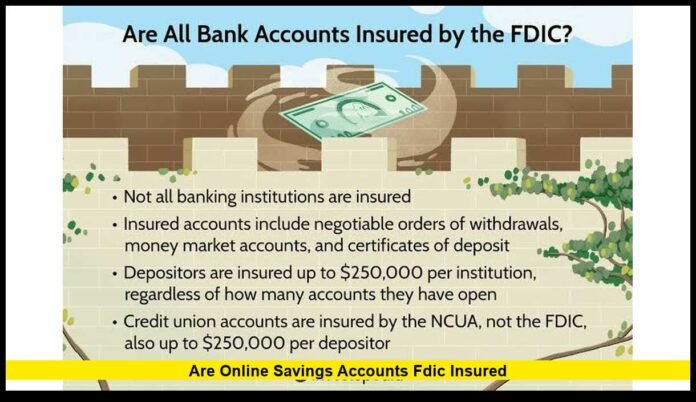

Are online savings accounts FDIC insured? Yes, eligible online savings accounts held at FDIC-insured banks are generally protected up to $250,000 per depositor, per insured bank, per ownership category. This protection applies whether customers access their money through a mobile app, a banking website, or a physical branch.
Online savings accounts give Americans a convenient way to save money, earn interest, and manage deposits without visiting a bank. Many customers choose digital banking because it offers flexible account access and competitive savings options. However, understanding federal deposit insurance remains essential before opening an account or transferring a large balance.
Not every company that offers an online savings product is a bank. Some financial technology companies work with partner banks to hold customer deposits. The institution holding the money, the type of financial product, and the account’s ownership structure determine whether FDIC insurance applies.
Knowing these distinctions can help customers protect their savings, avoid exceeding insurance limits, and make better-informed banking decisions.
What Is FDIC Insurance for Online Savings Accounts?
The Federal Deposit Insurance Corporation, known as the FDIC, is an independent federal agency that protects depositors when an insured bank fails. Established in 1933, the agency administers the federal deposit insurance system.
FDIC insurance protects eligible deposits at participating banks. The protection applies to qualifying accounts regardless of whether customers open them online or in person.
For example, a customer who opens a savings account through an insured bank’s website generally receives the same standard deposit insurance protection as someone who opens an equivalent account at a branch.
The standard FDIC insurance limit is $250,000 per depositor, per insured bank, per ownership category. The agency calculates coverage using the depositor’s combined eligible balances within the same ownership category at that bank.
This means customers cannot automatically obtain a separate $250,000 limit for every savings account they open. If someone has individual checking and savings accounts at the same insured bank, the balances generally count toward the same coverage limit.
The same rule can apply when customers use different financial apps that deposit their money at the same underlying bank.
The most important consideration is therefore the identity of the bank holding the deposits, not the name of the banking app or the convenience of its digital services.
Are Online Savings Accounts Automatically FDIC Insured?
Eligible deposit accounts generally receive FDIC insurance automatically when they are held at an insured bank. Customers do not need to purchase separate coverage or pay an additional premium.
Banks fund the deposit insurance system through assessments paid to the FDIC. Customers benefit from the protection when their deposits satisfy the applicable requirements.
However, an online financial product does not qualify for insurance simply because its provider advertises banking services. The account must represent an eligible deposit held at an FDIC-insured institution.
Before opening an account, customers should check several important details:
- Bank identity: Find the legal name of the institution holding the deposits.
- Insurance status: Verify that the institution has FDIC insurance.
- Product eligibility: Confirm that the account is an eligible deposit rather than an investment product.
- Account ownership: Understand whether the account is individually owned, jointly owned, or held under another qualifying category.
- Combined deposits: Calculate the total eligible balances held at the same bank within the same ownership category.
These checks help customers determine whether their savings qualify for federal protection and whether their entire balance falls within the applicable limit.
A high advertised interest rate, a familiar brand name, or a statement that a company works with banks does not establish the exact amount of coverage available.
How Much FDIC Insurance Do Online Savings Accounts Provide?
The standard coverage limit remains $250,000 per depositor, per insured bank, per ownership category. This amount applies to the combined eligible deposits in the relevant category, not separately to each account.
The following examples illustrate how coverage generally works for a person with individual accounts at one insured bank.
| Combined eligible deposits | General insurance treatment |
|---|---|
| $25,000 | Fully insured |
| $100,000 | Fully insured |
| $200,000 | Fully insured |
| $250,000 | Within the standard limit |
| $275,000 | $250,000 insured; $25,000 exceeds the standard limit |
| $400,000 | $250,000 insured; $150,000 exceeds the standard limit |
These examples assume the customer has no other deposits in the same ownership category at that bank. They also assume that the accounts qualify for FDIC insurance.
Accrued interest counts toward the insurance limit. If a savings account contains $250,000 in principal and earns additional interest, its total balance can exceed the standard limit.
Consider a customer with $240,000 in an individual online savings account and $20,000 in an individual checking account at the same bank. The combined balance is $260,000. Under the standard individual ownership category, $250,000 is insured, while $10,000 exceeds the ordinary limit.
Coverage can differ when deposits qualify under separate ownership categories. Eligible joint accounts, certain retirement accounts, and qualifying trust accounts may receive separate coverage under applicable rules.
Customers with substantial balances should calculate insurance across all relevant accounts instead of treating each account as an independent source of protection.
Are Online-Only Banks FDIC Insured?
Yes. An online-only bank can offer FDIC-insured savings accounts without operating traditional branches.
Some banks conduct nearly all customer interactions through websites, mobile applications, electronic transfers, and remote support. Other institutions combine digital banking with physical branches.
The FDIC’s standard deposit insurance rules do not depend on whether a bank operates a branch network. An eligible deposit at an insured online-only bank receives the same standard coverage as an equivalent deposit at an insured traditional bank.
However, customers must distinguish between an actual bank and a financial technology company that provides access to banking services.
A digital financial brand may rely on a partner bank to hold customer deposits. In that situation, the partner bank’s insurance status and the structure of the arrangement determine whether the funds qualify for FDIC protection.
Before transferring money, read the account agreement and deposit disclosures. Identify the legal institution that holds the funds and verify its insurance status.
An online-only business model does not reduce FDIC coverage. The decisive factors are the insured bank, the eligibility of the deposit, and the applicable ownership category.
How to Check Whether an Online Savings Account Is FDIC Insured
Customers can take several straightforward steps to verify deposit insurance before opening an account.
1. Identify the Bank Holding Your Money
Read the account agreement, deposit disclosures, and product terms. Find the legal name of the institution responsible for accepting and holding the deposits.
The company advertising the account may not be the bank that actually holds the funds.
2. Verify the Bank’s FDIC Status
Use the FDIC’s official BankFind database to check whether the institution has deposit insurance. Make sure the legal name matches the bank identified in the account documents.
3. Confirm the Product Is an Eligible Deposit
An ordinary savings account at an insured bank generally qualifies for deposit insurance. Investment products available through the same website or app do not automatically receive this protection.
4. Review the Ownership Category
Determine whether the account belongs to one person, multiple qualifying co-owners, or another eligible ownership arrangement. The FDIC uses ownership categories to calculate coverage.
5. Add All Relevant Deposits Together
Include eligible checking accounts, savings accounts, money market deposit accounts, and certificates of deposit held at the same bank within the same ownership category.
6. Examine Any Partner-Bank Arrangement
If a financial technology company provides the app or account interface, identify the partner bank. Review how the arrangement records customer ownership and deposit balances.
7. Recalculate Coverage After Major Deposits
Large transfers, additional deposits, and interest payments can push a balance above the insurance limit. Review coverage whenever your financial circumstances change significantly.
These steps can help customers establish whether their money qualifies for protection before moving substantial savings into a new account.
Are Fintech Savings Accounts FDIC Insured?
Some financial technology companies offer savings products through partnerships with FDIC-insured banks. The technology company may provide the website, mobile application, customer support, or payment interface while a partner bank holds the deposits.
However, a financial technology company is not automatically an FDIC-insured bank, and not every product it offers qualifies for deposit insurance.
Some arrangements may qualify for pass-through deposit insurance. Under this structure, the FDIC may recognize the underlying customers as the owners of deposits held through an intermediary.
Pass-through coverage depends on whether the arrangement satisfies the applicable requirements. Relevant factors include the legal relationship, the bank’s records, and documentation identifying the actual owners and their respective interests.
Customers should distinguish between two questions:
- Is the financial technology company itself an FDIC-insured bank?
- Are the customer funds held through that company eligible for FDIC insurance at a partner bank?
These questions can have different answers.
Review the account disclosures to identify the partner bank and understand how the funds are held. Do not assume that every product offered through an app receives insurance simply because the company has a banking partnership.
Customers should also understand what happens if the technology provider experiences an operational failure. The partner bank may remain open, but the provider’s disruption could affect access to account information or services.
What Happens If an Online Savings Bank Fails?
When an FDIC-insured bank fails, the FDIC works to protect eligible depositors under federal deposit insurance rules.
In many cases, another insured bank acquires the failed institution or assumes its deposits. Customers may then access their funds through the acquiring bank under the applicable arrangements.
If another bank does not take over the deposits, the FDIC determines the insured amounts and arranges payment to eligible depositors.
The agency considers the depositor’s eligible balances, the ownership category, and the total deposits held at the failed bank. Principal and accrued interest through the date of failure count toward the applicable insurance limit.
For example, a customer with $75,000 in an eligible online savings account and no other deposits in the same ownership category at that bank would have the entire balance within the standard $250,000 limit.
By contrast, a customer with $300,000 in combined individual deposits at the same bank would generally have $250,000 insured under the standard single-owner category. The remaining $50,000 could be uninsured.
Amounts above the insurance limit may become claims against the failed bank’s receivership. Recovery of those amounts is not guaranteed.
A technology provider’s failure is different from a bank failure. If a financial app stops operating while its partner bank remains open, that event does not automatically mean the bank has failed or that FDIC insurance has been triggered.
Keeping account statements, deposit confirmations, and account agreements can help establish ownership and balances during a disruption.
Do Online Savings Accounts at Different Banks Have Separate FDIC Limits?
Yes. Deposits held at separate FDIC-insured banks generally receive separate insurance coverage, subject to the applicable ownership-category rules.
However, different account names do not necessarily represent different banks. Two financial brands may deposit customer funds at the same institution. When that happens, the FDIC generally combines eligible deposits owned by the same person in the same ownership category at that bank.
Consider these examples:
| Banking arrangement | General insurance treatment |
|---|---|
| $200,000 in an individual savings account at Bank A | Fully insured if otherwise eligible |
| $200,000 at Bank A and $200,000 at a separate insured Bank B | Generally insured separately |
| $150,000 in individual savings and $125,000 in individual checking at one bank | $250,000 insured; $25,000 exceeds the standard limit |
| Two online brands placing deposits at the same partner bank | Deposits may be combined for coverage purposes |
These examples assume eligible deposits and do not include other ownership categories or special circumstances.
Customers who use multiple banking apps should identify the actual institution holding each deposit. A different app, account number, or marketing name does not automatically create another insurance limit.
Spreading eligible deposits across separately insured banks can help customers protect larger cash balances. Before making transfers, verify each institution’s identity and calculate the available coverage.
Are Joint Online Savings Accounts FDIC Insured?
Yes. Qualifying joint online savings accounts can receive FDIC insurance based on the number of eligible co-owners.
The standard limit for joint accounts is $250,000 per co-owner at each insured bank, provided the account meets the applicable requirements.
For example, a qualifying joint savings account with two eligible owners may receive up to $500,000 in coverage at one insured bank. This assumes both owners meet the FDIC’s eligibility requirements and have qualifying ownership interests.
If the account holds $400,000 and the owners have equal shares, each person’s $200,000 share falls within the standard joint-account limit, assuming they have no other joint deposits that reduce their available coverage at that bank.
Joint ownership does not automatically increase the insurance available for separate individual accounts. The FDIC calculates coverage according to each qualifying ownership category.
Customers should ensure that the bank’s records accurately identify the owners and their interests. Simply giving another person access to an account does not necessarily establish qualifying joint ownership.
Which Online Savings Products Does FDIC Insurance Cover?
FDIC insurance covers eligible deposit products held at insured banks. Customers should understand which products qualify because a financial app may offer both banking and investment services.
Common eligible deposit products include:
- Savings accounts: Traditional and online savings deposits.
- Checking accounts: Eligible deposits used for everyday payments and banking.
- Money market deposit accounts: Bank deposit products that may earn interest and offer certain transaction features.
- Certificates of deposit: Eligible time deposits held at insured banks.
- Certain official bank items: Qualifying cashier’s checks, money orders, and other official obligations issued by a bank.
A money market deposit account differs from a money market mutual fund. The deposit account may qualify for FDIC insurance, while the mutual fund is an investment product that does not receive FDIC deposit insurance.
The same distinction applies to brokerage services offered through financial institutions. An investment does not become an insured savings deposit simply because customers access it through a banking website or app.
Before transferring money, review the product description and account agreement to establish whether the funds represent eligible bank deposits.
What Does FDIC Insurance Not Cover?
FDIC insurance protects eligible bank deposits against the failure of an insured institution. It does not guarantee the performance or value of every financial product.
The FDIC does not insure investments such as:
- Stocks and bonds.
- Mutual funds.
- Annuities and life insurance policies.
- Cryptocurrency assets.
- Municipal securities.
- U.S. Treasury securities, which have different federal backing and are not FDIC-insured deposits.
These distinctions matter when a financial company offers savings accounts and investment services through the same platform.
For example, a customer might hold an insured savings deposit and mutual fund shares through one financial company. The savings deposit may qualify for FDIC protection, but the mutual fund shares do not.
FDIC insurance also does not protect customers against every instance of fraud, theft, unauthorized transactions, or compromised banking credentials. Separate laws, contractual protections, and recovery procedures may apply, depending on the circumstances.
Customers should use strong passwords, enable multifactor authentication when available, monitor transactions, and report suspicious activity promptly. These precautions address risks that deposit insurance does not cover.
Does FDIC Insurance Cover Interest Earned on Online Savings Accounts?
Yes. Eligible accrued interest counts toward the applicable FDIC insurance limit.
This matters because interest increases a savings account’s balance over time. An account that starts below $250,000 could eventually exceed the limit if the customer continues adding money or allows interest to accumulate.
Suppose a customer has $248,000 in an individual online savings account and no other deposits in that ownership category at the same bank. The customer has only $2,000 of room before reaching the standard limit.
Additional deposits or accrued interest could push the total above $250,000. Any amount exceeding the applicable limit may be uninsured.
The FDIC includes eligible principal and accrued interest through the date of an insured bank’s failure when calculating coverage.
Customers approaching the limit should review their balances regularly. They can also consider eligible deposits at another insured bank or qualifying ownership categories, provided the arrangements genuinely meet the applicable requirements.
A higher annual percentage yield does not increase the FDIC insurance limit. The standard rules remain the same regardless of the interest rate offered.
How to Keep Online Savings Within FDIC Insurance Limits
Customers with substantial savings can take practical steps to understand their coverage and avoid unnecessary uncertainty.
Track deposits at each bank. Include eligible checking accounts, savings accounts, money market deposit accounts, and certificates of deposit within the relevant ownership category.
Verify the institution behind every account. Multiple apps may use the same partner bank. Check the legal name of the institution holding your funds.
Account for interest. Leave room for accrued interest and future deposits when calculating how close your balance is to the applicable limit.
Understand ownership categories. Eligible individual, joint, retirement, and trust accounts may receive separate coverage when they satisfy the relevant requirements. Changing an account title alone does not guarantee additional protection.
Keep account documentation. Save account agreements, statements, and deposit confirmations. These records can help establish ownership and balances if a bank or service provider experiences a disruption.
Review coverage after major deposits. An inheritance, property sale, or substantial transfer can change your insurance position. Recalculate coverage after such transactions.
Use an FDIC insurance estimator. The FDIC’s Electronic Deposit Insurance Estimator can help customers calculate coverage based on eligible accounts held at a particular bank.
These steps can help customers make informed decisions about where to hold their savings without assuming that every account receives a separate insurance limit.
Frequently Asked Questions About FDIC Insurance for Online Savings Accounts
Q: Are online savings accounts FDIC insured?
A: Yes. Online savings accounts held at FDIC-insured banks generally receive automatic insurance up to $250,000 per depositor, per insured bank, per ownership category.
Q: Is an online-only bank as safe as a traditional bank under FDIC insurance?
A: Both can provide the same standard deposit insurance protection. Coverage depends on the bank’s insured status, the type of deposit, and the applicable ownership category, not whether the bank operates physical branches.
Q: How do I check whether my online savings account is FDIC insured?
A: Identify the legal name of the bank holding your money, verify its insurance status, and review the account disclosures to confirm that the product qualifies as an insured deposit.
Q: Can I receive FDIC insurance on more than $250,000?
A: Yes. Qualifying joint accounts, certain retirement accounts, and eligible trust accounts may receive separate coverage under applicable rules. Deposits at separately insured banks also generally receive separate coverage.
Q: Are fintech savings accounts FDIC insured?
A: Some qualify through partner banks. Coverage depends on the deposit arrangement, the bank’s insurance status, and whether the arrangement meets FDIC requirements.
Q: Does FDIC insurance cover savings account interest?
A: Yes. Eligible accrued interest counts toward the applicable insurance limit. If principal and interest exceed that limit, the excess may be uninsured.
Q: What happens if my online savings bank fails?
A: The FDIC works to protect eligible deposits within the applicable limits. Customers may gain access through an acquiring bank or receive payment through the FDIC’s deposit insurance process.
Q: Does FDIC insurance protect against online banking fraud?
A: No. Deposit insurance protects eligible deposits against bank failure, not every loss caused by theft, fraud, or unauthorized access. Other protections may apply depending on the circumstances.
Q: Are online savings accounts at credit unions FDIC insured?
A: Credit unions generally use a different federal insurance system. Eligible deposits at federally insured credit unions receive protection through the National Credit Union Administration, subject to its applicable rules and limits.
Q: Can I open savings accounts at multiple banks to increase FDIC coverage?
A: Yes. Deposits at separate FDIC-insured banks generally receive separate coverage. Verify that the accounts are held at distinct insured institutions rather than assuming different financial brands represent different banks.
Final Thoughts
Online savings accounts can provide Americans with a convenient way to earn interest while keeping eligible deposits protected under federal insurance rules. The most important steps are to verify the bank, understand the $250,000 standard limit, and calculate combined balances across accounts in the same ownership category.
Customers should also distinguish insured deposits from investments and carefully review arrangements involving financial technology companies. Checking account disclosures, monitoring balances, and calculating coverage can help savers make informed decisions about their money.
Have you verified the FDIC coverage on your online savings account? Share your experience in the comments and stay informed about important changes to savings protection.