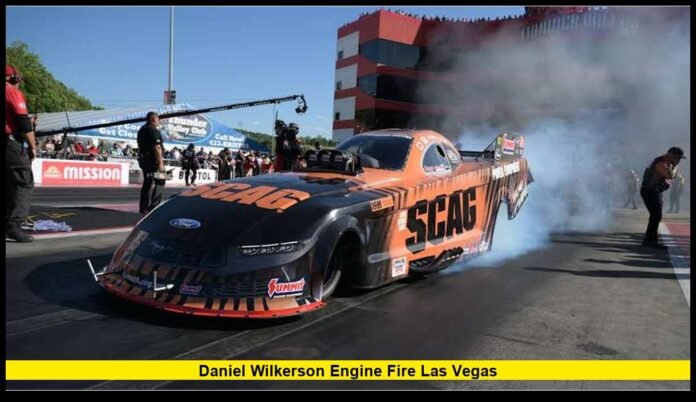

The Daniel Wilkerson engine fire Las Vegas incident became a major talking point during the 2026 NHRA Las Vegas Nationals after a violent engine explosion damaged his SCAG Jackal Funny Car during qualifying on October 31. The car erupted in flames, shed large sections of its bodywork, and scraped the guardwall before stopping. Wilkerson exited the vehicle and said he was fine, providing an encouraging immediate update following the frightening incident.
The explosion occurred during the third Funny Car qualifying session at The Strip at Las Vegas Motor Speedway in Nevada. Wilkerson was paired with fellow competitor J.R. Todd when his car lost traction and suffered a major blower explosion.
The incident unfolded rapidly. Flames rose around the vehicle, pieces of bodywork broke away, and Wilkerson had to manage the car while attempting to avoid the other driver. The vehicle eventually contacted the guardwall before coming to a stop in the shutdown area.
The immediate concern centered on Wilkerson’s safety. His comments after the incident offered reassurance, although they did not establish the complete technical cause of the failure or the full extent of the damage to the car’s internal components.
As of November 1, 2026, the confirmed information establishes the circumstances of the explosion and Wilkerson’s immediate reported condition. The final repair requirements, total damage cost, and subsequent competition status remain unconfirmed in the available incident reporting.
What Happened During the Las Vegas Funny Car Explosion?
The incident began approximately 500 feet into Wilkerson’s qualifying run. The tires started losing traction, and a major blower explosion followed.
The sudden failure transformed an ordinary qualifying attempt into an emergency. Instead of continuing toward a competitive finish, Wilkerson had to deal with a damaged vehicle, flames, and bodywork breaking apart around him.
The explosion produced a large fireball that made the incident particularly dramatic for spectators. The car’s exterior sustained extensive damage as the bodywork separated into numerous pieces.
Wilkerson then moved toward the left side of the track. His car scraped the guardwall before he brought it to a stop in the shutdown area.
The sequence matters because it explains why the incident involved more than an engine problem. The explosion affected the vehicle’s bodywork and forced Wilkerson to manage the car’s movement while trying to avoid a collision.
The published incident account also described Wilkerson exiting the vehicle quickly. He subsequently said he was fine, offering an immediate update after the car stopped.
Several key details define the incident:
- Driver: Daniel Wilkerson.
- Race car: SCAG Jackal Funny Car.
- Competition: 2026 Mopar NHRA Las Vegas Nationals presented by Dodge.
- Venue: The Strip at Las Vegas Motor Speedway.
- Date: October 31, 2026.
- Session: Third Funny Car qualifying session.
- Other competitor in the pairing: J.R. Todd.
- Recorded sequence: Loss of traction, blower explosion, fire, bodywork damage, guardwall contact, and a stop in the shutdown area.
- Immediate safety update: Wilkerson said he was fine.
These details provide a factual foundation for understanding the incident without assigning a cause that has not been established.
Daniel Wilkerson’s First Comments After the Engine Fire
Wilkerson’s immediate comments helped clarify what he experienced inside the car.
Following the explosion, he said he was fine but embarrassed by the incident. He also expressed disappointment about the damage and the work his team had invested in preparing the vehicle.
His account emphasized how quickly the situation developed. The tires had only just begun spinning when the explosion occurred, leaving little time to respond before the car sustained substantial damage.
Wilkerson also explained his decision to steer left. He wanted to avoid hitting J.R. Todd, who was racing in the adjacent lane.
That decision provides important context for the vehicle’s movement toward the guardwall. Wilkerson acknowledged that steering left contributed to the car scraping the wall.
His comments also conveyed the intensity of the heat. He described the experience as the hottest thing he had ever felt, illustrating the severity of the conditions during the explosion.
The separation of the bodywork was another notable part of his account. Wilkerson expressed relief that the body came off, given the heat he experienced.
His remarks offered a firsthand explanation of the emergency and the decisions he made during the run. They did not, however, establish the mechanical sequence that caused the initial explosion.
The distinction is important. A driver’s account can explain what happened on the track without identifying the precise internal failure that triggered the event.
For now, the most significant personal update is that Wilkerson reported being fine after exiting the damaged car.
Was Daniel Wilkerson Injured in the Las Vegas Incident?
Wilkerson’s condition was one of the first concerns after the explosion. The flames, damaged bodywork, and guardwall contact made the incident alarming, but his immediate comments offered reassurance.
He said he was fine after the car stopped. The published account also described him exiting the vehicle quickly and appearing physically okay.
Those details establish his immediate reported condition. They do not amount to a comprehensive medical evaluation, and the available incident reporting does not provide a detailed medical assessment.
There is no confirmed information in the available reports establishing that Wilkerson sustained a particular injury. Claims about serious injuries, hospitalization, or a specific recovery period would therefore be unsupported.
The distinction between an immediate statement and a complete medical update matters. A driver may escape an incident without an obvious injury, but further medical information would be necessary to make broader claims about their health.
Wilkerson’s reported condition was encouraging following the explosion. His ability to leave the vehicle and speak about the incident also helped address immediate concerns among fans.
As of the latest confirmed information available for this article, Wilkerson said he was fine. Any additional medical developments would need separate verification.
What Is a Blower Explosion in Funny Car Racing?
The Las Vegas incident was described as a blower explosion. Understanding that terminology helps explain the type of mechanical event involved, although it does not establish the precise cause of Wilkerson’s failure.
A blower is part of a forced-induction system that supplies pressurized air to an engine. In professional drag racing, the engine and its supporting systems operate under demanding conditions during acceleration.
A major failure involving this equipment can produce a dramatic explosion and extensive vehicle damage. However, the term alone does not identify every component involved or explain why a particular failure occurred.
In Wilkerson’s case, the documented sequence began with the tires losing traction. A blower explosion followed, producing a fireball and damaging the vehicle’s bodywork.
The available information does not establish whether a specific internal engine component failed first or what mechanical conditions initiated the explosion.
A reliable technical explanation would require additional evidence from an inspection or an official statement detailing the findings.
It is also important not to assume that the fire itself identifies the original failure. Flames can follow a mechanical explosion, but their presence does not establish which component initiated the event.
For that reason, the most accurate description remains that Wilkerson experienced a major blower explosion during the third Funny Car qualifying session in Las Vegas.
How the Explosion Affected Wilkerson’s Qualifying Results
The incident interrupted Wilkerson’s third qualifying attempt and produced a result well below his earlier performance.
The published session results recorded his third-session run at 4.916 seconds and 146.45 mph. His previous best run stood at 3.914 seconds at 328.14 mph.
The difference reflects the disruption caused by the explosion. The damaged vehicle could not complete the attempt under normal competitive conditions.
The session report listed Wilkerson in 10th place following that run. That position reflects the reported qualifying standings at the time, rather than necessarily establishing his final result for the entire event.
Qualifying results depend on recorded runs and the applicable event rules. A single interrupted attempt does not automatically determine a driver’s overall performance.
Wilkerson’s earlier run remained part of his qualifying record. The later incident did not erase the performance he had already recorded.
The speed difference also provides context for the seriousness of the disruption. His earlier run reached 328.14 mph, while the incident-affected attempt recorded 146.45 mph.
Those figures should not be compared as though both represented ordinary completed runs. The later attempt involved a major mechanical failure that interrupted the car’s progress.
The confirmed results help explain how the incident affected that particular session. They do not, by themselves, establish the final race outcome or whether Wilkerson subsequently returned to competition.
What Damage Did the SCAG Jackal Sustain?
Wilkerson’s SCAG Jackal suffered substantial visible damage during the explosion.
The published account described the Funny Car’s bodywork breaking into hundreds of pieces. The vehicle also scraped the guardwall, which caused further damage to its exterior.
This level of damage can create significant work for a racing team. Crew members generally need to assess the vehicle’s condition before determining what repairs are necessary and whether it can safely return to competition.
The engine, bodywork, and other affected systems may require inspection after a major explosion. The specific work depends on what the inspection reveals.
However, the available incident reporting does not provide a complete inventory of the damage to Wilkerson’s car. It also does not confirm the total repair cost or the condition of every internal engine component.
Wilkerson expressed disappointment about the damage and acknowledged the work his team had put into preparing the vehicle.
His comments show that the incident affected more than the immediate qualifying attempt. It also created uncertainty about the condition of the car and the work needed after the explosion.
Nevertheless, the final repair requirements remain unconfirmed. It would be inaccurate to state that the team replaced the engine, completed repairs, or prepared a replacement vehicle without verified information.
The established fact is that the SCAG Jackal experienced a major explosion and extensive bodywork damage during qualifying.
Why Wilkerson Steered Away From J.R. Todd
J.R. Todd was competing in the adjacent lane when Wilkerson’s car experienced the explosion.
Wilkerson explained that he did not want to hit Todd. He therefore tried to steer left, a decision that contributed to the car moving toward the guardwall.
This detail helps explain the sequence of events after the explosion. Wilkerson was not simply dealing with a mechanical failure; he was also trying to avoid another vehicle while managing a damaged car.
The published session report recorded Todd’s run at 4.060 seconds and 251.39 mph. It also noted that Todd experienced traction problems and lifted off the throttle early.
The two runs therefore encountered different problems. Wilkerson suffered the major blower explosion, while Todd’s attempt was affected by traction issues.
The available information does not establish that Todd caused the explosion or that contact between the vehicles triggered it.
Instead, Wilkerson’s comments indicate that avoiding Todd influenced his steering decision during the emergency.
That distinction matters when describing the incident accurately. The two drivers competed in the same pairing, but the reported evidence does not establish that Todd’s actions caused Wilkerson’s mechanical failure.
What the Incident Shows About NHRA Funny Car Safety
The explosion highlights the challenges drivers face when a vehicle suffers a sudden mechanical failure at racing speed.
Funny Car competition involves powerful vehicles accelerating over a short distance. Drivers must respond quickly when traction changes or a mechanical problem interrupts a run.
Wilkerson’s account illustrates how limited the reaction time can be. He described the tires beginning to spin shortly before the explosion occurred.
Once the engine failed, he had to manage the car while flames and bodywork damage complicated the situation.
His decision to steer away from Todd added another consideration. Avoiding a collision while controlling a damaged vehicle required him to respond to more than one immediate risk.
The car ultimately scraped the guardwall before coming to a stop in the shutdown area.
The incident also demonstrates why a dramatic visual event should not automatically be treated as evidence of a safety-system failure. The available reporting does not establish that a particular safety rule failed or that a specific change to racing regulations is necessary.
Those conclusions would require a broader technical review and reliable evidence about the circumstances.
What can be stated is that the incident developed rapidly, caused extensive vehicle damage, and required Wilkerson to manage an emergency while moving down the track.
His reported condition after the incident was encouraging. However, the full technical circumstances and subsequent vehicle status remain separate questions that require confirmed updates.
Latest Update on Daniel Wilkerson After the Las Vegas Engine Fire
As of November 1, 2026, the confirmed information available for this article concerns the qualifying incident on October 31.
The key developments are straightforward:
- Wilkerson’s SCAG Jackal experienced a major blower explosion and fire.
- The incident occurred during the third Funny Car qualifying session at the Mopar NHRA Las Vegas Nationals.
- The tires lost traction approximately 500 feet into the run.
- The explosion caused extensive damage to the car’s bodywork.
- The vehicle scraped the guardwall before stopping in the shutdown area.
- Wilkerson exited the car and said he was fine.
- His recorded third-session result was 4.916 seconds at 146.45 mph.
These facts establish the immediate sequence and the driver’s reported condition.
However, the available reporting does not confirm the complete mechanical cause, the final cost of repairs, the completion of repairs, or the vehicle’s subsequent competition status.
The event’s schedule extended into Sunday, November 1, after Saturday’s qualifying sessions. Claims about Wilkerson’s final participation or the completed race outcome would require a verified event report.
The distinction between the initial incident and later developments is especially important for a story that continues to attract attention. A confirmed update about the driver’s condition does not automatically establish the status of the vehicle.
Similarly, the visible damage does not reveal whether the team can repair the car quickly or whether a replacement vehicle would be necessary.
Until further details are confirmed, the initial incident account and the published qualifying results remain the clearest established record of the event.
Why the Daniel Wilkerson Las Vegas Incident Matters to Racing Fans
The explosion attracted attention because it combined a sudden mechanical failure, a large fireball, extensive body damage, and an on-track emergency.
Fans were concerned about Wilkerson’s safety, but they also wanted to understand what happened to the SCAG Jackal and whether the team could continue its weekend.
Those questions require separate answers. Wilkerson’s statement addressed his immediate condition, while the qualifying results documented the impact on his run. Neither establishes the full technical cause or the vehicle’s eventual repair status.
The incident also highlights the importance of accurate reporting when dramatic racing footage circulates online. Images can show flames, debris, and visible damage, but they cannot independently confirm the mechanical cause or a driver’s medical condition.
For that reason, the most useful developments will be verified updates about Wilkerson, the team’s technical assessment, and the car’s condition.
The available information provides a clear account of the October 31 incident without requiring assumptions about what happened inside the engine.
The Las Vegas engine fire was a dramatic moment in Daniel Wilkerson’s 2026 racing season. Share your thoughts in the comments and follow confirmed developments about his condition, the SCAG Jackal, and his return to competition.