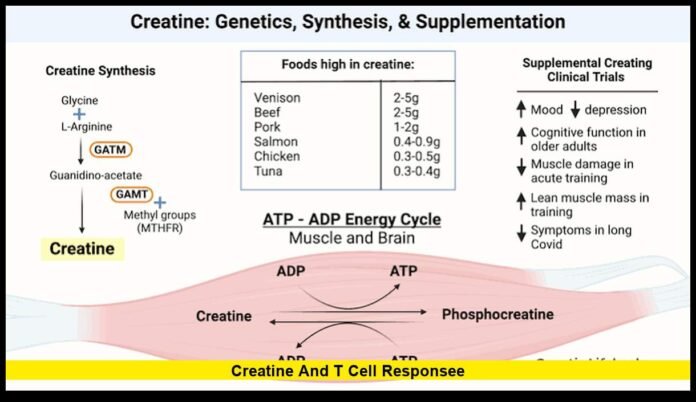

For years, creatine has been recognized as one of the world’s most researched nutritional supplements for improving athletic performance and supporting muscle energy. Today, however, scientists are looking beyond the gym. New discoveries surrounding creatine and t cell response are opening an entirely different area of medical research, suggesting that this naturally occurring compound may influence how the body’s immune system produces and powers disease-fighting cells. While the science is still developing, researchers are increasingly interested in whether creatine could eventually contribute to future treatments for infections, cancer, and immune-related disorders.
A Shift in How Researchers View Creatine
Most people associate creatine with weightlifting or high-intensity exercise because it helps muscles rapidly regenerate energy during demanding physical activity. That reputation has remained largely unchanged for decades.
Recent scientific investigations, however, have shown that muscles are not the only tissues requiring rapid bursts of energy. Immune cells also consume enormous amounts of energy whenever the body detects harmful bacteria, viruses, or abnormal cells.
This realization has encouraged immunologists to examine whether creatine plays a much broader biological role than previously understood.
Rather than viewing creatine solely as a sports supplement, researchers are now studying it as an important component of cellular metabolism that may support multiple organs and systems throughout the body.
Understanding T Cells and Their Importance
T cells are among the immune system’s most specialized defenders. Produced in the bone marrow and matured in the thymus, they form a critical part of adaptive immunity, allowing the body to recognize and remember specific threats.
Unlike the body’s immediate defenses, T cells learn to identify unique pathogens and coordinate highly targeted attacks.
Several major categories perform different functions.
Helper T Cells
Helper T cells coordinate immune responses by communicating with other immune cells. They release signaling molecules that activate B cells, macrophages, and cytotoxic T cells, ensuring the immune system responds efficiently.
Without helper T cells, immune responses become poorly organized and significantly weaker.
Cytotoxic T Cells
Often called killer T cells, these immune cells directly destroy virus-infected cells and many forms of cancerous tissue.
They recognize abnormal proteins on cell surfaces before releasing specialized enzymes that eliminate damaged or infected cells.
Regulatory T Cells
An effective immune system must attack dangerous invaders while avoiding healthy tissues.
Regulatory T cells help maintain this balance by preventing excessive immune activity that could otherwise lead to autoimmune diseases or chronic inflammation.
Memory T Cells
After recovering from an infection or receiving a vaccine, memory T cells remain in circulation.
These long-lasting cells recognize familiar pathogens and respond much faster if the same organism enters the body again.
Their presence forms the foundation of long-term immune protection.
Why Energy Matters So Much to Immune Cells
Every immune response requires an enormous amount of cellular energy.
When resting, T cells consume relatively little fuel.
Once activated, however, everything changes.
Within hours, they begin dividing rapidly, producing proteins, releasing chemical messengers, and traveling throughout the body to locate infected or abnormal tissue.
Each of these activities dramatically increases demand for ATP, the molecule that powers nearly every cellular process.
Without sufficient ATP production, immune cells cannot function efficiently.
Scientists have therefore begun studying how immune cells manage their energy supply during periods of intense activity.
The Role of Creatine Inside Cells
Creatine acts as an energy reserve.
Inside cells, creatine combines with phosphate to form phosphocreatine.
Whenever ATP levels begin falling, phosphocreatine quickly donates its stored phosphate group, allowing ATP to be regenerated almost immediately.
This buffering system has been extensively studied in skeletal muscle because muscles require repeated bursts of rapid energy.
Researchers now understand that activated immune cells face similar metabolic challenges.
Instead of constantly waiting for new ATP to be produced through slower metabolic pathways, creatine allows cells to restore energy supplies almost instantly.
That ability may prove particularly valuable for T cells engaged in prolonged immune responses.
The Discovery That Sparked New Research
One of the most significant findings in recent years was the identification of creatine transporters on T cells.
These specialized proteins allow immune cells to absorb creatine from their surroundings.
The discovery suggested that creatine is not simply present inside immune cells by chance.
Instead, T cells appear to actively obtain creatine because it serves an important metabolic purpose.
Laboratory experiments soon demonstrated that immune cells lacking sufficient creatine often showed reduced performance under demanding conditions.
Conversely, cells with improved creatine availability frequently maintained stronger activity during experimental testing.
These observations encouraged researchers to investigate the broader implications for human health.
What Laboratory Studies Have Revealed
Research performed in cell cultures and animal models has produced several encouraging findings.
Scientists have observed that creatine may help activated T cells maintain healthier energy levels while responding to disease.
Experimental studies have also suggested improvements in several important functions, including:
- Better survival of activated immune cells
- Greater production of protective signaling molecules
- Improved persistence during prolonged immune responses
- Enhanced ability to recognize abnormal cells
- Reduced signs of metabolic exhaustion
These observations remain preliminary but have generated substantial interest throughout the fields of immunology and cellular metabolism.
The Connection to Cancer Research
Perhaps the most exciting area of investigation involves cancer immunotherapy.
Modern cancer treatments increasingly rely on the patient’s own immune system rather than chemotherapy alone.
Checkpoint inhibitors, adoptive T-cell therapies, and CAR-T treatments all depend upon highly active immune cells capable of identifying and destroying cancer cells.
Unfortunately, tumors often create hostile environments that gradually weaken T cells.
As immune cells become exhausted, they lose much of their ability to attack cancer effectively.
Scientists are investigating whether improving cellular energy metabolism with creatine could help immune cells remain active for longer periods inside tumors.
If future clinical trials confirm these early findings, creatine could become one component of combination therapies designed to strengthen existing immunotherapy approaches.
At present, however, creatine is not an approved cancer treatment, and researchers emphasize that considerably more human research is required.
Can Creatine Help During Viral Infections?
Another area receiving attention involves infectious diseases.
During serious viral infections, T cells undergo rapid expansion as they work to eliminate infected cells.
Researchers are studying whether supporting cellular energy metabolism could help maintain effective immune responses throughout prolonged illness.
Although laboratory findings remain promising, current evidence does not establish that creatine supplementation prevents viral infections or improves recovery in healthy individuals.
Clinical trials are continuing to explore this possibility.
Aging and the Immune System
As people grow older, immune function naturally changes.
Older adults often experience slower responses to new infections, reduced vaccine effectiveness, and declining production of certain immune cells.
Scientists are examining whether age-related changes in cellular metabolism contribute to these declines.
If energy production becomes less efficient with age, therapies targeting metabolic pathways—including creatine metabolism—could eventually become part of strategies aimed at maintaining healthier immune function in older populations.
This remains an active area of research rather than an established medical practice.
Creatine and Immune Cell Exhaustion
One of the greatest challenges in immunology is understanding immune exhaustion.
When T cells remain activated for extended periods, particularly during chronic infections or cancer, they gradually lose effectiveness.
Exhausted cells divide less frequently, produce fewer protective molecules, and become less capable of eliminating dangerous targets.
Researchers suspect that declining energy availability contributes to this process.
Because creatine supports rapid ATP regeneration, scientists hope it may help preserve cellular performance during sustained immune activity.
Although this theory continues to gain attention, definitive proof in humans has not yet been established.
Could Creatine Improve Vaccine Responses?
Vaccines depend upon healthy immune activation to create lasting protection.
Scientists are exploring whether optimizing cellular metabolism before or during vaccination might strengthen memory T-cell formation.
Current evidence remains limited, and no public health authority recommends creatine supplementation specifically to improve vaccine effectiveness.
Nevertheless, the topic represents another promising avenue for future research.
Safety Remains an Important Consideration
Creatine monohydrate continues to be one of the most extensively studied dietary supplements available.
For healthy adults using recommended amounts, research has generally found it to have a favorable safety profile.
Some users may experience temporary water retention or mild digestive discomfort, particularly when beginning supplementation or consuming large doses.
Maintaining adequate hydration is generally advised.
Individuals with existing kidney disease, serious medical conditions, or those taking medications affecting kidney function should consult a healthcare professional before using creatine supplements.
Pregnant or breastfeeding individuals should also seek medical advice before beginning supplementation.
What Current Research Does Not Show
Despite increasing excitement, important limitations remain.
Current evidence does not demonstrate that creatine can:
- Cure infections
- Replace vaccines
- Prevent cancer
- Eliminate autoimmune diseases
- Serve as an independent immune treatment
- Replace physician-prescribed medications
Much of today’s knowledge comes from laboratory experiments and animal studies rather than large human clinical trials.
Medical recommendations require considerably stronger evidence before becoming standard practice.
Questions Scientists Still Need to Answer
Several major questions remain unanswered.
Researchers continue investigating:
- Which patients benefit most?
- What dosage supports immune cells most effectively?
- How long would supplementation need to continue?
- Could benefits differ among various diseases?
- Are there interactions with existing medications?
- How does long-term supplementation influence immune balance?
Future clinical studies involving thousands of participants will help clarify these important issues.
Why Immunometabolism Is Becoming a Major Field
The growing interest in creatine reflects a larger scientific movement known as immunometabolism.
Rather than studying immune cells in isolation, researchers now recognize that metabolism strongly influences immune performance.
Energy availability affects how immune cells grow, communicate, divide, and eliminate disease.
Creatine represents just one of several naturally occurring molecules under investigation for its ability to support these metabolic processes.
Other nutrients, amino acids, vitamins, and cellular signaling pathways are also being studied as scientists seek better ways to strengthen immune function without overstimulating the immune system.
What This Means for the Future
Medical science is entering an era where understanding cellular energy may become just as important as understanding genetics.
If ongoing clinical trials confirm current laboratory findings, therapies designed to improve immune metabolism could become valuable additions to treatments for cancer, chronic infections, and age-related immune decline.
Creatine may eventually play a supporting role in these strategies, though experts caution that much more evidence is required before clinical recommendations change.
For now, creatine remains best known for its established role in exercise performance, while its potential effects on immunity continue to be explored through rigorous scientific investigation.
Final Thoughts
Research into creatine and t cell response represents one of the most intriguing developments in modern immunology. Scientists have discovered that immune cells require enormous amounts of energy to fight disease, and creatine appears to help meet those demands by supporting rapid ATP regeneration. Although laboratory studies continue to produce encouraging findings, the medical community agrees that larger human trials are essential before creatine can be recommended specifically for immune health or disease treatment. As research advances, this familiar nutritional compound may prove to have a much broader biological role than previously imagined, offering new possibilities for understanding how the immune system functions and how future therapies might enhance its effectiveness.