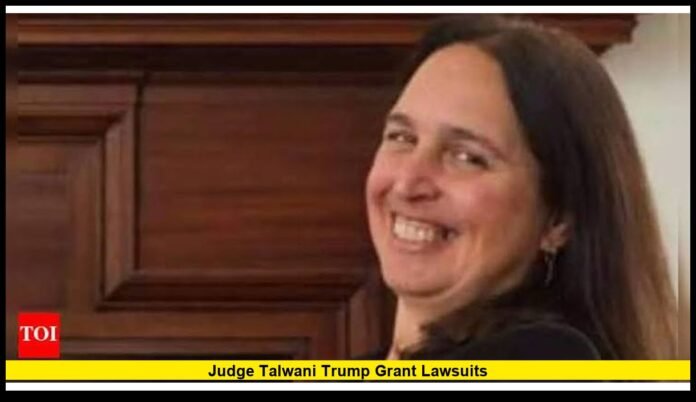

The judge talwani trump grant lawsuit has become one of the most closely watched legal battles involving federal funding in 2026. A federal judge in Boston has ruled that the Trump administration cannot rely on a disputed federal grant regulation to terminate billions of dollars in already-awarded funding simply because those grants no longer align with current policy priorities. The decision represents a significant legal setback for the administration and could influence how federal agencies handle grant agreements going forward.
╔════════════════════════════════════════════════════════════════════╗
║ – Judge Indira Talwani ruled against the Trump administration’s use of a disputed grant termination clause. ║
║ – The lawsuit was filed by a coalition of Democratic-led states. ║
║ – The ruling protects billions of dollars in existing federal grants. ║
║ – The court found the administration’s interpretation lacked legal support. ║
║ – The decision may influence future federal funding disputes and appeals. ║
╚════════════════════════════════════════════════════════════════════╝
What Is the Judge Talwani Trump Grant Lawsuit About?
The lawsuit centers on a provision within federal grant regulations that the Trump administration argued allowed agencies to cancel grants whenever funded projects no longer matched the administration’s policy priorities.
A coalition of more than twenty Democratic-led states challenged that interpretation, arguing the government was attempting to rewrite the terms of legally awarded grants after recipients had already begun relying on the funding.
According to the states, allowing agencies to revoke grants based solely on changing political priorities would create uncertainty for universities, nonprofits, local governments, research institutions, public safety initiatives, and numerous federally supported programs.
The plaintiffs argued that once grants are legally awarded, they function much like contractual agreements and cannot simply be withdrawn without clear legal authority.
Judge Indira Talwani’s Decision
U.S. District Judge Indira Talwani ruled in favor of the states, concluding that the administration’s interpretation of the grant regulation was inconsistent with both federal law and the broader regulatory framework governing federal financial assistance.
Her decision stated that the disputed clause did not clearly authorize agencies to terminate grants merely because administration priorities had changed after the grants had already been awarded.
The court also determined that such an expansive interpretation could violate constitutional principles governing congressional spending authority, since Congress—not the executive branch—appropriates federal funds.
As a result, the administration cannot rely on the challenged regulation to revoke existing grants for policy reasons alone.
Why the Lawsuit Matters
The ruling has implications far beyond a single legal dispute.
Federal grants support thousands of projects nationwide, including:
- Scientific research
- Public universities
- School nutrition programs
- Crime prevention initiatives
- Public health projects
- Climate resilience programs
- Infrastructure planning
- Community development
Had the administration prevailed, critics argued that future administrations could potentially revoke funding whenever political priorities changed, creating uncertainty for organizations that depend on long-term federal support.
Supporters of the lawsuit argued that grant recipients need predictable funding in order to complete multi-year projects.
Which States Filed the Case?
The coalition argued that billions of dollars in federal funding across multiple agencies were potentially at risk under the administration’s interpretation of the regulation.
State attorneys general maintained that Congress never intended executive agencies to possess such sweeping authority to cancel awarded grants based solely on shifting policy goals.
The Administration’s Position
The Trump administration defended its interpretation by arguing that agencies must retain flexibility to ensure federal funds continue supporting current governmental priorities.
Officials contended that if a grant no longer advances an agency’s mission, the government should have authority to discontinue funding under existing regulations.
Government attorneys also challenged whether the states had standing to sue, arguing that many of the alleged future funding losses were speculative.
Judge Talwani rejected those arguments and issued summary judgment in favor of the plaintiff states.
Legal Questions at the Center of the Case
Several important constitutional and administrative law issues emerged during the litigation.
Spending Clause
The court examined whether the executive branch could effectively impose new funding conditions after Congress had already appropriated money and grants had been awarded.
Administrative Authority
Another issue involved whether federal agencies had exceeded their regulatory authority by interpreting the termination clause more broadly than its original purpose.
Contract Principles
The states argued that grant agreements create legal expectations similar to contracts, making retroactive cancellation inconsistent with longstanding federal practice.
Judge Talwani’s opinion largely agreed with these concerns, emphasizing that the regulation did not clearly authorize the broad termination powers claimed by the administration.
Programs Potentially Protected
The ruling could affect funding across numerous sectors.
Programs that were discussed during the litigation include:
- Violence prevention initiatives
- Scientific research grants
- Education funding
- Food security programs
- School meal assistance
- Public safety efforts
- Environmental and climate preparedness projects
- Community service initiatives
Many organizations receiving these grants argued that sudden cancellations would disrupt ongoing work, staffing, research timelines, and local services.
Possible Appeal
Legal observers expect the Trump administration to continue defending its position through the appeals process.
Because the case involves executive authority, federal spending, and administrative regulations, the dispute could ultimately receive appellate review and potentially reach the U.S. Supreme Court if conflicting rulings emerge in similar cases.
Until then, Judge Talwani’s ruling limits the administration’s ability to use the challenged regulation as justification for canceling existing grants based solely on policy disagreements.
Broader Impact on Federal Grant Policy
Regardless of future appeals, the decision is likely to influence how agencies approach grant management.
Federal agencies routinely award billions of dollars through competitive grants covering education, transportation, healthcare, scientific innovation, disaster preparedness, housing, and economic development.
The court’s decision reinforces the principle that executive agencies cannot substantially alter funding obligations after grants have already been awarded unless Congress or applicable law clearly authorizes such action.
Legal experts say future administrations—regardless of political party—may need to exercise greater caution before attempting broad funding cancellations based on changing priorities alone.
What Happens Next?
Several developments could follow in the coming months:
- The administration may appeal the ruling.
- Federal agencies will likely continue administering existing grants while litigation proceeds.
- States will continue monitoring federal funding decisions for compliance with the court’s order.
- Additional lawsuits could arise if agencies attempt alternative methods of reducing grant funding.
Because billions of dollars remain tied to ongoing federal programs, the case is expected to remain an important legal battle over executive authority and congressional spending powers throughout 2026.
Final Thoughts
The judge talwani trump grant lawsuit highlights the continuing legal conflict over the limits of executive authority in administering federal funds. Judge Indira Talwani’s ruling preserves existing grant protections for now, while raising broader constitutional questions about how much discretion presidential administrations have to reshape spending decisions after Congress has appropriated funds. The outcome of any appeal could establish an important precedent for future federal grant policies across multiple administrations.
What do you think about the court’s decision? Share your thoughts in the comments and stay tuned for the latest legal and political developments.