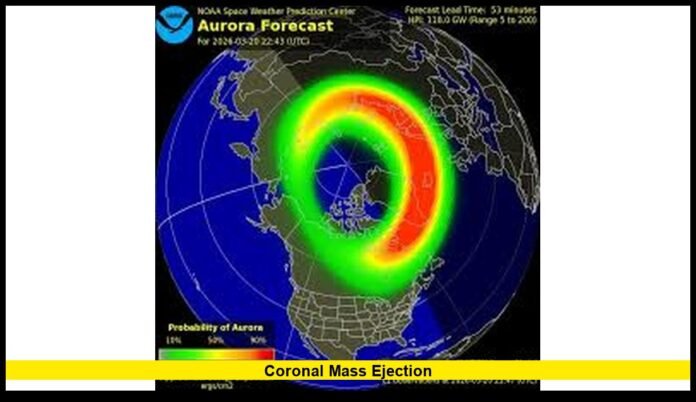

Coronal mass ejection activity has become one of the most closely watched space weather developments of 2026 as repeated solar eruptions continue affecting geomagnetic conditions around Earth.
Scientists monitoring the Sun have observed an unusually active period during the current solar cycle. Strong solar flares, fast-moving plasma eruptions, and geomagnetic storm alerts have already shaped the first half of the year. Americans across several states have also witnessed bright northern lights displays tied directly to recent solar events.
The growing attention around solar storms reflects how connected modern infrastructure has become to satellite technology, navigation systems, aviation networks, and power grids. While most geomagnetic disturbances remain manageable, experts continue monitoring every major eruption closely because stronger events can disrupt communication systems and create temporary technological problems.
Solar activity has remained elevated throughout May 2026, with multiple active sunspot regions rotating into Earth-facing position. This has increased the likelihood of additional Earth-directed eruptions in the coming weeks.
What a Coronal Mass Ejection Means
A coronal mass ejection, commonly called a CME, occurs when the Sun ejects enormous clouds of plasma and magnetic energy into space. These eruptions originate in the solar corona, which is the outer atmosphere surrounding the Sun.
Some CMEs travel slowly and pass through space without major consequences. Others move at extremely high speeds and interact directly with Earth’s magnetic field.
When a powerful CME reaches Earth, it can trigger geomagnetic storms. These storms create disturbances in the magnetosphere, which protects the planet from charged particles coming from space.
The effects vary depending on several factors, including:
- The size of the eruption
- The speed of the solar particles
- The magnetic orientation of the CME
- Earth’s current geomagnetic conditions
Recent solar events have demonstrated how quickly conditions can change once a major eruption leaves the Sun.
Solar Maximum Continues Driving Strong Activity
The Sun naturally moves through an approximately 11-year solar cycle. Scientists currently believe the Sun remains near the peak phase known as solar maximum.
During this period, solar magnetic activity increases sharply. More sunspots appear across the solar surface, and the number of solar flares and coronal mass ejections rises significantly.
Solar Cycle 25 has produced stronger activity than many early forecasts expected. Scientists originally predicted a moderate cycle, but activity levels have continued exceeding those projections throughout 2025 and into 2026.
Several recent solar flare events reached high intensity classifications, including multiple X-class eruptions. These powerful flares often occur alongside CMEs capable of producing geomagnetic storms at Earth.
Recent Solar Storm Activity in 2026
Space weather monitoring agencies have issued multiple geomagnetic storm watches during recent months.
Several CME impacts during spring 2026 produced moderate to strong geomagnetic disturbances across Earth’s upper atmosphere. In some cases, aurora visibility expanded well beyond typical northern regions.
Recent developments included:
| Event | Impact |
|---|---|
| Strong Solar Flares | Temporary radio blackouts |
| Earth-Directed CMEs | Geomagnetic storm conditions |
| High-Speed Solar Wind | Increased aurora visibility |
| Active Sunspot Regions | Elevated eruption risk |
| Geomagnetic Disturbances | Satellite monitoring alerts |
Forecasters continue tracking multiple active regions on the Sun capable of generating additional eruptions.
Why Northern Lights Became Visible Across More U.S. States
One of the most noticeable effects of recent geomagnetic storms has been the expansion of aurora activity into parts of the continental United States.
During strong geomagnetic conditions, charged solar particles collide with gases in Earth’s atmosphere. These interactions create glowing waves of light known as auroras.
Typically, the northern lights remain concentrated near polar regions. However, stronger geomagnetic storms can push aurora visibility much farther south.
Recent sightings occurred in:
- Washington
- Montana
- North Dakota
- Minnesota
- Michigan
- Wisconsin
- Idaho
- Maine
- New York
Many skywatchers captured vivid green, purple, and pink aurora displays during overnight viewing periods.
The growing popularity of aurora photography on social media has also increased public interest in solar storms and coronal mass ejection activity.
How Solar Storms Affect Technology
Modern technology depends heavily on systems vulnerable to space weather conditions.
A strong CME can create fluctuations in Earth’s magnetic field strong enough to interfere with electronics, communication systems, and navigation signals.
Potential impacts include:
Satellite Disruptions
Satellites orbiting Earth can experience charging effects during geomagnetic storms. These disturbances may interfere with communications and onboard electronics.
GPS Accuracy Problems
Navigation systems sometimes lose precision during intense geomagnetic conditions. Aviation and maritime industries monitor these disruptions carefully.
Radio Communication Interruptions
High-frequency radio signals may weaken during solar storm events, especially in polar regions.
Power Grid Stress
Geomagnetic currents can flow through electrical systems during severe storms. Utility operators monitor these conditions to prevent instability.
Increased Spacecraft Drag
Earth’s upper atmosphere expands slightly during geomagnetic storms. This creates additional drag on satellites in low-Earth orbit.
Despite these risks, most recent solar storms have caused only temporary disruptions rather than widespread failures.
How Scientists Track a Coronal Mass Ejection
Solar researchers use advanced spacecraft and observation systems to monitor solar activity around the clock.
Key monitoring tools include:
- Solar Dynamics Observatory
- GOES weather satellites
- DSCOVR spacecraft
- ACE spacecraft
- Ground-based solar observatories
These systems help scientists measure:
- Flare intensity
- CME speed
- Particle density
- Solar wind conditions
- Magnetic orientation
Once a CME erupts from the Sun, scientists estimate whether it may strike Earth and calculate its expected arrival time.
Forecasting remains challenging because CME magnetic structure can shift during travel through space.
Understanding Geomagnetic Storm Scales
Space weather experts classify geomagnetic storms using NOAA’s G-scale system.
G1 Storms
Minor geomagnetic disturbances with limited impacts.
G2 Storms
Moderate conditions capable of producing stronger aurora activity and minor communication problems.
G3 Storms
Strong geomagnetic storms that may affect power systems and satellite operations.
G4 Storms
Severe disturbances with elevated risks for infrastructure systems.
G5 Storms
Extreme events capable of causing major technological disruptions.
Several recent storms during the current solar cycle approached severe levels, increasing concern among infrastructure operators and emergency planners.
Read More – Northern Lights Aurora Borealis Forecast
Airlines Pay Close Attention to Solar Activity
Commercial airlines monitor solar storms closely because high-latitude flights depend heavily on radio communication systems.
Polar routes remain particularly sensitive to space weather disruptions. During strong solar events, airlines may reroute aircraft to maintain communication reliability.
Radiation exposure levels also rise slightly at high altitudes during major solar events. Aviation safety teams continually assess these conditions during geomagnetic storm periods.
Although travelers rarely notice these operational changes, airlines take space weather forecasting seriously.
NASA and Space Agencies Remain on Alert
Space agencies worldwide continue tracking coronal mass ejection activity because astronauts and spacecraft face greater exposure outside Earth’s atmosphere.
Solar radiation storms can become dangerous for astronauts conducting missions in orbit or beyond Earth’s protective magnetic field.
NASA engineers also monitor spacecraft systems carefully during periods of elevated solar activity.
Current planning for future lunar missions includes extensive preparation for space weather threats because astronauts traveling beyond low-Earth orbit will face increased exposure risks.
Why Magnetic Orientation Matters
The strength of a geomagnetic storm depends heavily on the magnetic structure inside a CME.
A southward-oriented magnetic field interacts more strongly with Earth’s magnetic field. This interaction allows greater energy transfer into the magnetosphere.
When this happens, geomagnetic storm intensity can increase rapidly.
Scientists often cannot fully determine a CME’s magnetic orientation until shortly before impact. This uncertainty explains why some solar storms become stronger than early forecasts suggested.
Historic Solar Storms Still Influence Research
Several past solar storms continue shaping today’s space weather preparedness strategies.
The Carrington Event of 1859
This remains the strongest solar storm ever recorded. Telegraph systems failed across multiple regions, and auroras appeared unusually far south.
The Quebec Blackout of 1989
A major geomagnetic storm collapsed portions of Quebec’s power grid, leaving millions without electricity.
The Halloween Storms of 2003
These powerful solar events disrupted satellites, aviation systems, and communication networks.
The May 2024 Geomagnetic Storms
Scientists described these storms as the strongest in decades. Auroras became visible across much of the United States.
Researchers continue studying these events to improve future forecasting systems.
Can Solar Storms Affect the Internet?
Concerns about severe solar storms often raise questions about internet reliability.
Most internet systems rely on extensive infrastructure networks that include satellites, undersea cables, and power systems. A major geomagnetic event could potentially affect several parts of that network simultaneously.
Scientists continue studying vulnerabilities involving:
- Undersea communication cables
- Satellite internet systems
- Data center power stability
- GPS timing synchronization
- Cellular communication infrastructure
Most experts believe modern systems are better protected than in previous decades. However, strong geomagnetic storms still present serious operational challenges.
Public Interest in Space Weather Keeps Growing
Public fascination with solar storms has increased dramatically during the current solar cycle.
Aurora photos regularly trend across social media platforms after major geomagnetic events. Astronomy groups, photographers, and weather enthusiasts closely follow every new solar eruption.
Interest has also grown because many Americans now understand how dependent modern life has become on satellite technology and communication networks.
Space weather forecasting has become increasingly important for:
- Airlines
- Military operations
- Utility companies
- Emergency management agencies
- Telecommunications providers
- Satellite operators
The growing attention surrounding solar activity reflects the expanding role technology plays in everyday life.
Could More Coronal Mass Ejection Events Arrive Soon?
Solar forecasters expect elevated activity to continue through much of 2026 as solar maximum conditions persist.
Several active sunspot groups currently visible on the Sun still possess the magnetic complexity needed to generate additional flares and CMEs.
Because the Sun rotates approximately once every 27 days, active regions can repeatedly return into Earth-facing position.
This ongoing cycle means additional geomagnetic storm watches remain possible throughout the year.
Scientists continue monitoring solar conditions daily to provide early warnings before Earth-directed eruptions arrive.
How Americans Can Monitor Space Weather
Space weather information is now easier to access than ever before.
People interested in tracking solar activity can follow:
- Aurora forecast maps
- Geomagnetic storm alerts
- Solar flare trackers
- Real-time solar wind data
- Satellite monitoring dashboards
Photographers and skywatchers especially rely on these forecasts when planning aurora viewing opportunities.
Clear skies, dark conditions, and strong geomagnetic activity often create the best viewing chances during major solar storms.
Coronal Mass Ejection Events Remain a Major Focus in 2026
The combination of strong solar activity, widespread aurora sightings, and growing infrastructure concerns has kept coronal mass ejection events in the national spotlight throughout 2026.
Scientists expect the Sun to remain active for the foreseeable future as Solar Cycle 25 continues near peak intensity. More geomagnetic storms, northern lights displays, and solar monitoring alerts are likely during the months ahead.
Americans across the country now follow space weather updates more closely than ever, especially as solar storms become more visible in everyday life.
As solar activity continues evolving through 2026, readers can expect ongoing updates about geomagnetic storms, aurora sightings, and new coronal mass ejection developments affecting Earth.